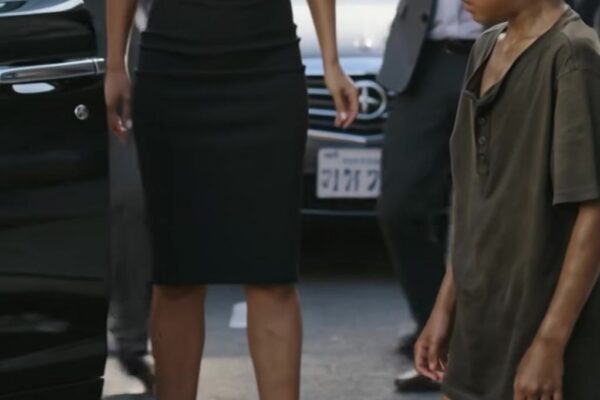
Mara built her life out of small refusals. She refused crowded trains by walking home late. She refused handshakes with a smile that suggested germs, not fear. She refused the casual brushes of strangers with the rigid grace of someone born to sharp corners. Touch meant heat, meant ownership, meant memories pressing their thumbs into bruises she’d spent years learning to hide beneath tailored coats and practiced indifference.
That was why the tug on the gold chain of her bag felt like an assault. Under a canopy of warm string lights strung between storefronts, she turned so fast her vision narrowed, anger already shaped and waiting behind her eyes. A boy stood there—too small to be bold, too dirty to belong to the polished evening crowd. He was breathing as if he’d run on raw determination, his hand hovering near the strap with a tremor that betrayed him.
“Don’t,” Mara warned, voice clipped enough to cut. “Don’t touch me.”
He recoiled, but he didn’t flee. His eyes were shiny, not with defiance but with the desperate steadiness of someone who’d been told there would be one chance and it had to count. Slowly, he opened his fist. In his palm lay a gold pin shaped like a leaf, its veins fine as thread, a blue stone set at its center like a tear that refused to fall.
Mara’s hand rose to her own collar before she could stop it. The same leaf, the same blue droplet, cool and heavy as a vow. It had been hers since she was fourteen, given on a night of slammed doors and bitten tongues—a night her mother pressed the pins into two palms as if they could stitch a family back together. There had been only two.
“You… you have the same,” the boy said. His voice was small enough to break. “My mom said it was important.”
Mara swallowed. She hated the way her throat tightened, the way the air felt too thin. “Where did you get that?” she demanded, but the demand wavered at the edges.
“From her,” he whispered. “She said the woman with the other pin is her sister.” He hesitated, then added, as if naming a storm, “Her name is Lena.”
The street kept moving around them: couples laughing, a cyclist ringing a bell, a vendor shouting about roasted nuts. But Mara felt sealed in glass. Lena. Sixteen years ago, that name had become an empty room Mara refused to enter. A fire in an old building. A report that never made sense. A funeral that never happened because there was no body and no certainty, only the thick silence of adults deciding what children were allowed to know. Mara had been angry first—furious at a sister who disappeared like a magic trick—and then she’d trained herself into not caring, because not caring was safer than hope.
She crouched without thinking, knees bending toward the pavement. It put her face level with the boy’s, close enough that she could see the cracked skin at the corners of his mouth, the faint bruise on his jaw. Her hands hovered, wanting to smooth his hair back, wanting to do something human, and she hated the wanting almost as much as she hated her fear of it.
“What’s your name?” she asked.
He hesitated. “Noah.” Then, like a confession, “She told me to find you if she didn’t wake up.”
The words landed like a fist to the ribs. “Didn’t wake up… tonight?”
Noah nodded once, hard. “She’s been sick. She sleeps and I listen to her breathing. Sometimes it stops for a second and I count in my head until it starts again.” His gaze dropped to his shoes. “She said you’d know what to do.”
Mara’s fingers went numb around the strap of her bag. “Where is she?”
Noah reached into his pocket and pulled out a folded piece of paper, soft and worn at the creases, as if it had been opened and refolded through many nights of indecision. “She wrote this,” he said. “She told me to give it to you and not to come back alone.”
Mara took it carefully, as if the paper might bruise. The handwriting hit her before the words did—Lena’s slanted loops, the way she crossed her t’s like she was underlining them for emphasis. The first sentence blurred as Mara’s eyes flooded, but she forced herself to read anyway.
If you’re holding this, I ran out of time.
She pressed her thumb against the ink to anchor herself. There was apology, and there was anger. There were lines about running, about thinking she could outrun the past, about finding out the past runs with you. There were details Mara didn’t want to hear—shelters, debts, names of people Lena didn’t trust. And then an address that made Mara’s stomach drop, because she knew it the way you know the shape of a scar: the building on Dovetail Street, the one people said burned down, the one where rumors insisted Lena had died.
Mara looked up at Noah. “Who told you to bring me there?”
Noah’s face drained of color. His eyes flicked past Mara’s shoulder, and in the reflection of a shop window Mara saw herself—pale, rigid, pin glinting at her throat like a warning—and behind her, across the street, a woman standing under the sickly glow of a pharmacy sign.
The woman didn’t move. She wasn’t old, but her posture carried the weight of years that had never been allowed to sit down. A dark coat, hair pulled tight, hands tucked into pockets as if to keep them from shaking. And on her lapel, catching the pharmacy light, was the same leaf. The same blue tear.
Three pins.
Mara’s heart tried to climb out of her chest. She turned fully, meeting the woman’s gaze. The woman’s eyes were fixed on Noah—on the boy and the paper and the space between Mara and him—and there was something in them Mara recognized with a cold clarity: not surprise, not relief. Surveillance. Calculation. The kind of watchfulness that belonged to people who expected the world to hurt them and intended to strike first.
The woman lifted her chin, the slightest invitation. Not to approach—an instruction to follow.
Noah’s fingers curled around his own pin as if it were a talisman. “She said… she said they’d try to stop me,” he murmured.
Mara’s body reacted before her mind caught up. Her instinct was to retreat, to protect her space, to keep her skin untouched and her life intact. But the boy beside her was trembling with exhaustion and fear, and Lena’s handwriting was burning through her pocket like a coal.
Mara exhaled, slow and deliberate, and made a choice that felt like stepping into fire. She reached for Noah’s hand.
Every muscle in her arm screamed against it. Touch was a door she had kept bolted for years. But she closed her fingers around his anyway—warm, dirty, real—and Noah startled, then held on as if she were a railing on the edge of a cliff.
“Stay close,” Mara said, voice low enough to belong only to them. Her eyes never left the woman across the street. “And don’t let go.”
The woman with the third pin turned and began to walk, disappearing into the flow of the city as if she’d been part of it all along. Mara tightened her grip on Noah and followed, each step carrying her nearer to Dovetail Street, to a sister who might be dying, and to the dreadful knowledge that someone else had been wearing their family’s grief like a badge.
Above them, the string lights swayed in a light breeze, each bulb trembling with borrowed warmth. Mara had spent years avoiding contact, believing distance could keep the past from reaching her. But the past had found her anyway—on a boy’s trembling palm, in ink on folded paper, in the glint of a third blue teardrop catching the night like an eye that never blinked.
And as Mara and Noah crossed the street together, she understood with sudden, brutal certainty: the fire sixteen years ago hadn’t ended anything. It had only changed the shape of what was hunting them.