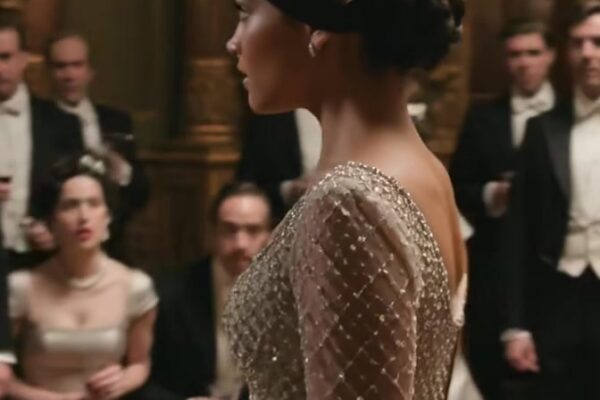
The restaurant looked untouchable—not merely expensive, but sealed. Its dark wood doors sat beneath a brass awning that caught the city lights like a crown, and the doorman’s gaze could stop people cold before they reached the first step. Even the air outside seemed instructed to behave.
Inside, everything glowed with the quiet assurance of money. Candlelight slid over crystal stems. Cutlery lay heavy and gold-toned against linen so white it looked unreal. A pianist in a tuxedo played something slow and careful, the kind of melody meant to keep voices lowered and secrets safe. The guests spoke as if sound itself cost extra here.
At table twelve, Vivienne Ashford sat with the ease of someone who had never had to prove she belonged. Her hair was pinned with an understated diamond comb. A thin smile appeared when it was required, then vanished when it wasn’t. Across from her, a younger man in a tailored suit leaned forward, trying to make her laugh. Their plates were arranged like artwork: perfect portions, perfect angles, perfect restraint.
Vivienne glanced at her watch. She had a board meeting in the morning, a charity luncheon in the afternoon, and a life crafted to exclude surprise.
The scrape of a chair ripped through the room.
It wasn’t the polite, muffled adjustment of a guest. It was raw, a sound from the street dragged across polished flooring. Conversations stuttered. Forks paused midair. The pianist’s hands hesitated but kept moving, as if the music could smooth over anything that didn’t belong.
Near the center of the dining room, a small figure stood beside an abandoned chair. She was a child, perhaps eleven or twelve, swallowed by a coat two sizes too large. The cuffs were frayed. The knees of her pants were worn to threads. A smudge of dirt marked her cheek like a bruise that refused to fade. Her hair was pulled back with a string, not a ribbon.
But what drew every eye was the object in her hands: a tiny locket, gold, dull with age. She held it as if it weighed more than she did.
One of the waiters moved at once, then slowed—uncertain whether to treat the intrusion as a nuisance or a threat. The doorman had not followed her in. That detail unsettled Vivienne more than it should have. Doors like these were not breached accidentally.
Vivienne’s chair tipped backward an inch. Disgust rose instinctively, trained into her by years of gala rules and social etiquette. She did not like her world touched by hunger.
“You can’t be in here,” she said, and her voice was sharp enough to make the waiter stop entirely. The words carried authority, as if spoken from a stage.
The girl flinched, but she did not retreat. Her eyes, too large in her thin face, held a kind of stubborn terror. She seemed to be shaking from more than the cold.
“I only need one minute,” the girl whispered.
One minute. Vivienne nearly laughed. In this room, a minute was a contract clause. A minute was a price. A minute was never given away.
Still, the girl took a step forward. The locket trembled between her fingers.
“Please,” she said, and the single word cut through the polished air with a rough edge that did not belong.
Something in the dining room shifted. People leaned, pretending they weren’t. Couples who had been discussing investments now watched like theater patrons.
Vivienne’s companion began to speak, but Vivienne lifted a finger. She was irritated—yet the child’s gaze fixed on her, not on the waiter, not on the nearest exit. It was as if the girl had come for Vivienne alone.
“What is that?” Vivienne asked, her tone designed to end the moment quickly.
The girl swallowed. Her throat moved like she was pushing down a stone. “It was kept for me,” she said. “It’s for you to see.”
Before Vivienne could refuse, the girl opened the locket. The hinge squealed softly, a small mechanical complaint in a room of quiet luxury. Inside was a photograph worn at the corners, the kind printed decades ago—colors faded toward sepia. Even from across the table, Vivienne recognized her own face.
Her skin went cold.
In the photograph, Vivienne was younger—late teens perhaps—eyes red-rimmed, mouth pressed tight as if holding back something unspeakable. She cradled a newborn wrapped in a hospital blanket, the baby’s face turned toward her neck. Behind her, a fluorescent ceiling and a curtain suggested a ward, not a private clinic. A date was stamped in tiny numbers along the bottom edge: nineteen years ago.
Vivienne’s breath caught, sharp as a shard of glass.
“That photo…” she said, and the words came out stripped of polish.
She had buried that year. Not hidden—buried. There was a difference. Hidden things could be found by accident; buried things were interred with intention.
Vivienne’s fingers tightened around the stem of her wineglass. The rim pressed against her thumb until it hurt.
“Where did you get this?” she asked, quieter now, as if volume could make it more real.
The girl’s eyes shone. “My mother kept it,” she said. “She told me to never lose it. She said it was the only proof.”
Proof. The word hit Vivienne in the ribs. Proof of what? That Vivienne had once been frightened. That she had once been alone. That she had once held a baby like she didn’t know whether to keep it or disappear.
Vivienne looked up, suddenly aware of the room. Of strangers watching. Of the faint music continuing like a heartbeat. Of the fact that she could not simply erase this by snapping her fingers.
“Who is your mother?” Vivienne asked.
The girl’s mouth trembled. She blinked hard, as if trying to keep tears from spilling because she had already spent too many in the street. “She’s gone,” she said. “But before she died, she told me what happened.”
Vivienne’s throat tightened. “What did she tell you?”
The girl lifted the locket higher, forcing Vivienne to see the younger version of herself again, the young woman who looked like she had been carved out of panic. “She said the woman in that picture gave me away,” the girl whispered. “She said she took money and turned her back. She said she never came back, not once.”
Vivienne stared at the child’s face and saw something she had not expected: a familiarity that had nothing to do with the photograph. The curve of the brow. The set of the mouth. The way the chin stubbornly refused to soften even when fear tried to claim it.
For a second, Vivienne’s mind fought for an escape route. Deny. Dismiss. Call security. Claim the photo was doctored. Blame a scandal-hungry stranger. But the picture existed. It had existed before money, before reputation, before the Ashford name had been restored and scrubbed clean. It was a relic from a life she had tried to seal behind charity checks and carefully curated interviews.
Her wineglass slipped.
It did not shatter immediately. It struck the table edge, spun, then dropped. The sound of crystal breaking was sudden and brutal, like a gunshot in a chapel. Red wine bled across linen like a wound that refused to be concealed.
Every head in the restaurant turned fully now, no pretense left. The waiter stepped forward at last, but his face held hesitation—an understanding that something larger than a trespass was happening.
Vivienne’s hands hovered over the spill as if she could undo it. Her pulse thudded in her ears. Her companion’s expression had gone stiff with alarm, his eyes darting between Vivienne and the child like a man watching a door crack open in a wall he thought was solid.
Vivienne rose slowly. Her chair did not scrape; she moved with a terrible care, as though any sudden motion might break what little control she had left.
“What is your name?” she asked the girl.
The child’s lips parted. Her voice was small, but it landed with weight. “Lena,” she said. “Lena Hart.”
Hart. Vivienne’s stomach turned. A name from the past surfaced—Marisol Hart, the woman who had held Vivienne’s hand in a public hospital and promised, in a whisper, to make everything go away. Vivienne had been young enough to believe that “go away” meant “be safe.” She had been desperate enough to accept help without reading the price tag.
Vivienne remembered signing a paper while tears blurred the lines. She remembered being told it was temporary. She remembered asking when she could see the baby again and being answered with a silence that felt like a locked door.
She had told herself, for years, that she had been forced. She had told herself that she had done what she had to. She had told herself that the baby had been adopted by a better family, somewhere clean and warm and far from scandal.
And now, in a room built to keep the world out, the world stood in front of her in torn sleeves and hungry eyes, holding the hinge of her past open with two trembling hands.
Vivienne leaned down until their faces were level. She could smell the street on the child: rainwater, old concrete, the metallic tang of a life spent too close to survival. She wanted to recoil. Instead, she found herself wanting to steady the girl’s hands.
“I didn’t sell you,” Vivienne said, and heard how weak it sounded, how much it resembled a plea. “I…” Her voice caught. “I was told you’d be safe.”
Lena’s eyes narrowed with a pain too old for her age. “Safe where?” she asked. “Because I wasn’t.”
Vivienne had no answer ready. No rehearsed line for this. The untouchable restaurant, the silk and candlelight, the polished shield of wealth—none of it could protect her from a child’s question asked with the blunt honesty of hunger.
Outside, rain began to tap against the high windows, soft at first, then harder, like fingers insisting at the glass. Vivienne looked around at the watching guests, at the staff frozen in a tableau of privilege interrupted, and she understood with a sudden clarity that her life had been built like this restaurant: stunning, exclusive, sealed.
But seals can be broken.
She reached for the locket, stopping short of touching it. “Come with me,” Vivienne said, not to the waiter, not to her companion, but to the girl. “Please.”
Lena hesitated, as if weighing whether this was another trick. Then she closed the locket with a click that sounded like a decision being made.
Vivienne straightened, and for the first time that night, she did not care who was watching. The restaurant had looked untouchable. Now it felt like a glass box, and Vivienne could see her own reflection in it—cracked, finally, by the truth she had spent nineteen years trying not to touch.
She took a step away from the table, leaving the spilled wine to stain the linen, leaving the perfect meal untouched, and held out her hand to the girl who had walked in from the storm carrying a piece of Vivienne’s life that refused to stay buried.