The hotel lobby looked like a place where suffering was not allowed to exist. The marble was pale as bone and polished to a shine that turned every footstep into a quiet confession. Chandeliers hung from a ceiling painted with clouds that never rained. Gold filigree climbed the walls like ivy that had been trained to behave. Even the air smelled curated—citrus and money and a faint, antiseptic promise that nothing unplanned would be permitted to happen here.
Guests drifted through the afternoon like well-dressed ghosts, their voices lowered to expensive murmurs. A pianist in the corner played as if the notes were too delicate to touch the floor. Behind the reception desk, the clerks wore the same expression: sympathetic, attentive, and fundamentally uninterested in anything that could not be solved with a room upgrade.
A tin cup rattled across the marble.
The sound was wrong in this place—too honest, too metallic, too alive. Heads turned with the synchronized irritation of people disturbed mid-pleasure. The cup skittered and spun, then settled on its side near the entrance, its small mouth open like a plea.
A doorman in a dark uniform had nudged it aside with the edge of his shoe, the motion practiced and casual, as if he did it every day and wanted the world to understand that he did not need to look guilty. His mouth twitched in a smirk that never quite became a smile.
In the revolving door stood a boy who could not have been more than eight. The hotel’s light exposed every detail that the street tried to hide: the tears that had dried into pale tracks on his grimy cheeks, the torn hem of his sweater, the socks blackened at the toes. He was small in the way hunger makes children small, folded inward as if he’d learned that taking up space was a punishable offense.
A few guests laughed, carefully, under their breath. Not loud enough to be accused of cruelty, but loud enough to share it.
The boy’s eyes followed the cup, then lifted to the faces around him. He didn’t reach for it. He didn’t move at all. It was as if he knew motion would invite hands—hands that shoved, hands that held him down, hands that pretended their touch wasn’t violence.
“Not here,” the doorman muttered, stepping closer to block the entrance. “Move along.”
The boy’s throat worked. His voice, when it came, was thin as thread. “I’m waiting.”
“For what?”
“For her.”
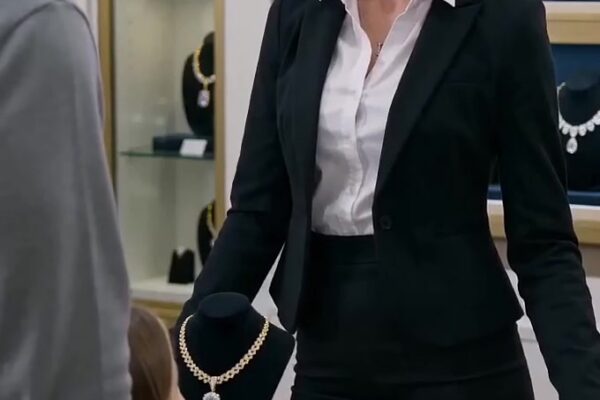
In that moment the doors by the elevator opened, and an elegant woman emerged like a final word. She wore a cream coat that fell perfectly from her shoulders and gloves the color of winter. Her hair was pinned with a precision that suggested time was a servant she did not thank. She moved toward the entrance with the steady pace of a person accustomed to doors opening before she reached them.
She saw the boy the way someone sees a stain on a white tablecloth—instantly, with displeasure. Her gaze flicked down, then away, as if looking longer might contaminate her.
“This is not a shelter,” she said, voice smooth as chilled glass.
The boy flinched, the movement so fast it looked like a reflex to an invisible blow. Yet he stayed where he was, feet planted on the marble as though he had promised himself he would not be moved again.
“My mom told me to wait here for you,” he said. The words shook, not from weakness alone but from the effort of holding them upright.
The woman stopped.
Not because of tenderness. Because of annoyance—because the boy had made his need into her problem. She turned halfway, prepared to dismiss him with the same effortless cruelty she’d used on men in meetings and staff who got her coffee wrong.
“I don’t know you,” she said. “And I don’t—”
Then the boy lifted his hand.
Something small lay in his trembling palm: a faded plastic bracelet, clouded with age, its printed letters almost eaten away. It looked absurdly fragile against the filth of his skin, like a scrap of innocence that had survived by hiding.
He held it up as if it were a badge.
On the tag, barely legible, were words pressed into plastic by a hospital machine that had long since been replaced: BABY LUCAS — MOTHER PENDING.
The woman’s breath caught. The change in her face was immediate and catastrophic, like a curtain ripped down. Color drained from her cheeks. Her lips parted, and for the first time her composure failed to arrive on time.
“…Where did you get that?” she whispered.
The lobby seemed to shrink around them. The pianist’s hands slowed, uncertain. Conversations thinned to silence. Even the doorman’s smirk evaporated, leaving a blank look of confusion.
The boy pressed the bracelet against his chest as if he feared it could be stolen, as if he had spent his whole life protecting this one brittle proof. “My mom kept it in her coat,” he said.
The woman took a step closer. Her gloved hand lifted, then fell, as though she didn’t trust herself to touch anything that might be real. “Who is your mother?” Her voice was still low, but the smoothness had cracked. Something raw pushed through.
The boy’s eyes filled, red-rimmed and stubborn. “She said you’d know. She said you gave me my first name.”
A sharp sound escaped the woman—half laugh, half choke. She looked around as if someone might intervene, as if the hotel itself might defend her from whatever was walking toward her on bare, dirty feet.
“Where is she?” she demanded, and the demand was not authority anymore. It was fear.
The boy swallowed hard. His jaw quivered. “She’s gone,” he said. “She died.”
The word hit the lobby like a thrown stone. Somewhere behind them a glass clinked against a saucer, too loud in the sudden quiet.
He continued, voice small but relentless, as if he had practiced the sentence until it no longer belonged to him. “She died telling me the woman who left us would recognize my first name.”
The woman staggered, only a little, but enough to betray her. Her gloved fingers began to shake. She stared at the bracelet as though it were glowing, as though the letters were burning through the plastic and into her eyes.
“Lucas,” she said, but it wasn’t a name. It was a memory she had tried to strangle.
The boy nodded once, as if he’d been waiting for her to say it. “That’s what she called me when I was sick and she didn’t have anything else,” he said. “She said you picked it.”
The woman’s gaze flicked to the doorman, to the watching guests, to the clerks behind the desk, all of them suddenly interested in a drama they’d hoped never to witness. Her world—this polished place—had always been a system of controlled appearances. She understood, with cold clarity, that she was being watched, and that her choice in the next few seconds would be remembered.
But the boy didn’t look like an audience. He looked like a question.
“What do you want?” she asked, and her voice trembled at the edges. It was the first honest thing she’d said.
The boy stared at her as if he didn’t understand the concept. Wanting had never been a safe activity. “I want to know why,” he whispered. “She never told me why you didn’t come back.”
The woman’s throat worked. Her eyes shone, not with tears yet but with something that might become them if she didn’t keep her face clenched. “Because I was young,” she said, as if youth were a defense and not an indictment. “Because I was scared. Because…”
Because I chose myself, she didn’t say. Because I could afford to.
The bracelet slipped from the boy’s fingers—his grip finally failing—and clattered onto the marble. The sound was sharp, humiliating, too loud. Instinctively, the woman bent down before she could stop herself. Her gloves hovered over it, and then, slowly, she picked it up.
For a second she held it in her palm like it weighed as much as the chandeliers. Her hand shook so hard the plastic rattled.
When she looked up, the boy was still standing in the same spot, bracing himself for whatever came next, as if the world always followed revelation with punishment.
The woman’s lips parted. Her voice came out smaller than it had any right to be. “What is your mother’s name?”
The boy hesitated, then said it. And the name—ordinary, human—landed on the woman’s face with the force of an old wound reopened.
She closed her eyes. In the silence that followed, the lobby’s perfection seemed suddenly ridiculous, a costume worn by a building that had no idea what life was. The woman opened her eyes again, and the cold dismissal was gone. In its place was a terror deeper than public embarrassment: the terror of being known.
“Come with me,” she said. Not as an order. As a plea.
The doorman shifted, uncertain. The guests leaned in, hungry for resolution. The clerks behind the desk pretended not to watch and failed.
The boy didn’t move. His voice was barely audible. “Are you going to send me away?”
The woman looked at him—really looked—at the dirt, the bruises, the way his shoulders curved like he’d been trying to make himself disappear. She swallowed, and when she spoke, every word cost her.
“No,” she said. “I’m going to finally do the thing I ran from.”
She extended her gloved hand. It hovered between them, ridiculous and immaculate. The boy stared at it as if it were a trap, as if kindness could be another form of harm.
And then, cautiously, he placed his small, ungloved fingers in her palm.
The marble lobby—built to forbid suffering—held its breath as the two of them stood connected by a handhold that felt like a verdict. Outside, behind the revolving doors, the city churned on, indifferent. Inside, under chandeliers and gold trim, a woman who had spent years perfecting the art of looking untouched began, at last, to be marked.
She squeezed the boy’s hand once, as if testing whether the past could still feel. “Lucas,” she said, and this time it was a name she couldn’t hide from. “I’m here.”
The boy’s eyes didn’t brighten. They didn’t trust that sort of miracle. But his shoulders dropped a fraction, the smallest release, as if a cord inside him had loosened.
In the place where suffering was not allowed to exist, it stepped forward anyway, uninvited and undeniable, and demanded to be seen.