Rain beat the gas station roof like fists on a coffin lid, and every blow reverberated through the thin metal into the fluorescent-lit store. Beyond the windows the highway dissolved into a sheet of black water. Neon from the OPEN sign shivered on the asphalt, breaking into bruised colors in the puddles. Three motorcycles stood under the awning, slick with rain, their chrome catching the light like teeth.
Inside, the air was a sour mix of gasoline, burnt coffee, and something older—regret that had seeped into the grout and never left. The owner, a wiry man with a permanent scowl and nicotine stains on his fingers, watched a small boy at the counter as if the child were a stray dog that might bite.
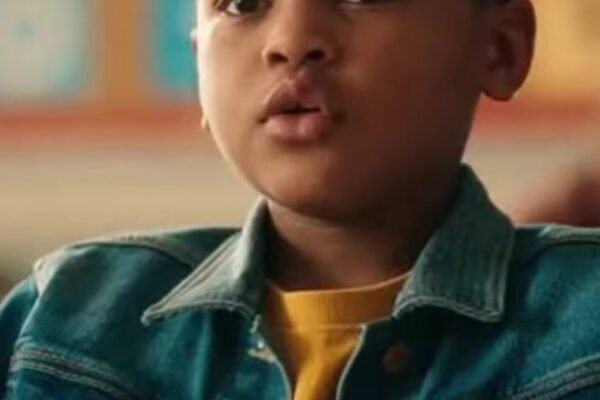
The boy couldn’t have been more than five. His clothes clung to him in torn, heavy strips. Water dripped from his hair into his eyes and down his cheeks, mixing with tears he tried to wipe away with a sleeve that was more hole than fabric. He stared at a wrapped sandwich sitting near the register like it was a miracle.
His small hand lifted—shaking, hesitant—toward the food. The owner’s palm slapped down, snatching the sandwich back so fast the wrapper crinkled like a scream. “Out,” the man barked. “I don’t run a charity.”
The boy flinched as though struck. “I’m so hungry,” he whispered, and the words were thin enough to tear.
Near the coffee machines, a cluster of bikers in soaked leather stood with their backs half-turned, pretending not to listen. Most of them looked away after a second, eyes fixed on their cups, their boots, the floor—anywhere but the child. All except their leader.
He was tall and grayed at the temples, his beard rough as sandpaper, his face carved by weather and choices. He had the kind of stillness that made rooms adjust around him. A patch on his jacket read NEO—three letters that had once been a nickname and now felt like a warning. He hadn’t said a word since they’d rolled in, just stood under the buzzing lights like a man waiting for a verdict.
The boy turned toward the door. His shoulders trembled, not only with cold. He took one step, then another, small shoes squelching. Something slipped from beneath his torn shirt, caught by motion and gravity. A silver locket swung on a thin chain, flashing briefly as it arced forward.
It would have hit the tile and disappeared beneath the racks if Neo hadn’t moved. His arm shot out with a speed that didn’t match his age. His fingers closed around the locket mid-swing, stopping it as gently as if it were a living thing.
The room held its breath without realizing it. Even the rain seemed to hush for half a second.
Neo stared at the metal in his palm. It was tarnished at the edges, the hinge worn. He knew that locket the way a man knows a scar—by touch before sight.
His thumb pressed. The clasp yielded.
Inside was a tiny, faded photograph, creased at the corners. A woman’s face looked back at him, half-smile caught forever between hope and exhaustion. The store lights bleached her features, but not enough to hide the familiar curve of her mouth. Not enough to erase the eyes—storm-dark and stubborn.
Neo’s throat tightened as if a hand had closed around it. For twenty years he had trained himself to keep her buried, to stack loud miles and louder mistakes on top of the memory until it couldn’t breathe. Yet here she was, staring up from a child’s locket on a night when the highway sounded like drowning.
He looked at the boy again. Really looked this time. The same eyes, wide and too old with fear. The same shape of jaw. The same expression like he’d been born already bracing for disappointment.
Neo’s voice came out low, scraped raw. “That locket,” he said, and the words weren’t a question so much as a surrender.
The boy lifted his chin with the fragile defiance of the desperate. “Mama kept it,” he said, and his lip trembled. “She said it was important.”
Neo’s hand began to shake. His knuckles went white around the tiny piece of metal. He forced himself to breathe once, then again. “What did your mama say my name was?” he asked, every syllable weighed like a stone.
The boy swallowed. Rainwater and tears clung to his lashes. “She… she said,” he stammered, “she said it was Neo. She said you rode the night like you didn’t need anyone.”
One of the bikers shifted, leather creaking. The owner scoffed under his breath, but no one looked at him. The attention had moved—pulled toward the counter as if by gravity.
Neo closed the locket carefully, as though shutting it might keep the past from spilling out. His eyes stayed on the boy. “What’s your name?”
“Eli,” the child whispered. “Mama called me Eli.” His gaze flicked to the sandwich behind the counter and then away, ashamed of his own hunger.
Neo’s chest tightened at the name. In another life, spoken in another voice, he had heard it before. He remembered a night in a trailer with a busted heater, the scent of cheap soap, her laughter turning into a serious look. He remembered her saying, If I ever have a boy, I’ll call him Eli. It means ‘my God’—like a prayer. He’d kissed her and told her not to talk about prayers as if life was already leaving.
He’d left anyway. Not because he didn’t love her, but because he’d been a man convinced love was something you ruined just by holding it. The road had been easier than responsibility. The gang had been simpler than a future.
“Where is your mama?” Neo asked. The question felt like stepping onto thin ice.
Eli’s eyes slid toward the window, toward the darkness where the highway vanished. “She told me to run,” he said. “There was shouting. A truck. She pushed me into the ditch by the bridge and said, ‘Don’t come out until the headlights are gone.’” His voice grew smaller. “I waited. But… she didn’t come back. So I walked. I followed the lights.”
Neo tasted metal. The bridge he knew—two miles back, where the road narrowed and the trees pressed close. A place men used when they wanted something to disappear. His mind flicked through faces, debts, old rivalries. He’d made plenty. A life built on speed always left broken things behind.
He turned his head slightly, not taking his eyes off Eli, and spoke to one of his men. “Jax. Get your keys. Now.”
Jax didn’t question him. He moved immediately, boots thudding toward the door. Another biker, Mara, stepped forward, her expression sharpening. “Neo,” she said quietly, “what is this?”
Neo’s jaw worked. “It’s my past,” he murmured. “And it’s bleeding.”
The owner cleared his throat like he was about to reclaim control of his store. “You people gonna buy something or—”
Neo’s gaze snapped to him, and the words died in the man’s mouth. Neo reached into his pocket and slapped a wad of bills on the counter—more than the store would make in a day. “Make another sandwich,” he said. “And hot chocolate. Now.”
The owner blinked, then moved with sudden obedience.
Neo crouched, bringing himself closer to Eli’s height. The movement made his knees protest, but he ignored it. “Eli,” he said, and saying the name felt like taking ownership of a truth he’d avoided. “You did good. You stayed alive.”
Eli stared at him with suspicion that didn’t belong to a child, suspicion earned. “Are you gonna make me leave?”
Neo swallowed hard. The rain hammered on, unrelenting. Outside, headlights slid past like ghosts. “No,” he said. “Not tonight. Not ever again if I can help it.”
The owner returned, pushing a fresh sandwich across the counter with hands that shook slightly. Neo took it and placed it gently in front of Eli. The boy hesitated, as if expecting it to be snatched away again. Neo didn’t move. He simply waited, letting the silence be a promise.
Eli’s fingers closed around the sandwich. He took a bite, and it was like watching someone come back from the edge. Tears ran down his face as he chewed, ashamed and relieved at once.
Neo stood, the locket’s chain looped around his fingers. He stared through the front window into the rain-smeared night. Somewhere out there, a woman’s life might be hanging by a thread. Somewhere out there, a debt he thought he’d outrun had come due.
He slipped the locket into his jacket pocket as if placing his heart back into his chest. “Mara,” he said, his voice turning to iron, “you stay with him. Don’t let him out of your sight.”
“Neo—” Mara began.
“Please,” Neo said, and it was the first time his crew had heard that word from him in years. He looked back at Eli, at the wet hair plastered to his forehead, at the small shoulders finally relaxing as warmth reached him. “I’m going to find your mama.”
Eli froze mid-bite. “You can?” he whispered around the food.
Neo’s eyes burned. The past was no longer a memory. It was a road he had to drive, no matter what waited at the end. “I don’t know what I’ll find,” he said softly. “But I know this: I’m not leaving you alone in the dark.”
He turned for the door. Thunder rolled somewhere far off, like a drum calling men to war. When Neo stepped into the rain, the storm swallowed him—but for the first time in two decades, he wasn’t running. He was going back.