The first sound was not loud, but it didn’t belong.
A hum like satin dragged across asphalt—too steady, too expensive for a block where winters chewed through shoes and the wind made quick work of dignity. Shiomara Reyes felt it before she saw it, a vibration climbing the handle of her ladle, running through the steel of her cart like a warning.
She had been serving breakfast since dawn. Rice with beans, a little stewed chicken when she could afford it. The same corner for eight years, tucked beside a closed-down laundromat and a mural that kept peeling, as if even paint was tired of staying. Her hands worked by memory. Scoop. Steam. Lid. Smile. She made food the way some people made prayers—quietly, stubbornly, without expecting an answer.
Then the cars came around the turn.
One white, one black, one white again, gliding in a line so neat it felt rehearsed. People paused mid-argument, mid-cigarette, mid-stride. A man pushing a cart of recyclables stopped as if his wheels had locked. Even the bodega’s doorbell, usually chirping its little song every minute, fell silent.
Three Rolls-Royces, polished so clean they reflected the gray sky like a dare.
They rolled to a stop in front of Shiomara’s cart. Right in front of it, close enough that the heat from her burners distorted the shine on their grills. Shiomara’s ladle hovered above the pot. Steam kissed her cheeks—familiar, forgiving. Everything else turned thin and strange, like a dream beginning to tear at the edges.
Her first thought was that she had done something wrong. That some permit she never managed to get right, some rule she didn’t know existed, had finally found her. There were days she imagined officials arriving with clipboards and cold eyes, days she lived as though her cart was a secret she was failing to keep.
The engines cut off. The silence afterwards was heavier than noise.
Doors opened with patient, deliberate clicks.
Three people stepped out: two men and a woman. Their coats were tailored, their shoes unscuffed, their posture practiced. They didn’t look at the cracked sidewalk, the slush, the graffiti; they didn’t look at the crowd swelling like a curious tide. They looked straight at Shiomara.
At her cart.
At her face.
The woman moved first. She was older than Shiomara expected, hair silvered and pulled back, cheekbones sharp with a life that had required strength. The man beside her had a blue tie and an expression that wavered between composure and something raw. The third—a little taller, with a brown coat and hands clasped tight—kept swallowing as if holding back words that had been waiting too long.
Shiomara tried to speak. “Good morn—” Her throat pinched closed, as if the cold had gotten inside her. She set the ladle down carefully, like any sudden movement might shatter the air.
The woman stopped at the edge of the cart. Her eyes were dark, fixed, searching Shiomara’s face with a focus that made Shiomara feel exposed down to the bones. Her hand rose to her chest, fingers pressing against her coat as though keeping something from breaking free.
When she spoke, the words came out thin with emotion.
“You…” The woman’s mouth trembled. “You fed us.”
Shiomara blinked. The city tilted.
The man in the blue tie stepped forward, voice careful, as if he didn’t trust it. “We were the kids under the bridge,” he said.
The bridge. Shiomara’s mind flew back without asking permission: the underpass near the river where the wind always found its way through, where the concrete stayed damp even in summer. She remembered the smell of wet cardboard. The sound of trains overhead like distant thunder. She remembered three small shapes huddled together in a nest of blankets too thin for December.
Triplets, the shelter worker had told her once, shrugging like it was trivia. Their mother gone. Their father unknown. Files that moved slow, problems that moved fast.
Shiomara had never asked their names at first. She worried names would make her too attached, and attachment was dangerous when you were barely holding your own life together. But names happened anyway. They always did. The boy with the narrow face was Luis. The one with the dimple was Mateo. The girl, who stared too hard as if daring the world to lie to her, was Alma.
Alma.
The woman in front of her—older now, refined, steady as a blade—was Alma.
Shiomara’s hands began to shake. She gripped the edge of her cart so hard she felt the metal bite her palms.
The taller man, the one in brown, spoke softly. “You told us to eat first,” he said. “You said the world could wait.”
Shiomara’s breath caught. She remembered saying it, not because it was wise but because it was the only thing she could give them that wasn’t measured in ounces. A sentence, warm as soup, to wrap around them when she couldn’t offer more.
She stared at them, trying to fit the past onto the present. The boys’ faces were broader now, their shoulders squared, their eyes still the same—too old when they were young, now carrying a different kind of weight.
“I… I didn’t—” Shiomara managed, but the rest dissolved. She had fed them when she had almost nothing. She had done it the way she did everything: because hunger was cruel, and because she recognized cruelty when she saw it.
Alma stepped closer, and tears finally slipped past the strength in her face. “We didn’t just remember you,” she said. “We built our lives around remembering you.”
The man in the blue tie—Luis, Shiomara realized, though she didn’t know how she knew—reached into his coat and pulled out an envelope. It was thick, cream-colored, sealed. He placed it on the cart with a gentleness that made the paper look fragile against the scratched steel.
“We tried to find you,” he said. “We asked shelters, churches, anyone who might know. But you moved corners. You changed carts. You kept living.” His voice cracked on the last words, like survival was both miracle and accusation.
Mateo—the taller one—took a step forward. “Open it,” he whispered.
Shiomara stared at the envelope as if it might burn her. The crowd was so quiet she could hear the hiss of her burner, the soft pop of rice simmering under the lid.
Her fingers fumbled with the seal. Paper tore. She slid out what was inside.
A photograph came first.
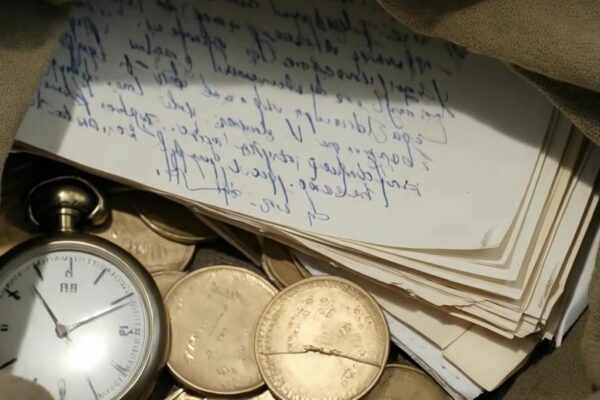
Old, faded, corners curled. Three children sitting on the ground under the bridge, each holding a plate. Their cheeks were hollow, their coats too big. Behind them, crouched and smiling despite exhaustion, was Shiomara herself—hair pulled back, eyes tired but kind, her hand resting on Alma’s shoulder like a promise.
Her vision blurred. She wiped at her face with the back of her wrist, leaving a streak of flour and steam-sweat on her skin.
Under the photograph was a document. Heavy paper. Stamps. Signatures. Her name printed in ink that looked too official to belong to her life.
Shiomara’s lips parted. “What is this?”
Luis exhaled shakily. “A deed,” he said. “To a building.”
“Not a room,” Alma added, voice firm now, as if she needed the words to stand upright. “Not a lease you can lose. A place. Your place.”
Shiomara stared at the lines of legal language until they swam. She saw an address. She saw her name again. She saw words like OWNER and TITLE and TRANSFER as if they were from another planet.
She looked up, overwhelmed, almost angry in her confusion. “I can’t—”
Mateo shook his head. “You can,” he said, and his eyes shone with the same stubbornness she remembered. “Because you already did the impossible once. You kept three kids alive with a cart and a heart that refused to shut.”
Alma placed her hand on the cart’s edge, near Shiomara’s shaking fingers. The contact was small but it anchored the moment, made it real. “We learned what kindness looked like from you,” Alma said. “We learned what a promise was when you handed us food and didn’t ask for anything back.”
The crowd began to murmur again, sound returning like blood to numb hands. Someone sniffed. Someone whispered, “God…” A man who had been waiting for a plate of rice took off his hat and held it to his chest without knowing why.
Shiomara tried to speak and failed. She could only stare at the photo, the deed, the faces of the children who were no longer children.
“We started with scholarships,” Luis said, as if confessing. “Then jobs. Then a business. Then another. People called it luck.” He swallowed. “We called it debt. A good one.”
“We promised,” Mateo said, “that if we ever got out, we’d come back for the person who refused to let us starve.”
Alma nodded, tears sliding freely now. “You gave us weeks,” she said. “Weeks turned into years. We kept each other alive because you taught us how.”
Shiomara looked down at her cart. The dents, the chipped paint, the handle worn smooth where her hands had gripped it through seasons. She thought of every morning she’d woken with fear in her throat and still pushed this cart to the corner because rent didn’t care about fear. Because hunger didn’t care about excuses.
She pressed the photograph to her chest. It smelled like old paper and time. “I just…” she began, voice breaking at last. “I just couldn’t watch you be hungry.”
Alma leaned in, forehead nearly touching Shiomara’s. “And we couldn’t live with forgetting,” she whispered.
Luis tapped the deed lightly, as if sealing it with sound. “You fed us when we had nothing,” he said. The words fell into the cold air like something sacred. “Now you won’t have to worry about empty plates again.”
For the first time in years, Shiomara let her shoulders drop. Not in defeat, but in release. The steam rose between them, curling around faces old and new, past and present, and for one strange, quiet moment on a battered corner of the city, the world did wait.
Then Shiomara reached for the ladle again, because her hands still needed to do what they knew. She looked at the three of them—grown, gleaming, impossibly real—and her voice came back.
“You all look hungry,” she said, and though she was crying, the words carried the shape of a smile. “Sit. Eat first.”
The three stepped closer, not like strangers with money, but like children coming in from the cold at last.
And Shiomara served them, as if feeding them was still the most natural thing in the world—because for her, it always had been.