At sunset, the rooftop terrace was full of laughter, clinking glasses, and the soft glow of the city below. Candlelight trembled in hurricane glass, and the skyline wore its evening jewels without shame. The party lived above the street the way a secret lives above a confession—high, safe, and convinced it would never be touched.
Music hummed from hidden speakers, light enough to pretend it wasn’t trying too hard. Men in linen and women in silk floated from conversation to conversation, trading compliments like currency. The waitstaff glided around them with trays of oysters and champagne, eyes lowered, footsteps silent.
Then the elevator doors opened again, and the rooftop’s polished spell caught on something rough.
A child stepped out barefoot.
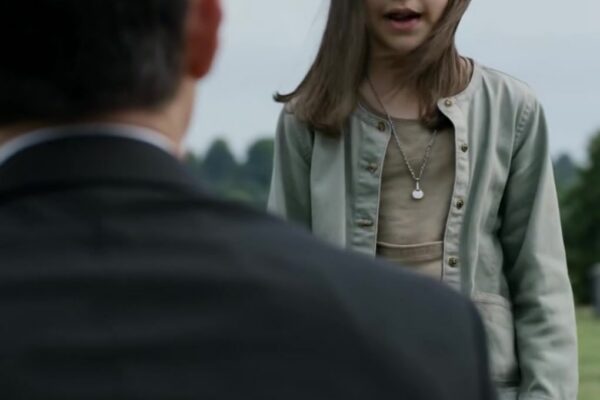
The child couldn’t have been more than ten, small-boned and too thin for the night breeze. Their clothes were ripped at the hem, stained with city dust and something darker at the knee. A faded bruise rode the curve of one cheek, and a red welt—fresh, ugly—still burned along the jawline as if someone’s fingers had left a signature.
In the child’s hands, held like a fragile promise, was a silver flute.
People stared the way people do when they see misfortune where it doesn’t belong. A few laughs tried to continue, as if volume could erase discomfort. Someone muttered that security was useless. Someone else lifted a phone, not to call for help, but to capture it.
“Look,” a man in a charcoal suit said with a grin too white. “A rooftop busker.”
The child took two steps forward, stopping at the edge of the long dinner table where a sculpture of flowers sat like a crown. The child didn’t ask for money. Didn’t speak at all. Only raised the flute with hands that trembled, as if the metal were cold enough to bite.
The first note was thin, almost lost in the breeze.
Then another, and another, gathering courage. The melody that formed was simple, but it carried a wound inside it. It sounded like someone humming in a hospital hallway to keep from falling apart. It sounded like a lullaby taught by a tired voice—soft, broken, and somehow beautiful in its refusal to lie.
The rooftop changed. Laughter thinned, then vanished. Glasses stopped clinking. Conversations stumbled mid-sentence and didn’t resume. Even the city below seemed to retreat, its sirens and engines swallowed by the sudden gravity of the tune.
A woman in a gold dress sat near the center of the table, her hair pinned in a way that suggested she had never been late for anything. Her lipstick was the color of red wine and cost as much as a week’s rent. She held her glass halfway to her mouth when the melody reached its turning point—the moment where it fell, then rose again with stubborn tenderness.
Her fingers locked around the stem.
Her eyes sharpened.
Then, as if struck by a name spoken in a crowded room, her breath caught.
When the child lowered the flute, silence didn’t return. Silence arrived. It planted itself among the candles and crystal and made everyone suddenly aware of their own hearts beating.
The woman in gold stood as if her body had decided before her mind could protest. She stared at the child, not with irritation, not with pity, but with the fragile terror of someone looking at a doorway that should be bricked shut.
“That song…” Her voice was not a hostess’s voice. It was a person’s voice. “Where did you learn that?”
The child swallowed. Up close, their eyes were too old for their face. “My mom taught me,” they said. Their voice was small and scraped raw, like they hadn’t spoken much lately. “Before she got sick.”
The woman took a careful step forward, as though the air between them might crack. “Your mother,” she repeated. “What’s her name?”
The child blinked hard. Tears threatened but didn’t fall yet, as if they were saving themselves for something more necessary. “Anna.”
The woman’s glass slipped from her hand. It struck the stone tile and shattered, the sound sharp enough to make several guests flinch. Red wine spread across the terrace like spilled blood, reaching toward the child’s feet.
“No,” the woman whispered, and for the first time she looked older than her dress, older than her jewelry. “No, that’s—” She forced the words past her teeth. “Anna died years ago.”
The child’s grip tightened on the flute. Their knuckles blanched. “Then why did she tell me…” The child’s chin trembled, and the tears finally escaped, streaking clean lines through the dirt. “Why did she tell me you’re my grandmother?”
It wasn’t the kind of question you could laugh off. It wasn’t even the kind you could deny without losing something vital.
Every face at the table turned toward the woman in gold, hungry for drama now that it had become personal. Someone’s phone was still raised, but they had stopped recording and forgot to lower it, as if their hand had frozen.
The woman’s mouth opened and closed once. Her gaze fell to the child’s bruise, the welt on the jaw. Her eyes flicked to the flute—real silver, not a toy. Engraved, faintly. As if it had once belonged to someone who took music seriously.
“What’s your name?” she asked, and the question sounded like a prayer she didn’t believe in but was desperate enough to try.
“Mila,” the child said. “Mila Hart.”
At the surname, a subtle tremor moved through the woman’s posture. Not a flinch—something deeper, like a foundation settling after a crack.
“Hart,” she echoed. Her eyes slid toward the far end of the table where an older man sat rigidly, his expression fixed in the practiced neutrality of money. He had not stood. He had not spoken. But in the moment the child said the name, the man’s hand tightened around his napkin until it tore.
The woman in gold turned back to the child. “Who brought you here?”
Mila hesitated, then lifted a dirty thumb over their shoulder, pointing to the elevator as if it were an alleyway. “I came,” they said. “I… I ran. They were going to take the flute. They said it was worth something. They said I was worth nothing.”
A murmur moved through the guests—an uncomfortable ripple. Several people shifted in their seats, suddenly interested in the skyline. A woman in pearls pressed her lips together, pretending she hadn’t been the one smiling earlier.
The woman in gold knelt, the satin of her dress pooling on the stone like molten sun. She didn’t touch the child immediately; she seemed afraid that contact would dissolve whatever fragile reality had formed. Her voice lowered. “Where is your mother?”
Mila’s tears thickened. “They said she didn’t come home,” the child whispered. “They said she left. But she didn’t. She promised. She taught me that song and she said if I ever got lost, I should play it. She said you would hear it.”
The woman’s eyes glistened, and for a second she looked like someone who had been holding their breath for a decade and was only now realizing it. “Anna never left,” she said, and the words came out jagged. “Anna was taken.”
The child stared at her. “Taken?”
The woman’s gaze flicked again toward the older man at the table. The man’s jaw flexed. He lifted his wineglass as if to drink, but his hand shook just enough to betray him.
“My daughter disappeared,” the woman said, voice trembling with fury she had apparently kept starved and chained for years. “And I let them tell me she was dead because it was easier than admitting I had been fooled. It was easier than tearing my life apart to find the truth.” She swallowed, and her mascara held, but her composure didn’t. “And I kept sitting at tables like this one.”
The rooftop seemed suddenly obscene—its flowers too perfect, its laughter too rehearsed. The breeze turned colder, as if the city had exhaled.
Mila wiped at their cheek with the back of a hand. “If you’re my grandmother,” they said, “then… can you help me find her?”
The woman in gold looked up, and something ferocious settled into her eyes. Not social charm. Not refinement. A vow.
She rose, and when she stood, she did not look like a guest anymore. She looked like someone who owned the building, the air, and the consequences. “Yes,” she said, louder this time, and several people flinched as if the word had struck them. “I can.”
She turned toward the older man at the table. “Arthur,” she said, and the name landed like a gavel. “You’re going to tell me where my daughter is.”
He offered a smile that couldn’t find its way to his eyes. “Elena,” he began, voice smooth, “you’re upset. This is—”
“This is my family,” she cut in, and her voice sharpened until it could have cut glass cleaner than the shards at their feet. “And you will not sit there with your imported wine and pretend you don’t recognize that flute.”
All eyes moved to the instrument. In the candlelight, the engraving became visible: a tiny lily and the initials A.H.
Mila held it up, suddenly frightened again by the attention, but unwilling to let go. “She said it was hers,” the child whispered. “She said you gave it to her when she was little.”
The man’s face tightened, and in that tightening the rooftop finally saw what wealth often hides: fear. Not fear of losing money. Fear of being named.
Elena stepped between Mila and the table, her body a shield in gold satin. “No more recording,” she snapped at the guests, and for once, her voice carried the authority everyone had assumed she possessed only for party planning. “Put the phones away. Anyone who doesn’t—leave.”
Chairs scraped. People stood, suddenly eager to prove they were decent. Several fled toward the elevator as if the terrace had caught fire.
Elena crouched again, this time placing her hand gently over Mila’s, covering the child’s trembling fingers around the flute. Her touch was warm, steady. “You did the right thing,” she said, and the words were not performance. “You came to the one place they never expected you to reach.”
Mila’s lips quivered. “I was scared.”
“So am I,” Elena admitted, her eyes never leaving the child’s face. “But we can be scared and still move.”
Behind them, Arthur pushed back his chair, a careful, measured motion as if he could still control the shape of the evening. “Elena,” he said, and now his smoothness was cracking. “Think about what you’re doing.”
Elena stood slowly, her hand remaining on Mila’s shoulder. She looked at Arthur as if she were seeing him clearly for the first time. “I am,” she said. “I’m thinking about Anna’s song. I’m thinking about bruises on a child’s face. I’m thinking about the years you told me to forget.”
She took Mila’s flute and pressed it back into the child’s hands with reverence, as if it were a key. Then she lifted her chin toward the waiting staff. “Call my driver,” she ordered, then softened as she looked down at Mila. “And call the police—no,” she corrected, voice hardening again, “call the investigators I should have called a long time ago.”
Mila’s eyes widened. “You believe me?”
Elena’s throat worked as if she were swallowing glass. “I believe the song,” she said. “I believe my daughter would do anything to lead you here.”
And as the city lights brightened below, the rooftop terrace—once a stage for laughter—became something else entirely: a battlefield dressed in linen, where a child’s broken melody finally dragged the truth into the open air.