At sunset, the rooftop terrace was full of laughter, clinking glasses, and the soft glow of the city below. The skyline looked rehearsed—towers pricked with light, windows catching fire for a few minutes before dusk swallowed the shine. On the terrace, everything was arranged to pretend the world never broke: linen so white it seemed to hum, orchids trembling in crystal vases, and a string quartet whose instruments were quieter than the gossip.
Marisol Vance stood near the balustrade, her gold dress catching the last sun like armor. She held a glass of wine and listened to men with watchbands worth more than scholarships talk about charities with the ease of people buying new shoes. Her name floated from mouth to mouth—Vance, Vance, Vance—like a blessing and a warning.
She smiled when expected, nodded when a donor listed his latest good deed. But her eyes kept shifting toward the elevator doors, as if she were waiting for someone who had never learned to arrive on time.
The doors opened again and again, releasing caterers with trays and guests with laughter. Then, in the thin gap between two bodies, a child slipped out as if the building itself had exhaled something it couldn’t digest.
He couldn’t have been more than nine. Bare feet on stone, toes dark with city grime. A shirt that once might have been white, now a map of stains and torn seams. On one cheek, the shape of a handprint lingered—red at the edges, already purpling at the center. He held a silver flute the way other children held stuffed animals, both hands wrapped tight, knuckles pale.
At first the terrace treated him like an oddity, the way the wealthy sometimes treat misery: with a curious tilt of the head, a quick laugh, a whisper that tastes like entertainment. A man near the fire pit lifted his phone, camera lens shining. Another guest followed suit, angling for a “moment.”
Marisol’s mouth tightened. The building had security. It had gates. It had people whose entire job was keeping the wrong kind of human out. Yet here he was, a small storm walking into a room built to resist weather.
The child stepped to the center of the terrace, where the last sun fell cleanly, and raised the flute. His hands trembled. A server started forward, then hesitated, perhaps uncertain whether the child was a problem or an opportunity.
He played.
Not loudly. Not with the bravado of a street performance meant to wrestle coins from pockets. The first notes were thin, almost torn, like fabric snagging on a nail. Then the melody found its spine. It carried itself in a slow, aching line—simple enough to remember, strange enough to hurt. The rooftop’s laughter didn’t stop all at once. It frayed. Conversations broke apart mid-sentence. The quartet, trained to ignore everything, faltered and went silent.
The air changed. The city below might as well have fallen away; traffic sounds faded into something distant and irrelevant. Even the clink of glass seemed too loud, too crude, and people began to hold their breath without realizing.
Marisol felt the music strike her like a familiar name called from a crowd. Her wine glass hovered halfway to her lips. The melody was not just beautiful. It was specific. It had corners and pauses she remembered in her bones—an old lullaby her mother used to hum under her breath when the mansion’s lights were out and the storms pressed their faces to the windows.
Her fingers, suddenly useless, trembled around the stem. She had not heard that tune in decades.
The child’s cheeks puffed with effort; his eyes were focused somewhere beyond the terrace, beyond the city, as if he were playing toward a room he could no longer reach. When the final note thinned and disappeared, the silence didn’t rush in. It arrived carefully, as if afraid to step wrong.
Marisol stood. The movement seemed enormous. Chairs scraped. Heads turned.
“That song,” she said, and her voice was not her own. It sounded too young, too unguarded. “Where did you learn that?”
The child lowered the flute. Up close, his lashes were wet. His mouth pressed into a line that fought to stay closed.
“My mom,” he whispered. “She taught me.”
Marisol took a step forward before she thought to. The stone beneath her heels felt unreal, as if she were walking on a dream that could crack.
“Your mother,” she repeated, the words thickening. “What is her name?”
He swallowed. His eyes flicked toward the guests holding phones. One phone lowered in embarrassment; another kept recording, stubborn as greed. The child’s grip tightened on the flute until the metal caught the light like a blade.
“Anna,” he said.
The name struck the terrace like a glass dropped from a great height. Marisol’s fingers went numb. Her wine slipped free and shattered on the stone, red spreading between the shards like a wound.
Someone gasped. No one moved to clean it.
Marisol stared at the child’s face, searching for echoes of a girl she had once loved and then buried alive in her own choices. Anna: the daughter who had laughed too loudly, who had asked too many questions, who had fallen ill and, later, vanished into the city’s shadow when Marisol’s husband insisted the family name couldn’t survive scandal.
“That’s not…” Marisol began, but her throat clenched. She forced air into her lungs. “That’s impossible.”
The child’s eyes filled completely. Tears spilled down the dirt on his cheeks, carving clean tracks. He didn’t wipe them away. He looked exhausted, as if crying was another task he could barely manage.
“She’s sick,” he said. “She’s been sick a long time.” He hesitated, and his voice sharpened with desperation. “But she’s still my mom.”
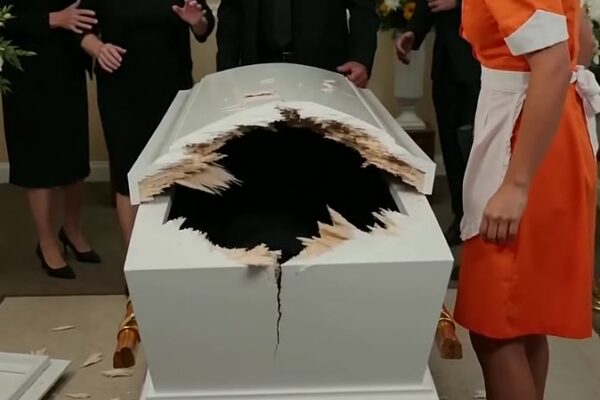
Marisol’s knees threatened to buckle. She had attended a funeral. She had worn black and accepted condolences. She had watched a closed casket lowered into perfect earth while cameras remained outside the gates. She had told herself it was mercy. She had told herself it was necessary. She had told herself the world asked too much of a woman with a powerful husband.
She took another step. The child did not retreat, though fear trembled through him. He stood with the brittle courage of someone who had already lost everything and had nothing left to protect but a tune.
“Anna died,” Marisol said, the words like splinters. “Years ago.”
The child blinked at her, as if he were trying to understand a language he didn’t know. Then he lifted his chin, and in that small gesture Marisol saw something unmistakable: the stubborn angle of Anna’s jaw, the same refusal to bend.
“She told me people say that,” he whispered. “She told me not to believe it.”
Marisol’s heart beat so hard she felt it in her fingertips. The terrace around them seemed to tilt, rich faces floating like masks at the edge of her vision. Her husband’s friends. Her donors. Her carefully curated life. All of it suddenly fragile, held together by lies and money and the distance between the privileged and the forgotten.
“Why are you here?” Marisol asked, though she already sensed the answer in her bones.
The boy lifted the flute slightly, a tiny silver proof. “Because she said this song would find you,” he said. His voice cracked, but he kept going. “She said if I played it where the sky is close, you’d hear.”
Marisol’s breath broke. “She said… she said I would hear?”
He nodded, tears shining. “She said you wouldn’t be able to pretend.”
Marisol reached out, stopping a hand’s span from his shoulder, afraid to touch him and confirm he was real. Her eyes burned. The city lights below began to wake, one by one, indifferent and gorgeous.
“What else did she tell you?” Marisol asked, voice barely a thread.
The child’s lips trembled around the words that seemed too large for his mouth. “She said you’re my grandmother.”
A sound escaped Marisol—half breath, half sob. She glanced at the shattered wine, the red spreading wider, and thought of bloodlines, of secrets, of the way wealth could bury a person deeper than any grave. She looked back at the boy and saw in him a question the world had tried to erase.
Across the terrace, the phones had stopped recording. Not out of kindness, but out of fear—fear that the story they were witnessing had teeth.
Marisol swallowed the taste of metal and regret. “Where is she?” she asked. The words came with a force that surprised even her. “Tell me where Anna is.”
The boy’s shoulders sagged with relief so sharp it was almost pain. He clutched the flute to his chest, as if it were the last bridge between worlds, and said, “I can take you. But you have to come now. Before the night nurses change shifts.”
Marisol turned toward the elevator, toward the gilded doors that had never once opened for her without obedience. Behind her, a man began to speak—her husband’s voice, thick with warning—but she didn’t look back. She had spent a lifetime choosing appearances over truth. The music had ended, yet it still rang in her ribs like a verdict.
She extended her hand. The child stared at it as if it were a strange object, unsure it was meant for him. Then, cautiously, he placed his small, dirty fingers into her palm.
His skin was warm. Real.
Marisol closed her hand around his, and the terrace—its laughter, its clinking glasses, its soft city glow—fell away behind them as if it had never mattered at all.