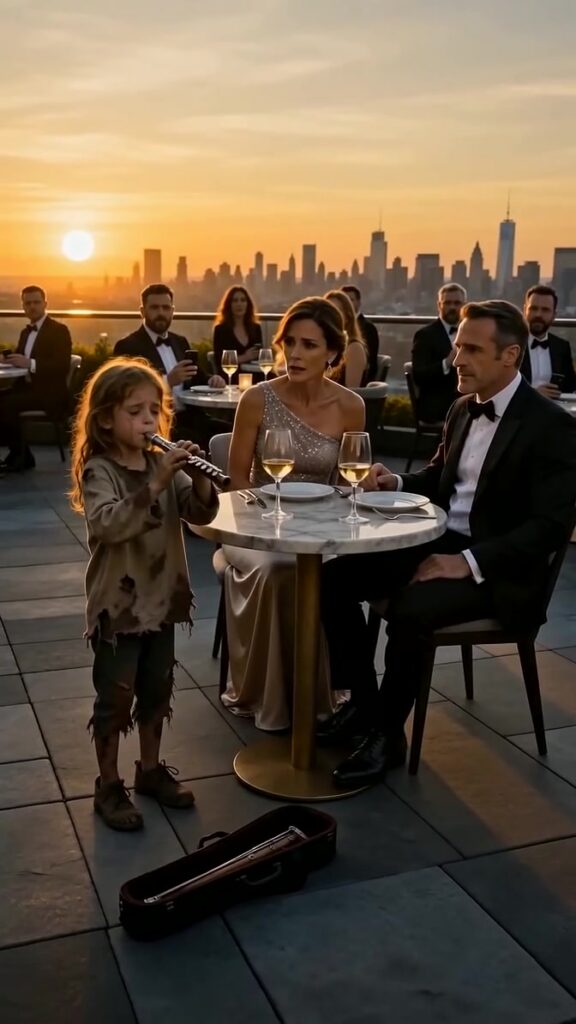
The terrace of La Volière floated above the river like a jeweled raft—linen the color of cream, chandeliers framed by ivy, crystal glasses that caught the last sunlight and fractured it into gold. People spoke softly here, as if volume itself was impolite. Even the waiters moved with careful ankles, gliding as though the marble could bruise.
So when the child’s plea cut through the hush, it sounded like something breaking.
She was hardly more than a wisp—five, maybe six—bare feet blackened by the city, a dress that had once been yellow but now wore the gray of long streets. Her small shoulders lifted and fell too fast. Clutched to her chest was a flute, not the kind sold in toy aisles, but a real instrument: scratched wood, tarnished rings, wrapped once with a strip of cloth to keep it from splitting. Her eyes darted from table to table, not searching for kindness, but for the least cruel face.
“Please,” she said again, the word thin with exhaustion. “I’m hungry.”
A man in a charcoal suit, the sort that looked tailored to his skeleton, leaned back and appraised her as though she were a street performance arranged for his amusement. He tapped one manicured finger against his wineglass. “We don’t pay for noise,” he said, then let a smile sharpen. “But we might pay for talent. Play, and we’ll decide.”
Chairs shifted. Phones rose like periscopes. A few guests laughed—not loud, but loud enough. The restaurant’s manager took one half-step forward, then halted, calculating the optics of cruelty versus the cost of confrontation.
The girl’s fingers tightened on the flute. For a moment, she looked at the exit, the river beyond it, the long climb down into the streets. Something in her face said she had already walked away from a hundred such tables. Then she raised the instrument to her lips, drew in a breath that seemed too big for her ribs, and played.
The first note was almost swallowed by the clink of cutlery. But the second note found the air and held it. The melody unfurled slowly, a line of sound as delicate as thread—then deepened, turning into something older than her body. It wasn’t cheerful, and it wasn’t meant to be. It carried the ache of a room with closed curtains, the rhythm of footsteps leaving, the way a name can be spoken like an apology.
As the tune gathered, the terrace changed. Hands paused halfway to mouths. Someone’s laugh died uncomfortably in their throat. Even the suited man’s smile faltered, as if he had been startled by an unexpected mirror. The river below continued to slide by, indifferent, but the air above it felt thick with listening.
At the center table sat Eveline Marchand, a woman whose presence usually guided the room the way a chandelier guided light. She wore a pale dress and a single dark gemstone at her throat. She had arrived with investors, discussed acquisitions, watched the world as if it were a portfolio. But now she stared at the little girl with a rigid stillness that didn’t belong to dinner.
Her fork slipped from her fingers and struck the plate with a small, bright sound. Eveline didn’t notice. The melody had reached its heart—the turn that made it unmistakable. Her eyes blurred, not with sentiment, but with recognition so violent it felt like an injury.
“That’s…” Eveline whispered, though no one was speaking to her. “No.” Her chair scraped as she stood, the motion sudden enough that nearby diners looked up, startled at her breach of etiquette. She took one step forward, then another, as if crossing a floor that had become water.
The girl played on, cheeks hollowing with each breath, tears slipping down without interrupting a single note. The final phrase came soft as a closing door. When the last note faded, it did not vanish; it seemed to hang over the terrace, insisting on being answered.
The girl lowered the flute. She swallowed. “My mama taught me,” she said, voice small and rough. “Before she couldn’t get up anymore.”
Eveline’s hands rose, trembling at chest height, as if she might reach for the child and feared she would shatter her. “What is your mother’s name?” she asked.
The suited man chuckled uneasily, irritated that the evening was slipping out of its intended entertainment. But his sound fell flat against the silence.
The child hesitated, then said, “Anna.”
Eveline’s face emptied of color so quickly it looked like the light had been turned off inside her. The gemstone at her throat rose and fell with a sharp breath. “That’s impossible,” she said, and the words weren’t denial so much as an attempt to keep herself standing. Her glass slid from her fingers, hit the marble, and burst into clear, ringing shards that scattered like startled birds.
No one moved to help. The breakage felt too small compared to the fracture happening in front of them.
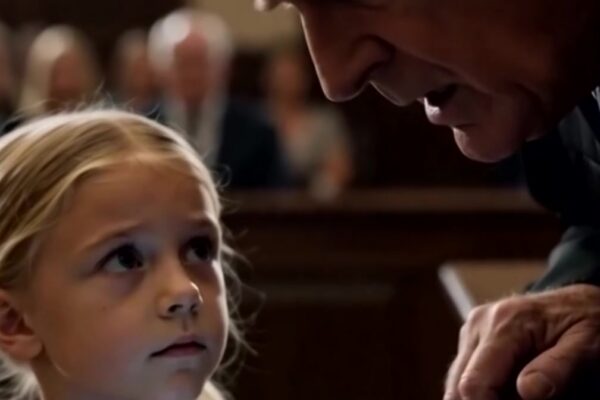
Eveline crouched until her eyes were level with the girl’s. Up close, the child’s grime could not hide the shape of her mouth, the angle of her brow. Things that were not learned. Things that were inherited. Eveline’s voice turned hoarse. “What did she call you?”
The girl blinked hard, as if trying to keep herself from disappearing. “Mara,” she said. “She said it means ‘of the sea,’ even though we never saw the sea.”
Eveline flinched. “Mara,” she repeated, and the name opened a door inside her that had been sealed for years. The restaurant fell away; the chandeliers dimmed into memory. She saw a hospital corridor, a signature smudged by tears, a body bag she had been told was her sister’s, a doctor who wouldn’t meet her eyes. She heard an official voice: Complications. No surviving family. She had believed it because grief had demanded an ending.
Eveline reached into her clutch with a frantic precision and pulled out a worn photograph—creased, carried too often, hidden too long. She held it up. In it, a young woman smiled tiredly at a cheap camera, holding a newborn wrapped in a blanket. Eveline’s own younger face hovered beside them, bright with the kind of hope that later feels naïve.
Mara stared. Her lips parted. “That’s my mama,” she whispered. Then she pointed with a shaking finger at the baby. “That’s me.”
A murmur finally moved through the terrace, like wind waking up. The manager stepped forward, then stopped again, watching Eveline as if she had become a different kind of guest—dangerous, unpredictable, human.
“Where is she?” Eveline asked, and there was steel under the tremor now, the tone of a woman who had made a career of taking what she was owed. “Where is Anna?”
Mara’s gaze dropped to the flute, to the strip of cloth binding it. “She’s in the room where it smells like wet walls,” she said. “Up the stairs behind the bakery. She sleeps all the time. I bring water. I play, and sometimes her eyes open and she looks past me, like she’s looking for something that isn’t there.”
Eveline’s throat tightened, her expression splitting between horror and fury. She looked back at the terrace full of polished people. Their wealth seemed suddenly obscene, their soft bread and bright sauces ridiculous against a child describing mildew as if it were normal.
The suited man cleared his throat, embarrassed by the turn. “Madam Marchand,” he began, as if to reclaim the evening, “surely—”
Eveline stood with a suddenness that made him stop. She pulled off the dark gemstone at her throat—the only heirloom she still wore—and pressed it into Mara’s palm, closing the child’s fingers around it like a vow. “You won’t have to beg again,” she said. Then she looked at the guests who had lifted phones, who had waited for entertainment. “Put those away,” she added, and her voice left no room for debate.
She turned to the manager. “Call my driver,” Eveline said. “And call a doctor. Not the kind who sends condolences. The kind who comes with an ambulance.” Her gaze sharpened, sweeping the terrace as if it were a boardroom. “And if anyone here has a problem with a barefoot child leaving through the front, they can take it up with my lawyers.”
Mara stared at her, stunned, as though kindness were a language she only half understood. “Are you… are you a rich lady?” she asked.
Eveline swallowed hard. “I am your mother’s sister,” she said. The words tasted like salt. “And I am late.”
For the first time since she had entered, Mara’s shoulders loosened, not in relief—relief was too fragile—but in a tired surrender. She clutched the flute to her chest and nodded once, as if agreeing to a plan she didn’t yet believe would hold.
Behind them, the terrace slowly resumed breathing. Forks were set down with care, conversations attempted and abandoned. The river kept moving. But a new truth had entered La Volière, and no amount of luxury could escort it out. As Eveline led the child toward the exit, stepping over the glittering shards of broken glass, the melody still seemed to linger in the air—less like a performance, and more like a signal flare, finally seen.