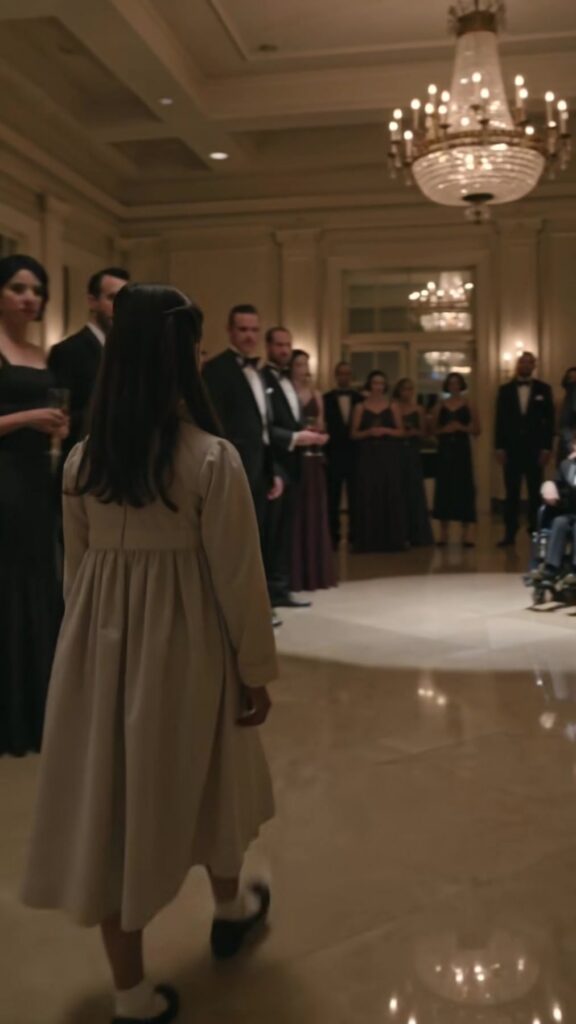
Everything felt controlled.
That was how Calder House was built: not with stone and glass, but with rules that fit so smoothly over your skin you stopped noticing the pressure. Every corner had a camera tucked into a molding, every door sighed only after it read your pulse, every chandelier light adjusted itself to the mood in the room the way a trained servant adjusted their face.
Elliot sat on the pale sofa as if he’d been posed there. His feet were flat on the rug, his hands in his lap, his shoulders set at the angle that made his mother’s jaw unclench. The walls behind him carried oil portraits of men who stared past the viewer, as if looking toward the next century and already owning it.
His mother, Miriam, had chosen the day’s outfit for him: charcoal slacks, a white shirt that pressed into his throat, the family crest on a pin at his collar. Everything had a meaning here. Everything made a statement.
Across the room, Dr. Voss sat with a leather folder on his knee. He didn’t look like a doctor so much as a man who made doctors nervous. Clean cut. Measured smile. A watch that didn’t tick so much as judge time for wasting itself.
“Your consistency is improving,” Voss said. “We’re seeing stabilization. Reduced anomalies. Better compliance.”
Miriam’s relief appeared as a slight softening around her eyes. “He’s doing what he’s told,” she said, as if Elliot were a puppy that had finally learned not to bite.
Elliot felt the words move through him like cold air under a locked door. Compliance. Stabilization. Anomalies. He was a report. A graph. A pattern that must not spike.
The house stayed quiet, listening. Somewhere, vents exhaled. Somewhere, a clock with no hands kept time by other measures.
“Perfect,” Voss added, tapping the folder once, a punctuation mark. “Until we clear the final incident.”
Elliot’s fingers twitched. The final incident. The phrase that always hung around him like a scent no one could air out. The day his memory fractured. The day the security recordings went black for three minutes and seventeen seconds. The day his father stopped looking him in the eye and started looking at him like a locked door.
Miriam rose and crossed to the tall front windows. Outside, the driveway curved like a question mark through manicured hedges. A pair of security guards stood near the gates, silhouettes against the afternoon sun. “He doesn’t need to remember,” she said. “Forgetting is an act of mercy.”
Voss smiled gently, as if forgiving her for being a mother. “Forgetting is an act of control,” he corrected.
Elliot swallowed. The collar felt tighter. He didn’t even have the urge to stand, because standing required permission in this room. Even his breath seemed leased.
The doorbell did not ring. Visitors did not arrive unannounced at Calder House. Guests were scheduled, vetted, announced by the house’s soft chime. It was another way everything stayed controlled.
So when the foyer doors opened anyway—without the chime, without a servant’s footsteps, without warning—the air changed. Not like a draft, but like a hinge snapping.
She walked in as if she had always belonged to the house and the house had simply forgotten to admit it.
She was about Elliot’s age, though time sat on her differently: like she’d been required to grow up with less softness. Dark hair clipped back at the nape of her neck, a jacket that had seen weather, boots scuffed like they’d argued with roads. Her eyes were steady and unpolished, a brown so deep it looked almost black, and she carried no handbag, no papers, no token of permission.
Miriam turned sharply. “Who are you?”
The girl’s gaze moved across the room, taking in the doctor, the portraits, the cameras—then settled on Elliot as if she were choosing him out of a crowd. “I came for him,” she said.
There was no hesitation. No explanation offered like a peace treaty.
Miriam’s voice went low, the way it did when she spoke to security. “You shouldn’t be here.”
“I wasn’t asking.” The girl stepped forward instantly, each footfall landing with a quiet certainty that made the room feel suddenly smaller.
Dr. Voss rose, the leather folder still in his hand. “Miss, this is private property.”
She did not look at him. “He’s not property,” she said, and the words landed hard, as if they were meant to crack something.
Elliot’s body reacted before his mind did. A tightness behind his eyes. A hum along his spine. Something in his chest tugged like a string being plucked.
Miriam put herself between the girl and the sofa. “Elliot, stay seated.”
He heard her, but the instruction didn’t fit the moment. It was like trying to apply a bandage to a fire.
The girl’s gaze never left his face. “Elliot,” she said, and it was the first time his name sounded like it belonged to him.
The room shifted. Not physically, not with furniture moving, but with gravity changing its mind. The portraits seemed to dim. The hum of the vents turned into a distant ocean. Elliot leaned forward without meaning to.
“…Wait.” The word slipped out of him, quiet. But enough.
Miriam snapped her head. “You don’t know her,” she said, the sentence sharp with fear masquerading as certainty.
Dr. Voss’s eyes narrowed, calculating. He glanced toward a camera in the corner, then toward the hallway where guards would appear if summoned.
“He does,” the girl said.
Elliot stared. The girl did not blink. Something stirred beneath his ribs, old and insistent. A smell—rain on hot pavement. A sound—metal scraping. A flash of light in a corridor. And a hand, smaller than his, gripping his wrist as if it was the only real thing left.
He swallowed, mouth suddenly dry. The controlled air of the house felt too clean, too thin, like it couldn’t support a living thought.
“It’s…” His voice cracked. He searched her face for the place where the memory could hook. “…It’s you.”
Not confusion. Recognition. Something deeper than memory, like a scar that knew the shape of the blade.
Miriam’s composure fractured. “Elliot,” she warned, stepping closer to him, hand extending as if she could physically pull him back into compliance.
The girl stepped closer too, slow, certain, as if the ground belonged to her. She extended her hand toward Elliot, palm open.
“Stand up,” she said.
The command was soft, but it carried weight. Not like an order. Like an invitation to become real.
Miriam moved fast. She grabbed Elliot’s forearm, nails pressing through fabric. “No.”
But it didn’t matter, because something inside him—something that had been held down with polite words and clinical terms—had already started.
Heat spread from Elliot’s chest outward, as if his blood had remembered it was allowed to run. The hum along his spine sharpened into a tone, a frequency he could almost hear. The edge of the coffee table shimmered. The curtains lifted a fraction without a breeze.
He looked at his mother’s hand on his arm and realized he had never considered that her grip might not be permanent.
Elliot’s fingers tightened around the sofa cushion. Then he let go.
As he began to rise, the world seemed to tilt toward the girl’s outstretched hand. The controlled architecture protested—a subtle flicker in the lights, a faint click in the walls. Dr. Voss’s face blanched, and for the first time his calm looked rehearsed.
Miriam’s voice shook. “Elliot, don’t—”
And then a voice behind them cut through the silence like a blade drawn from velvet.
“Step away from my son.”
Elliot froze halfway up. The girl’s hand remained extended, unwavering. Miriam turned toward the doorway, her breath catching. Dr. Voss’s eyes widened as if he’d just seen an equation go wrong.
In the threshold stood a man Elliot recognized in the way you recognize a storm you’ve been warned about. His father. Julian Calder. Dark suit, calm expression, and in his hand—not a phone, not a weapon, but a small device with a glass face that pulsed faintly, like a captured heartbeat.
He looked at the girl and smiled with no warmth. “You were difficult to find,” he said. “But control always catches up.”
The girl’s gaze hardened. “You should have let him go,” she replied, and for the first time anger flickered through her steady eyes.
Julian’s attention slid to Elliot, and Elliot felt it like a hook. “Elliot,” his father said, voice gentle, practiced. “Sit down. You’re having an episode.”
The word episode tried to wrap around Elliot like a net. It had worked before. It had been used to explain away nightmares, gaps in memory, strange bursts of electricity in his fingertips. It had been used to make him doubt his own senses until the house’s quiet felt safer than his own thoughts.
Elliot looked at his father’s device, at the faint pulse. He looked at Dr. Voss’s folder, at Miriam’s white knuckles. He looked at the girl’s open hand.
Something inside him chose.
His mother’s grip slipped as the air thickened, as if the room itself was holding its breath. The lights trembled. The cameras in the corners blinked, their red dots stuttering.
Elliot straightened fully, standing for the first time without permission, and the sensation was so sharp it almost hurt.
He reached toward the girl’s hand.
Julian’s smile vanished. “Elliot,” he said, the softness dropping away to reveal steel. “If you touch her, you’ll remember everything.”
The girl didn’t flinch. “That’s the point,” she whispered.
And Elliot, caught between the world that had been built to contain him and the hand that promised the truth, felt control finally crack—like ice on a river the moment spring decides to arrive.
His fingers hovered a breath from hers.
Then the device in Julian’s hand flared, the pulse becoming a harsh, bright surge, and the house’s quiet turned into a scream only Elliot could hear.