“HEY—STOP!”
The shout ripped through the half-built skeleton of the tower and made the whole construction site flinch like a living thing. A drill screamed once and died. A crane’s hook swayed and slowly stilled. Dust, caught in a shaft of late-afternoon light, hung in the air as if it too had been ordered to halt.
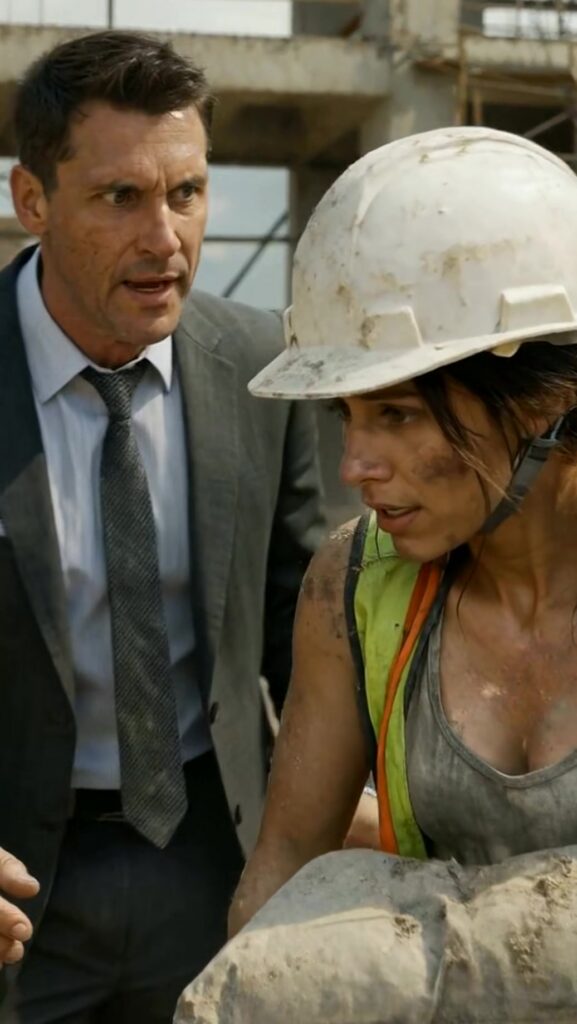
The man who had shouted didn’t belong among rebar and scaffold. His suit was charcoal and sharp, too precise for this grit and heat. Yet he moved through the maze of materials with a speed that made the foremen hesitate—like he’d spent his life charging into places no one wanted him.
He held a phone, not raised to his ear but turned outward, its camera lens open like an eye. It had started as anger—he’d come to see why his project was behind schedule, why invoices bled red, why the contractor’s reports reeked of excuses. He’d come to catch proof, to catch someone slack, to catch any weakness he could crush into compliance.
Then the camera found her.
She was young, and she was bent under the weight of two cement bags that looked too heavy for her shoulders. The fabric of her shirt was gray with powder, clinging to her back with sweat. Her hands trembled as she tried to set the load down without spilling it. On her wrists, thin skin shone raw from rubbing against rope and rough paper sacks.
When his shout hit her, she reacted as if she’d been struck. Her shoulders jumped. Her chin tucked. She turned just enough to show the edge of her face and immediately lowered her gaze to the dirt.
“I’m sorry, sir,” she said, words pouring out fast and practiced. “I wasn’t resting—please don’t fire me.”
There was a crack in her voice at “fire,” like she’d said it before to someone who didn’t care. Like she’d learned to apologize before anyone accused her, because it hurt less than waiting for the blow.
He meant to answer with a cold sentence he’d used a hundred times. He meant to say her name wasn’t on his list, that he didn’t need another excuse, that the company’s patience had limits. He meant to be the man his board expected.
But his words wouldn’t come.
His chest tightened, not with rage but with a sudden wrongness, a feeling like stepping into a room you shouldn’t know and recognizing it anyway. He stared at her face—too long, too still. The anger drained from his expression in stages, leaving confusion and then something that looked frighteningly like grief.
“…those eyes,” he heard himself say.
The woman blinked, startled by the softness in his tone. She glanced up a fraction, just enough for him to see.
Dark eyes, yes—but not simply dark. The particular shape, the slight lift at the outer corners, the way the lashes cast a shadow even through dust. Eyes he’d seen on a photograph so often he could trace the contours in his sleep. Eyes he had once searched for in crowds until his throat burned from calling a name.
He lowered the phone, the camera still recording, forgotten. He took a step closer, slower now, careful, as if sudden movement might shatter something already cracking open.
“What’s your name?” he asked.
His voice was no longer a weapon. It was frayed at the edges, as if it had been held underwater for years and was only now breaking the surface.
She hesitated. Her fingers tightened around the coarse paper of the cement bag. “Lucía… sir.”
The name hit him like a hand to the heart. He swayed, almost imperceptibly, and steadied himself by locking his knees. Lucía. A name he hadn’t spoken aloud in over a decade because it had always sounded like a prayer that went unanswered.
He saw it again—an old hospital corridor, too bright, smelling of disinfectant; a newborn wrapped in pink; his wife’s exhausted smile; the tiny fist clutching his finger. Then, months later, sirens, a smashed car, a missing seat, and a report that used words like “unconfirmed” and “no further leads.” The official conclusion had been an absence. The kind of loss that never ends because it has no ending.
Now the ending stood in front of him, dusty and trembling, asking not to be fired.
His hand lifted without his permission. It shook as it rose toward her hair, fingers spread as if reaching for a ghost.
She froze. Her breath caught. She didn’t pull away—she didn’t understand what she was supposed to do when a powerful stranger reached toward her. Submission had become her reflex.
His fingertips brushed a strand of hair stuck to her cheek. He moved it aside gently, revealing the curve of her neck.
“If you’re… my daughter…” he whispered, the words so thin they barely survived the air.
The world narrowed. Workers and machinery became muted shapes. The sun turned the dust into floating sparks around them. He leaned in, eyes searching with the terror of a man desperate to be right and terrified of what right would mean.
“You’ll have three marks,” he said, swallowing. “Right here.”
He remembered them vividly—three faint birthmarks in a line, like small drops of ink, just below the left ear. He had kissed them once when she was a baby, promising absurdly that nothing in the world would ever touch her.
His fingers hovered above her skin, not daring to press. Lucía’s throat bobbed as she swallowed. She seemed caught between fear and bewilderment, as if the ground had tilted beneath her and she didn’t know which direction was safe.
Then, from behind them, a voice cut through the hush.
“SIR—WAIT—THAT GIRL—”
It was the site manager, Emilio, red-faced and rushing across the gravel. His hard hat was askew, and he looked like a man sprinting toward a disaster he’d predicted but failed to stop. He reached for the suited man’s arm as if to drag him away, then thought better of touching him and stopped short, hands clenched.
“Don’t,” Emilio gasped. “Don’t do that here.”
The suited man—Julián Valera, owner of the company, name on the tower’s steel—turned slowly. His eyes were glass-bright. “What did you just say?”
Emilio’s gaze flicked to Lucía, then to the workers who had begun to edge closer, drawn by the tension the way metal is drawn to a magnet. “Not in front of them,” he muttered. “Please.”
Lucía shifted, instinctively trying to make herself smaller. “I can go,” she said quickly, voice shaking again. “I’ll go. I didn’t mean—”
“No,” Julián said, the word snapping like a rope pulled taut. He faced her again. “Stay.”
Emilio’s throat worked. “Sir… she’s not on the roster. She shouldn’t even be here. She came through an agency. A cash agency.” He lowered his voice, but the fear made it sharp. “We’ve had problems. People disappearing from other sites. Workers who can’t prove where they came from. Papers that don’t match names.”
Julián barely blinked. “And you didn’t tell me.”
“I tried,” Emilio said, desperation spilling out. “Accounting shut me down. Someone in HR signed off. I was told to let it go.”
Julián’s jaw tightened. The tower behind him suddenly felt less like a building and more like a monument to rot hidden under polished surfaces.
He turned back to Lucía, softer again, because whatever else was true, she was not the rot. She was the one who had been used by it.
“Lucía,” he said, tasting the name carefully. “Who brought you here?”
Her lips parted, and for a second she looked like she might finally speak the truth—then her eyes darted over his shoulder, past the scaffolding, toward the gate. A van sat idling there, half-hidden by stacked pallets. Its windows were dark.
In that instant, Julián understood. The threat wasn’t in his memories. It was watching them now.
Lucía’s voice dropped to a whisper. “If I say… they’ll take my brother.”
The words landed like a hammer.
Julián’s hand closed around his phone again, not as a camera anymore but as a lifeline. He started dialing without looking at the screen, eyes never leaving hers. “Listen to me,” he said, and the promise in his tone was no longer absurd. It was dangerous. “No one is taking anyone from you again.”
Behind them, the van’s engine revved, a low growl under the suspended silence, and dust stirred at its tires as if the ground itself sensed the truth rising to the surface—and knew it would cost someone dearly.
Julián stepped between Lucía and the gate, his suit already losing its cleanliness to the site’s dirt, as if the world was marking him with reality. “HEY—STOP!” he shouted again, but this time it wasn’t for the workers.
It was for whoever had stolen a life and tried to bury it under concrete.
And this time, the site did not freeze.
It moved.
Because the truth had been seen. And once seen, it could not be unseen.