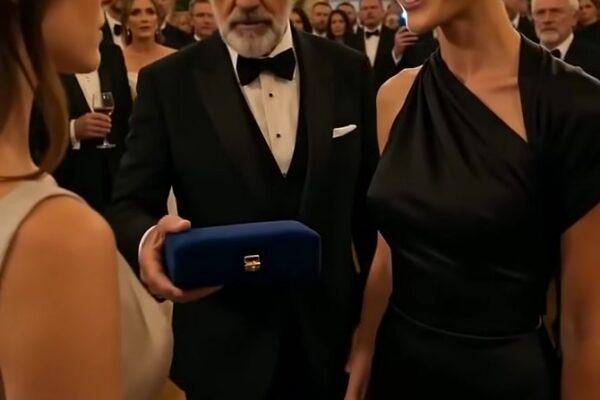
Golden light from dozens of chandeliers spilled across the polished marble floors of the Harrington mansion, sparkling like fragments of distant galaxies. The soft clink of crystal glasses mixed with the low orchestra and the practiced laughter of people who had never needed to whisper. In the ballroom, power was a perfume—senators, investors, surgeons, and stars pressed shoulder-to-shoulder beneath gilded ceilings as if the air itself belonged to them.
Tonight was supposed to be a triumph: Daniel Harrington at forty, the self-made architect of a technology empire, the man who could bend markets with a single sentence. Outside, luxury cars curved through the driveway like a necklace of black obsidian. Inside, the stage waited with its bouquet of microphones and a screen ready to project a highlight reel of victories.
Daniel didn’t watch the guests. He watched the small hand locked around his own.
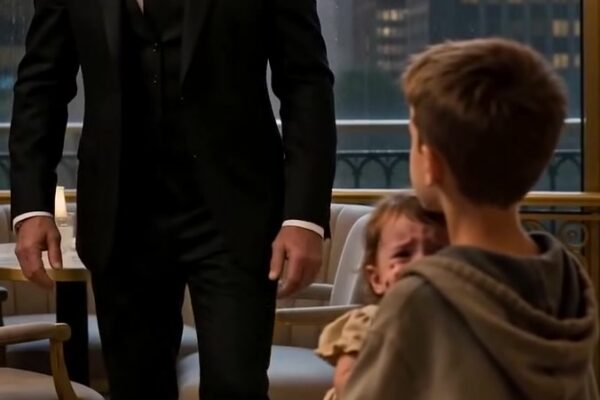
Emily stood beside him in a white dress sewn with silver thread that caught the chandelier light and returned it in shy flashes. She looked like a child dressed for a dream, except her face held the stillness of someone older. Her eyes—wide, brown, and unwavering—didn’t scan the room for attention. They studied it the way a person studies weather, searching for thunder.
She had not spoken in three years.
When Daniel raised the microphone, the orchestra softened as if the strings were exhaling. The hum of conversation drained away. Every guest turned, poised between admiration and appetite. Daniel took a breath that snagged somewhere behind his ribs.
“I didn’t bring you here only to celebrate,” he began, voice steady until it wasn’t. He paused, blinking hard as though the chandelier glare had burned him. “I need help.”
The room shifted—silk brushing silk, men tilting their heads, women hiding surprise behind champagne flutes. Daniel looked down at Emily, and whatever strength he’d built companies with seemed suddenly flimsy.
“My daughter lost her voice,” he said, and the words landed like broken glass. “We’ve seen the best specialists. We’ve tried everything.” He swallowed. “If anyone here can help her speak again… I will pay one million dollars.”
Money, in that room, was usually the end of all questions. But the offer only opened more. Some faces pinched with sympathy; others sharpened with calculation. A few people smiled the way they smiled at auctions, already wondering what leverage might be found in a child’s silence.
Emily tightened her grip on her father’s hand until his knuckles whitened. Daniel did not flinch. He deserved the pain; it was easier than the memory.
Three years ago, the night rain turned the highway into a mirror. Emily had been in the back seat, clutching a toy astronaut while her mother sang softly from the front. Headlights came too fast, too bright. Metal screamed. Glass burst like stars. Daniel arrived at the hospital with blood on his cuffs that wasn’t his, and his wife’s wedding ring pressed into his palm by a nurse who wouldn’t meet his eyes. Emily woke without a scratch—and without a voice.
The doctors gave the condition a name that sounded clean, manageable. Trauma-induced selective mutism. Daniel learned quickly that names didn’t cure anything. He flew therapists across oceans. He bought clinics new wings. He wrote checks that made board members weep with gratitude. Emily learned to communicate through scribbled notes and careful nods. But the sound of her laughter, her questions, her small ordinary complaints—all of it was gone, as if the accident had stolen not only a life, but an entire future’s worth of noise.
Daniel lowered the microphone and stared out at his guests, willing someone—anyone—to step forward with certainty instead of condolences.
A voice rose from the back of the room. Thin, young, and utterly unafraid.
“I can make her speak again.”
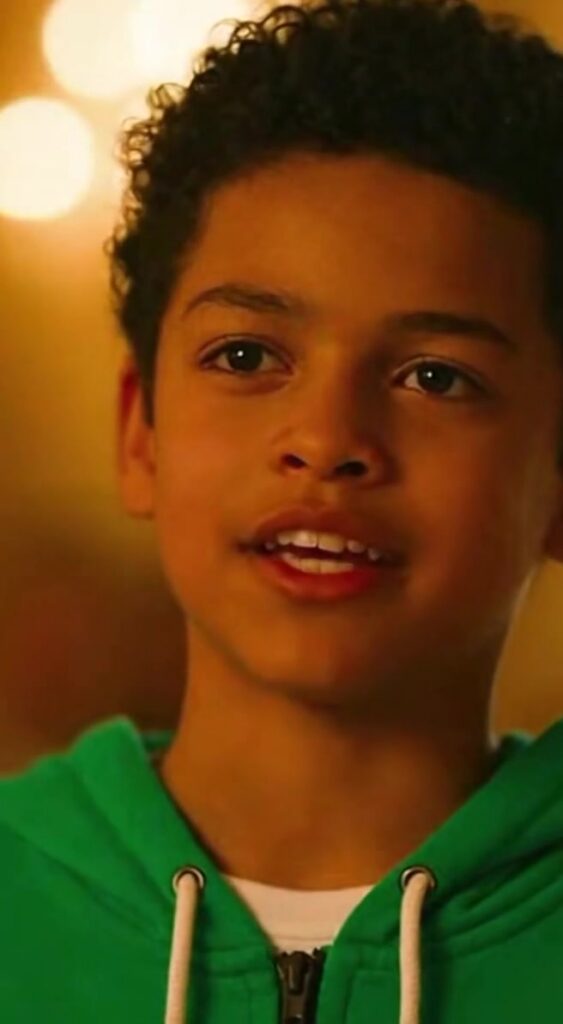
Every head turned at once. Near the entrance stood a boy who looked about nine, his hair in dark, unruly clumps, his clothes too big and too torn to belong inside that mansion. He seemed less like a guest and more like a mistake that had wandered in from the street and refused to apologize for existing.
Two security guards moved toward him with the smooth aggression of men used to escorting discomfort out of sight. The boy didn’t retreat. His gaze stayed fixed on Emily, as if the entire chandeliered universe had narrowed to one silent child.
“Kid,” one guard hissed, “you’re not supposed to be here.”
“I heard him,” the boy said, nodding toward Daniel. “I can help.”
A ripple of mockery traveled through the crowd. A billionaire’s plea interrupted by a grimy child—some guests looked offended, as though poverty were an unsanctioned costume at their gala. Daniel felt heat flare behind his eyes. He had been bleeding in public, and this was the answer the night handed him: a stranger with dirty shoes.
“Who let him in?” Daniel snapped, turning briefly toward his staff. Then, to the boy: “Go do your work. This isn’t a game.”
The words were sharp enough to cut. They echoed off marble and glass. A few people nodded approvingly, grateful for a return to order.
But the boy didn’t react to the insult. He simply stepped forward again, slow and deliberate, until the guards hesitated—uncertain whether to drag him away in front of cameras and senators. The boy’s eyes never left Emily’s face.
Emily, who had avoided strangers for years, was already staring back. Not with fear. With recognition so sudden it felt like a gust through a closed room.
Daniel noticed the change in her posture—the smallest lift of her chin, the way her fingers loosened and then gripped again. It was as if she had heard a sound no one else could hear.
“What’s your name?” Daniel asked, forcing his voice down into something controlled.
The boy swallowed once, then answered plainly. “Noah.”
“And why should I believe you, Noah?” Daniel demanded. He expected a rehearsed lie, a scam, a sad story polished for profit. He expected desperation.
Noah looked at the chandeliers overhead, not dazzled—measuring. “Because she doesn’t need another doctor,” he said. “She needs someone who was there.”
The room tightened. Daniel’s throat went dry. “There where?”
Noah’s gaze dropped to Emily’s hands. “In the rain,” he said quietly. “When the road turned into glass.”
Daniel felt the floor tilt under him. The accident details hadn’t been public. He had paid handsomely to keep them sealed, not out of reputation but out of protection. The idea that this boy could name the night made Daniel’s skin prickle with cold.
Emily’s breathing quickened. She lifted her free hand and, with a tremble that seemed to come from somewhere deep, pointed at Noah. Her eyes shimmered, not with tears yet—like they were holding them back with sheer will.
Noah stepped closer, stopping a few feet away. He didn’t reach for her. He didn’t force intimacy. He simply crouched so they were level, and spoke softly, as if addressing an injured animal that might bolt at loudness.
“You don’t have to talk,” he said. “But you can.”
Emily’s lips parted. Nothing came out. Her throat worked, a painful swallow. Daniel’s heart slammed so hard he thought it might shake sound loose from her by force.
Noah slipped one hand into his pocket and drew out something small: a toy astronaut, its white plastic scuffed and scraped, one arm bent at a wrong angle. Daniel’s breath stopped. Emily’s eyes widened until they looked almost black.
That astronaut had been in the car. Daniel remembered it tumbling across the hospital floor while nurses rushed past. He remembered searching for it later, thinking absurdly that if he could give Emily the toy back, maybe the world could be stitched. It had vanished.
Noah held the astronaut out on his open palm. “You dropped him,” he said. “I picked him up.”
The ballroom seemed to shrink. The chandeliers blurred. Daniel could hear only the blood in his ears and the soft, ragged inhale his daughter took as if she were learning the shape of breath all over again.
Emily reached toward the toy, her fingers hovering before touching it, reverent like prayer. Her shoulders shook once. She looked up at Noah, and then—slowly—at her father.
Her lips moved again. The first attempt was air. The second was a sound so small half the room might have missed it if they’d dared to breathe.
“Da…” she rasped, voice raw as scraped stone.
Daniel’s knees nearly gave out. He clutched the microphone stand for balance, but he didn’t need it—Emily’s gaze held him upright better than steel ever could.
She tried again, tears spilling now, not loud, just unstoppable. “Dad.”
In that instant, all the wealth in the room became meaningless decorations—gold leaf on a world that had almost ended. Daniel’s mouth opened, but no sound came. His face crumpled with relief so violent it looked like grief.
Noah stood, expression unreadable, and slipped the astronaut into Emily’s hands as though returning a lost planet to its orbit. The crowd erupted into murmurs, then applause, then a frantic storm of questions. Cameras lifted. Phones glinted like knives.
Daniel raised a hand, and the noise faltered, obeying the reflex to defer. His eyes never left Noah.
“How?” Daniel whispered into the microphone, voice trembling now without shame. “How did you do that?”
Noah’s gaze flicked to the tall glass doors where rain had started again, tapping at the panes like fingers seeking entry. “I didn’t do anything,” he said. “I just brought her back what she lost.”
Daniel stepped off the stage, closing the distance in three strides. He lowered himself in front of the boy, the billionaire kneeling on marble as if it were an altar. “Tell me what you want,” he said hoarsely. “Money. A home. Anything.”
Noah’s eyes widened for the first time, a flash of child beneath the hardened edges. He shook his head once. “I want you to stop looking past kids like me,” he said. “You have a house full of light. Some of us only ever see it from the street.”
Emily clutched the astronaut to her chest and leaned into Daniel’s side, her small voice scraping its way out again, stronger this time. “Dad… please.”
Daniel closed his eyes, feeling the weight of that single word settle into him like a promise. When he opened them, the chandeliers still shone, but the light no longer looked like distant galaxies. It looked like something reachable—something that could be lowered from the ceiling and placed, carefully, into trembling hands.
He stood, drawing Emily close, and faced the room that had come for celebration and found confession instead. “The million dollars,” he said, voice ringing through the ballroom, “is his.” He glanced down at Noah. “And so is my attention. Starting now.”
Outside, rain washed the driveway clean, each drop a quiet insistence that even the brightest mansions were not separate from the storm. Inside, a child’s voice—thin, damaged, miraculous—began to return, and the people who had come to admire a man’s power were forced to witness something rarer: the moment power finally learned what it was for.