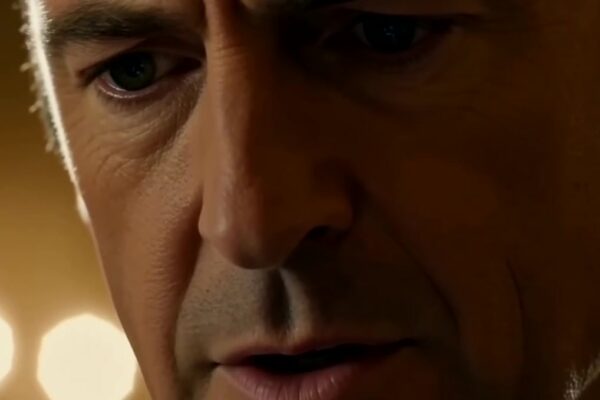
Rain polished the courthouse steps until they shone like black glass. People hurried past the columns with their collars up, their umbrellas like dark flowers turning away from the wind. Inside, the marble foyer smelled of wet wool and old paper—centuries of decisions pressed into dust.
That was where the boy stood.
He couldn’t have been more than fifteen. His sneakers were too thin for the weather, soaked through at the toes, and the sleeves of his jacket ended short of his wrists as if he’d grown out of it too fast. He held a single envelope in both hands, like it had weight beyond paper—like it could swing the building one way or the other.
He didn’t look like he belonged, not among the lawyers with their briefcases and clipped steps, not among the journalists scanning faces for stories, not among the families clutching each other before hearings. He looked like someone’s errand. A mistake.
The guard at the metal detector noticed him immediately. He was a broad man with a square jaw and a patience worn smooth by long shifts. “Hey,” he called, not unkindly. “You lost?”
The boy’s eyes flicked up. Gray, ringed in red from wind or lack of sleep. He shook his head once. His grip tightened on the envelope.
“This isn’t a shelter,” the guard said, lowering his voice as if trying to keep the moment from becoming a spectacle. “If you’re waiting for someone, you can’t wait in here without business.”
“I have business,” the boy replied. His voice didn’t crack, but it held a tremor he couldn’t hide.
The guard’s gaze dropped to the envelope. No seal anyone could recognize, just plain paper, the kind sold in stacks at grocery stores. “What’s that?”
“Something I need to deliver,” the boy said. “To Judge Marrow.”
A snort came from behind the security line, from a man in a navy suit who had the bored confidence of someone accustomed to rooms like this. He was already pushing his belt back through the scanner. “Judge Marrow doesn’t receive notes from kids in raincoats,” he said to no one in particular. “What is this, a school assignment?”
The boy didn’t look at him. He stared past the metal detector toward the hallway where doors waited with brass plaques and rules. “It’s for him. It’s about the Rookbridge fire.”
The air shifted. Just slightly. The Rookbridge fire was the kind of tragedy that never stopped burning in the city’s throat. Three years ago, an old apartment building had gone up in minutes; the official story was faulty wiring, a sad accident, no one to blame. Forty-seven people had died. For a month, the newspapers had run photos of ash-covered windows and teddy bears in plastic bags. Then the city moved on, as cities do.
But the names were still written on sidewalks in chalk whenever anniversaries returned. People still argued in diner booths about how the sprinklers hadn’t worked, how the exits had been chained, how someone should have gone to prison.
The guard’s expression tightened. “You’re not going in,” he said, more firmly now. “If you have something to submit, you can mail it.”
“I tried,” the boy said. “They sent it back.”
“Who sent it back?”
“The clerk,” he answered. “They said it wasn’t proper. They said I wasn’t proper.”
The man in the navy suit—an attorney by the look of his tie clip—leaned closer, amused and irritated all at once. “Listen, kid,” he said, “this isn’t how it works. The judge isn’t your pen pal.”
The boy’s cheeks flushed, whether from cold or anger. He swallowed hard and lifted the envelope, as if presenting it to the room. “It’s not a letter,” he said. “It’s evidence.”
At the word, a few heads turned. A woman with a press badge slowed as she walked past. A bailiff at the far end of the foyer glanced over.
The guard exhaled, and for a moment he looked tired rather than stern. “Evidence for what?” he asked, still trying to keep the moment from expanding.
“For the hearing today,” the boy said. “The appeal. The insurance company. The building owner. They’re all here.”
The attorney’s smile thinned. “This is adorable,” he murmured, and then louder, to the guard: “You can’t let him disrupt proceedings.”
The boy stepped forward. The metal detector beeped a warning as he moved too quickly, and the guard held out an arm to stop him. The envelope brushed the guard’s sleeve—cold, damp paper, ordinary as a grocery receipt.
“You don’t understand,” the boy said, and his voice broke on the last word. He blinked rapidly, like he refused to let anything spill. “They’re going to say it was an accident again. They’re going to wash it clean. If they do that, my mother stays dead in their paperwork forever.”
Silence snapped in around him. Even the attorney paused, the mockery on his face suddenly less certain.
The guard looked at the boy more closely now—the raw knuckles, the trembling hands, the way his shoulders held themselves as if braced against a blow. “What’s your name?” he asked.
“Noah Vance,” the boy said. “Apartment 7C. Rookbridge.”
The press woman’s eyes widened at that. “Vance?” she repeated softly, as if tasting the name for recognition. “You were one of the survivors.”
Noah didn’t answer. He stared at the hallway, toward the doors where grown people decided what counted as truth.
The guard lowered his arm an inch. “What’s in the envelope, Noah?”
Noah’s throat worked. “A memory card,” he said. “And a key.”
“A key to what?” the attorney asked, impatience returning as a shield.
Noah turned toward him for the first time. In his eyes was something older than his face. “To a storage unit,” he said. “My mother rented it under a different name. She didn’t tell anyone. She didn’t even tell me. I found the paperwork in a cookbook after… after everything.”
The attorney’s mouth opened, but no sound came. He glanced, involuntarily, toward the courtroom corridor.
“What’s in the unit?” the guard asked, and his voice was quieter now.
Noah drew in a breath that shook. “Records,” he said. “Invoices. Photos. Copies of inspection reports that disappeared. And a video.”
“A video of what?” the press woman demanded, stepping closer, her badge swinging.
Noah held the envelope against his chest. “Of the night before the fire,” he said. “My mom worked late at the building office. She was cleaning out a drawer when she heard the owner’s manager on the phone in the hallway. She started recording because—because she was scared. She thought it was about money. It was about the alarms.”
The guard’s jaw clenched. The attorney’s face had gone pale in a way that made him look suddenly younger, less polished.
“You’re lying,” the attorney said, but it landed with no conviction.
Noah’s hands trembled so hard the envelope crinkled. “I’m not,” he whispered. “He says it. He says they’re disabling the system for ‘testing’ because the city inspector is coming, and the fines would be worse than ‘a little risk.’ Those are his words. He laughs.” Noah’s voice rose, ragged. “He laughs.”
For a moment, no one moved. The courthouse felt like a held breath.
Then the guard looked over his shoulder and called down the hallway, sharp and clear. “Bailiff! Get the clerk. Now.”
Footsteps echoed. The press woman lifted her phone but hesitated, sensing the gravity of the moment more than the opportunity. The attorney stepped back, as if distance could save him.
Noah stood perfectly still, rainwater dripping from his hair to the marble floor. “They tried to send me away,” he said to no one in particular, voice small again. “I almost left. I almost believed them.”
The guard turned to him, and his sternness had softened into something like respect. “You did the right thing coming here,” he said.
Noah shook his head once. “I didn’t come to be brave,” he replied. “I came because she can’t.”
The clerk arrived with the bailiff, flustered, and behind them—unexpectedly—Judge Marrow himself, drawn by the commotion. He was an older man with a tired face that had learned to hide emotions behind neutrality. But when he saw Noah, something flickered. Recognition? Or the sudden awareness that the building’s weight had just shifted.
Noah raised the envelope toward him. His arms were thin, but they did not waver.
“Your Honor,” he said, and the words seemed too formal for his soaked jacket, his trembling hands, his bruised adolescence. “My mother left this for today. She didn’t know she’d be gone. But she knew someone would try to make it quiet.”
Judge Marrow stepped closer. The foyer held its breath again.
And when Noah placed the envelope into the judge’s hands, it was as if the rain outside finally found a way inside the courthouse—cold, relentless, impossible to ignore.
“Open it,” Noah said, voice steady now, as though he’d handed off not paper, but fate. “Please. Before they send me away again.”