He had billions and the kind of influence that made airport lines disappear. People called him “sir” before they knew his name. He owned whole city blocks the way other people owned shoes. If a country’s minister needed a favor, they didn’t dial a hotline—they dialed him.
And none of it mattered in the small, too-bright hospital room where his daughter’s world kept shrinking.
Mina was seven and stubborn in the exact way he secretly loved. She used to race him down the hallway of their penthouse, hair flying, laughing like the air itself was funny. Now she sat very still, head angled slightly as if listening for something that wouldn’t come. Her eyes looked normal—clear, brown, bright when she smiled—but the light inside them was fading, like a dimmer switch someone kept turning down without permission.
“Is it blurry?” he’d ask, trying to keep his voice steady.
“A little,” she would say. Then, quieter: “It’s like the corners are disappearing.”
He had flown in specialists like they were catering. London, Dubai, New York. Private jets, private suites, private consultations that ran into the early hours. Men and women with perfect hair and calm hands sat across from him with scans displayed on tablets, using careful words that sounded expensive and helpless at the same time.
Degenerative. Rare. Aggressive. Unpredictable.
They tried everything—therapies with long names, pills that came in tiny foil squares, experimental treatments whispered about in research wings. Nothing held. The only reliable trend was the calendar marching forward and Mina’s vision stepping backward.
He did what he always did when faced with a problem: he tried to purchase the solution. He donated millions to foundations he’d never heard of before. He offered to build labs, endow chairs, fund entire teams. He called in favors from people who owed him their careers.
The universe did not negotiate.
One afternoon, after another appointment that ended with “We’ll monitor,” he couldn’t bear the antiseptic glow of the hospital any longer. Mina had been quiet the whole ride, her fingers tracing the seam on the leather seat as if it were a map. The driver asked where to go. He surprised himself by saying, “The park.”
It was the kind of park he’d helped renovate with a donation years ago. His name was on a plaque near the fountain, the letters polished and smug. He hadn’t noticed it in a long time.
They sat on a bench that burned through his suit pants because the day was brutally hot. Even the air felt impatient. Mina’s hand in his was smaller than he remembered, her skin a little too warm. Around them, the city moved on—joggers with earbuds, toddlers arguing over a plastic shovel, a man selling bottled water from a cooler like it was contraband.
Mina tilted her face up toward what she couldn’t fully see. The sunlight hit her cheeks and she smiled, trying to pretend it was just a normal day.
“Daddy,” she said, in the soft voice she used when she was about to ask for something. “Is it nighttime already?”
His chest tightened so fast he thought he might actually make a sound. Nighttime. At two in the afternoon. He looked up at the sky—an impossible blue—then back at her, and he saw the effort in her expression, the way she was forcing her eyes to make sense of a world that was slipping away.
He lied without thinking. It came out smooth, practiced, the kind of lie that had once protected stock prices and business deals.
“Not yet,” he said, forcing a smile. “Still daytime. The sun’s just… hiding a little.”
Mina nodded like she accepted it, but her fingers tightened around his, and he hated himself for the comfort he’d tried to wrap around a truth that couldn’t be softened.
Seconds later, a shadow fell across the ground in front of them—sharper than the others, like a curtain being pulled.
He looked up, expecting a passerby.
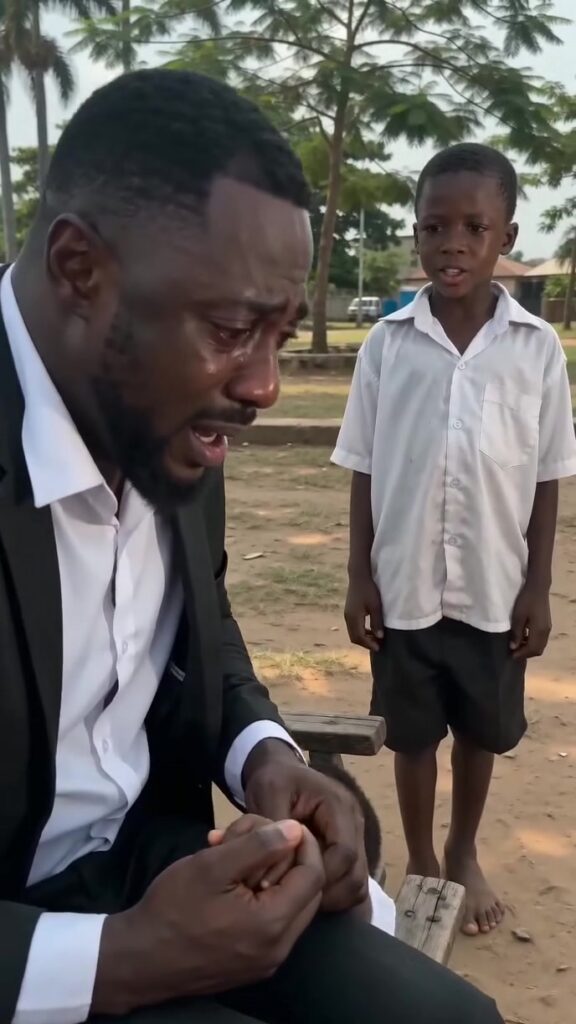
A boy stood there. Barefoot. Not homeless-barefoot, not “lost his shoes” barefoot. His feet looked clean, like he’d simply decided shoes were optional. He wore shorts and an oversized T-shirt with a faded cartoon animal on it. His hair was messy, sun-lightened, and his eyes were the strange part: too steady, too old for his face, as if he’d already watched a thousand endings and didn’t flinch anymore.
“You shouldn’t tell her that,” the boy said.
His voice was calm, not accusing—just certain.
The billionaire’s security team wasn’t with him. That was the point of the park. Privacy. He felt suddenly exposed, like he’d left the vault door open.
“Excuse me?” he asked, keeping his tone polite out of habit.
The boy nodded toward Mina. “You shouldn’t tell her the sun is hiding. That makes it sound like the sun chose to leave her.”
Mina turned her head, searching. “Who is that?” she asked, aiming her question into the warm air.
“Just a kid,” he said, but the words tasted wrong. “Sweetheart, stay close.”
The boy didn’t move closer. He didn’t need to. He had their attention like a hook.
“You’re Eli Ravan,” the boy said, pronouncing his name perfectly, the way only people who feared him or studied him did. “You own the towers, the ports, the banks. You bought that park.”
Eli’s throat went dry. “Who are you?”
The boy looked at Mina again. His expression softened in a way that made Eli furious—who was this child to look at his daughter like he understood her suffering?
“I’m someone who hears things,” the boy said. “Like when people lie because they think the truth will break someone.”
Eli felt his pulse in his wrists. “Get lost.”
The boy didn’t blink. “She asked if it was nighttime because it feels like nighttime to her. You can’t buy daylight back with money.”
Eli’s blood ran cold. Not because of the insult—he’d been insulted before—but because the boy’s voice carried the weight of a diagnosis no doctor had dared to say out loud: that Mina’s darkness wasn’t temporary. That it was coming for good.
Mina’s hand trembled in his. “Daddy, what’s he saying?”
Eli swallowed. “Nothing, baby. He’s just—”
“He’s saying you’re scared,” the boy interrupted, still calm. “And you should be. But not because of the dark.”
Eli stared at him. “Then because of what?”
The boy pointed—not at Mina, but at Eli’s chest, right where his heart hammered against expensive fabric.
“Because you’ve been paying everyone to fix her eyes,” the boy said, “and you haven’t asked her what she still wants to see.”
The words hit like a slap because they were absurd and accurate at the same time. Eli had been fighting the disease like it was a hostile takeover. He’d been treating Mina like a problem to solve, not a person watching her own world dim.
Mina’s voice came out small. “Daddy… I want to see the ocean again.”
Eli’s mouth opened, but nothing came out. The ocean. Last summer. Her squeal when the waves chased her ankles. The way she’d begged him to build a sandcastle even though he’d been on calls, pacing like the shore belonged to him too.
He looked back at the boy. “Who are you?” he asked again, quieter this time.
The boy’s eyes were unreadable. “Someone who knows that time is the only thing you don’t own.”
Then, as if delivering the final line in a story Eli didn’t want to hear, the boy added, “If you keep lying to her, she’ll start lying to you. She’ll pretend she’s okay so you don’t fall apart. And you’ll miss what’s left.”
Eli felt something in him crack—something he’d kept reinforced for decades. He squeezed Mina’s hand, suddenly terrified of how easily a moment could slip away.
“Mina,” he said, voice breaking despite his best effort, “it’s not nighttime. It’s very bright out. But… I think it might feel like night to you. I’m sorry.”
Mina was silent for a second. Then she leaned her head against his arm, trusting him anyway. “Okay,” she whispered. “Can we go to the ocean?”
He nodded too fast. “Yes. Today. We’ll go today.”
When he looked up to tell the boy—what? Thank you? Go away?—the space in front of the bench was empty.
No footsteps fading, no rustle of leaves, no kid weaving through strangers. Just sunlight, hard and honest, on the pavement.
Eli’s skin prickled. He scanned the park, heart racing. People walked, laughed, bought water, lived ordinary lives. No barefoot boy.
He looked down at Mina. “Did you hear him?”
She nodded slowly. “Yeah,” she said. “He smelled like… rain.”
Eli stared at the cloudless sky. Rain was impossible.
“Daddy?” Mina asked, tugging gently at his sleeve. “When we go to the ocean… will you tell me what it looks like the whole time?”
He swallowed, feeling the weight of everything he’d tried to outrun with money. “I will,” he said. “Every second.”
As he stood to lift her into his arms, his gaze flicked to the plaque by the fountain—his name shining like it meant something. For the first time, it looked like a joke.
And somewhere in the back of his mind, colder than fear and sharper than grief, the boy’s warning echoed: time was the only thing he didn’t own.