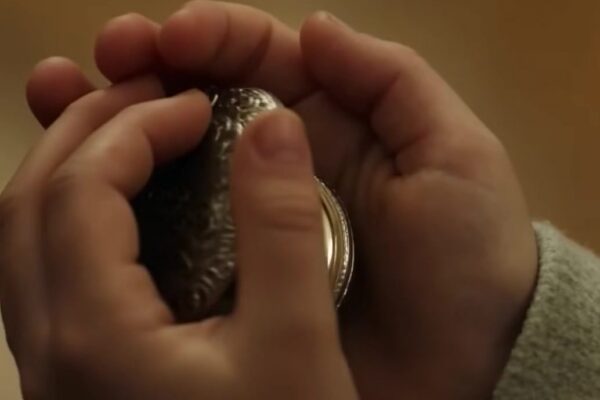
The first time Julian Hawthorne saw the gold pocket watch after the night Lenora disappeared, it was in a dream that tasted like iron. He would be in the corridor outside the nursery, the house dark except for the watery glow of stormlight through stained glass. He’d hear the thin, polite tick as if time itself were trying to sound innocent. He’d open his hands and find the watch there, warm as skin, and on its lid the family crest gleaming with the same stubborn pride it had always worn. Then the lid would spring open, and instead of hands and numbers, there would be Lenora’s eye staring up at him—wide, accusing, alive.
He woke from that dream for years with his fingers curled into a fist, nails biting his palm, as if he’d been holding on to something that kept slipping away.
On a wet Thursday in October, the watch returned to him in daylight.
Julian was in the music room, signing ledgers he hadn’t read, the way a man does when grief has become a vocation. Rain tapped the tall windows. The house smelled faintly of beeswax and old flowers, the scent of wealth that refused to admit it could rot. He heard the door open softly and assumed it was his mother’s nurse bringing her afternoon tea. Instead, it was the new maid—small, pale, hair pinned too tightly under her cap. Her name was Mara, or Mary, or something that sounded like the first note of a lullaby. She stood at the threshold as if the room might bite.
“Mr. Hawthorne,” she said, voice brittle. “I—I found something. In the laundry. In the pocket of your father’s old coat. I thought you’d want it.”
In her gloved palm lay a gold pocket watch.
Julian’s pen stopped mid-stroke. For a second the ticking in the room wasn’t from the rain or the grandfather clock—it was from that object, as if it had carried its own heartbeat into the house. The air cooled. Something behind Julian’s ribs went quiet and hard, as though a door had slammed shut.
He stood so quickly his chair skidded. “Where did you get that?”
Mara flinched. “I told you—”
He crossed the room in three steps and took the watch from her. It was heavier than he remembered, or perhaps his hands were less steady. The metal was scratched at the edge, a small bruise on a thing that had once been immaculate. He held it up near her face, close enough that she had to focus on it or close her eyes.
“This watch belonged to my grandfather,” he said. His voice was precise, sharpened by years of unsaid things. “My sister had it the night she vanished. The police wrote it into their report. They said it was the last item of hers anyone saw. Why is it in your hand?”
Mara’s throat bobbed. Then her composure broke like a thin plate. She began to cry—quick, hot tears that didn’t look like guilt so much as injury.
“I didn’t steal it,” she said, words tumbling. “I swear. I’ve had it since I was little. Since the orphanage. It’s the only thing—” She pressed her fists against her mouth, as if trying to keep the rest of herself from spilling out. “It’s the only thing I have that felt like it came from… somewhere. From someone.”
The room filled with her sobbing and the stubborn tick of the watch. Julian’s anger, poised to strike, faltered—not because he believed her, but because the grief in her sounded practiced, the kind you learn when you’ve been accused of taking things you didn’t ask for.
Behind him, the hallway creaked.
His mother stood in the doorway with a teacup on a tray. Lydia Hawthorne wore her mourning like a second skin—black lace even in daylight, pearls that looked like frozen tears. She had come, as she always did, to hover near Julian without knowing how to touch him. The moment she saw the watch, her fingers loosened.
The cup slipped. Porcelain struck the wood and shattered with a sound too bright for the room. Tea spread in an amber pool between white shards.
Julian turned at the crash. His mother’s face had drained of color so swiftly it looked like the house had stolen it. Her mouth opened, closed. Her eyes fixed on the watch as if it were a weapon.
“Mother?” Julian said, but the word didn’t reach her. She was already trembling.
Mara, still crying, looked between them, baffled. “I’m sorry,” she whispered. “Please don’t send me away. I didn’t mean—”
Julian ignored her. His thumb slid across the back of the watch where, as a boy, he’d traced the engraving and asked his grandfather why metal needed initials. He turned it under the lamplight. The engraved letter caught, bright as a cut.
L.
It wasn’t just any L. It had the thin flourish his father insisted upon, the final stroke curling like a question mark. Julian had watched his father approve the design, impatient, the week before Lenora disappeared. “She must have something lasting,” his father had said, as if permanence could be purchased and fastened to a chain.
Julian’s breath tightened. The room narrowed. The sound of rain and distant thunder retreated until there was only the ticking in his palm and the ragged pull of Mara’s sobs.
“That—” Julian began, and couldn’t finish.
His mother took one step into the room and seemed to age a decade in it. Her hands hovered at her throat, as if the air were suddenly too scarce.
“Son,” she said, voice fractured. “There is an initial engraved on the back.”
“I can see that,” he snapped, then immediately regretted the harshness. He looked from his mother to the maid, and back again. Mara’s eyes were red-rimmed, terrified, pleading for a verdict.
Julian held the watch out toward Mara. “Where did you get it?” he demanded again, but this time the question felt like it belonged to the world, not to her.
“In the orphanage,” she said, shaking. “They said it was found with me. Around my neck, on a chain. I was too young to remember. Sister Agnes kept it locked away and gave it to me when I turned sixteen. She said it was proof that I… that I was not nothing.”
Lydia made a sound that wasn’t quite a sob and wasn’t quite a laugh. Julian watched his mother’s lips press together as if she were trying to hold a confession inside her like poison.
“Mother,” he said, suddenly softer. “What is this?”
His mother’s gaze lifted to Mara, and the look in it was so raw Julian almost stepped between them. It wasn’t hatred. It wasn’t recognition in the simple sense. It was the expression of someone seeing a ghost and realizing she had been the one to bury it.
Lydia’s knees buckled slightly, and she gripped the doorframe. “Close the door,” she whispered.
Julian didn’t move. “Tell me.”
Lydia’s chest rose and fell in sharp, uneven breaths. Then she said the sentence that made the air in the music room collapse into a strange, dead quiet.
“Your sister,” Lydia whispered, each word dragged out as if it tore at her mouth, “was not the child we lost that night.”
Julian stared at her, not understanding—his mind refusing the shape of what she was offering. He heard Mara give a small, broken sound, a question she couldn’t form. The watch in Julian’s hand ticked on, indifferent and relentless.
“What are you saying?” Julian asked. “Lenora was—Lenora was—”
Lydia shut her eyes. When she opened them again, there was water on her lashes. “There was a fire,” she said, voice thin. “Do you remember? You were eight. Your father and I told you the smoke confused you, that you imagined the shouting. But there was a fire in the servants’ wing. And in the panic—” She swallowed. “In the panic, a nurse brought me a baby. She said it was Lenora. She was crying, and her face was smudged with soot, and I… I clutched her like salvation.”
Julian’s stomach turned cold. “And?”
Lydia’s gaze flicked to Mara, who stood rigid as a statue, tears still sliding down her cheeks. “And I never asked why the baby had a watch engraved with our daughter’s initial,” Lydia said. “Because the truth was standing right in front of me, and I was too desperate to see it.”
Julian’s fingers tightened around the watch until its edges bit his skin. “Where is Lenora?” he whispered.
Lydia’s voice became a confession and a prayer. “I think,” she said, “that Lenora was carried out of this house and left where no one would look. And the child we raised—your sister in every way that mattered after—” Her breath hitched. “She belonged to someone else.”
Mara’s eyes widened as if the room had tipped. “No,” she said. “No, I’m— I’m just—” She shook her head hard, as if she could shake the words off. “I’m nobody.”
Julian looked at her then—really looked. The curve of her brow, the set of her jaw, the way she held herself as though braced for impact. There was something familiar there, not from memory but from portraits in the long gallery—faces that had looked out over generations with the same stubborn line at the mouth.
The watch ticked, and ticked, and ticked.
Julian felt the old grief rearrange itself, not disappearing, but shifting into a sharper, more dangerous shape: possibility.
He opened the watch. Inside, beneath the lid, a tiny photograph was tucked behind the glass—faded, nearly rubbed blank. Two children stood in a garden: a boy with solemn eyes and a girl in a white dress with a ribbon. Julian’s throat clenched. He recognized his own face, younger, and beside him Lenora’s smile like sunlight.
Except the girl’s eyes were not Lenora’s.
They were Mara’s.
Julian lowered the watch slowly, as though it might explode. He met Mara’s gaze, and for the first time, her fear was mirrored by his.
In the doorway, Lydia Hawthorne slid down to the floor among the tea-stained shards, weeping with a violence that sounded like years finally breaking loose.
Outside, the rain intensified, drumming on the windows as if the sky itself demanded answers. And in Julian’s palm, time kept moving forward—patient, merciless—while the past, long buried under polished floors and family stories, clawed its way into the light.