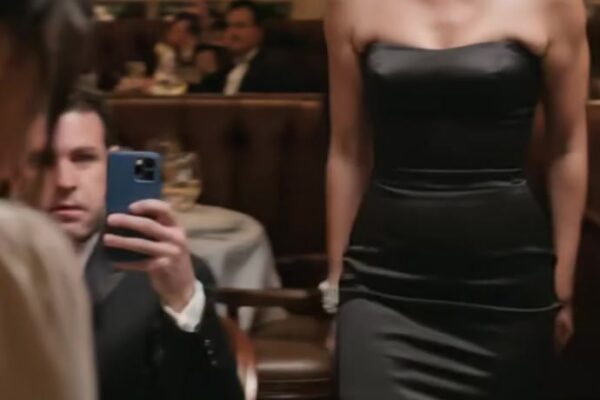
“I’ll give you ten thousand if you open it,” he smirked, loud enough for the chandelier crystals to catch the words and throw them around the ballroom. Laughter exploded on cue. In the glittering crowd—men with cuffs like mirrors, women with perfume that smelled like threats—phones rose as if trained. The safe stood against the far wall like a gilded altar, its surface polished to a theatrical shine, a trophy meant to be admired, not challenged.
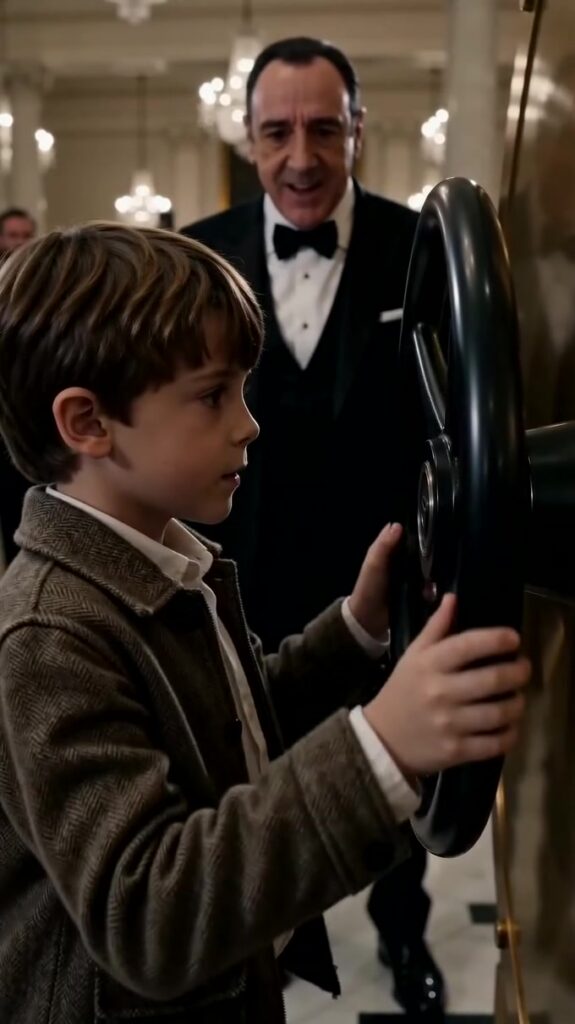
The boy did not laugh. Eight years old, a brown tweed jacket buttoned neatly to his throat, hair combed as if someone had taken great care and then walked away. He simply walked—steady, unhurried—toward the safe. At first the guests cheered the spectacle, delighted by the idea of a child embarrassed for money. But as he crossed the marble floor, the laughter thinned. Something in his composure unsettled the room, like a candle that refuses to flicker in wind.
He reached the door of gold metal and placed his small hand flat against it, fingers spread. Not a boy admiring wealth—more like someone greeting a familiar gravestone. He closed his eyes, and the closest phones zoomed in, hungry for the moment his confidence would break. Instead he leaned forward and set his ear to the dial, cheek pressed to the cold, listening as if the safe had a pulse.
Behind him, the rich man—Mr. Halden, patron of charities and destroyer of competitors—lifted a glass and made a show of generosity. “Go on,” he said. “Turn it. Prove the fairy tales wrong.” The boy’s head tilted slightly, not toward the safe but toward Halden, as if the boy had heard a different sound: a tremor in the man’s voice. “Are you certain?” he asked. It was a small question, but it sliced through the room. A few murmurs rippled, then died.
Halden laughed once, sharp. “Open it.”
The boy’s fingers curled around the wheel. He turned it slowly, pausing between degrees with the patience of someone counting steps down into a cellar. The safe answered with a faint internal tap. One of the women near the front lowered her phone without realizing she’d done it. Another tiny metallic click followed. Halden’s smile stiffened. He set his glass down as if it had become heavy. “Who showed you that?” he demanded, and for the first time that night his voice was not performance but fear.
The boy did not look away from the dial. “No one showed me,” he said softly. “My father made this lock.” He spoke it without drama, as if stating the weather, and yet a hush collapsed over the ballroom. The musicians stopped on a wrong note. You could hear the pocketed breath of every guest.
Halden stepped forward too quickly, reaching as if to snatch the air from the boy’s mouth and put it back in. His hand clamped around the boy’s arm. “Stop.” The word cracked. Several people flinched; none moved. The boy turned at last, eyes level with Halden’s belt buckle but unwavering, and asked with a calm so absolute it felt rehearsed by something older than childhood, “Why? Is your name still in there?”
Halden’s face drained. He stared at the safe as if it had begun to speak. “Don’t—” he started, then swallowed the rest. Another heavy shift echoed from within, the sound of mechanisms conceding. The boy resumed turning. The final lock released with a sound like a door closing in a storm: decisive, loud, impossible to pretend you didn’t hear.
The boy slipped free of Halden’s grip—not with a jerk, not with anger, but with a simple withdrawal that suggested he’d never belonged to the man’s hand in the first place. He pulled the handle. The safe opened a finger’s width, and an unexpected breath of cold air crawled out, raising gooseflesh on the nearest wrists. The crowd surged without thinking, people leaning in as if the safe contained the missing piece of a story they’d been fed for years.
“Close it!” Halden shouted, suddenly hoarse. “Security!” He looked over shoulders, searching for uniforms, for authority, for anything loyal. But the guards at the doors stood frozen, faces pale, eyes fixed on the boy. Perhaps they’d heard rumors. Perhaps the boy’s voice carried a truth that outranked paychecks.
The safe door swung open wider. There were no stacks of cash, no diamonds, none of the decadent secrets the crowd had imagined. Inside sat a single leather folder with the company crest pressed into its cover, a faded photograph, and a silver pocket watch ticking loudly in the dark, the sound unnaturally sharp—as if the safe amplified time itself.
The boy reached in and picked up the photograph first. It showed a younger Halden in a cheap suit, arm slung around another man whose eyes, even in the worn print, matched the boy’s. The other man’s smile was small but steady, the smile of someone who trusted. Halden made a sound that was not a word. “That’s—” he whispered, but the syllable died, strangled by recognition.
The boy turned the photograph outward for the room to see. “My father,” he said. A collective inhale swept the guests; even the chandelier seemed to hold its light. The boy lifted the leather folder next. The crest stamped on it—the Halden Group—was familiar to everyone in the room, emblazoned on walls, invitations, donor plaques. He opened it with careful hands. Inside were contracts, not glittering but lethal: signatures, dates, clauses with the sharpness of knives. The ink looked old and yet alive.
“He said you would hide what you couldn’t burn,” the boy told Halden, flipping to a marked page. “Somewhere only the sound of your own conscience could keep you company.” He glanced at the watch, and its ticking seemed to swell, a metronome for guilt. “You used his designs to build your empire. You used his name to seal your deals. Then you erased him.” His finger traced a line of legal language, then stopped on a name written smaller than the rest, as if someone had tried to make it disappear.
Halden stumbled backward, knocking into a table. Glassware chimed like alarm bells. “You don’t understand,” he said, but he was pleading now, not commanding. He looked at the crowd and found no allies. They watched with the hungry stillness of people seeing the truth as entertainment—until it became too real. The boy’s voice lowered. “You stole everything,” he said. His gaze did not waver. “The patents. The company.” A pause, long enough for the pocket watch to count several heartbeats. “And then you stole me.”
A tremor ran through Halden’s jaw. He searched the boy’s face as if trying to find a lie to grab onto, something childish to dismiss. “That’s impossible,” he whispered. “You were—” He stopped, because every explanation required naming the crime. The boy reached into the safe once more and took out the pocket watch. On its back was an engraving worn smooth at the edges: a name, and beneath it, a date that matched the boy’s birthday.
“He left this with instructions,” the boy said, and the room leaned toward him like a tide. “If I ever came to the place where people laugh at locks, I was to open the one built with his hands. I was to bring time back into the room.” He lifted the watch, its ticking steady and merciless. “He said the truth would arrive when you stopped hearing anything but yourself.”
Halden’s knees seemed to forget their purpose. He gripped the edge of the table, eyes slick with panic. “You can’t do this,” he hissed. “Not here.”
“Here is exactly where,” the boy answered. He slid a page from the folder and held it up—an assignment of rights, a confession tucked into legal language, a signature that tied Halden to the disappearance of the man in the photograph. Then he looked out at the glittering crowd and spoke with the simplicity of a verdict. “You offered me money to open a safe,” he said. “But you built your fortune on keeping it closed.”
Phones began recording again, but now the guests were not laughing. They were witnesses. The ticking of the watch filled the ballroom as if time itself had stepped forward to testify. Halden stood in the center of his own celebration, surrounded by crystal and silence, and watched an eight-year-old boy hold the weight of a man’s sins with hands that did not tremble.
The boy placed the photograph on the safe’s ledge like a marker on a grave. He tucked the folder under his arm. Then, without rushing, he turned and walked back across the marble floor—past the champagne, past the frozen smiles, past Halden’s collapsing world—carrying the sound of the watch like a small, steady thunder.
At the doors he paused and looked back once. Not in triumph. Not in cruelty. Only in certainty. “Ten thousand won’t be necessary,” he said. “I came to collect what he couldn’t.” Then he left the ballroom with the contracts, the photograph, and the ticking proof that some locks are made to keep monsters in—until the right hands return.