The Juniper Spur Diner sat where the highway went straight as a dare, sun-baked and shimmering at the edge of Arizona’s brutal noon. Heat pressed on the windows until the glass looked warped, turning the world outside into a wavering mirage of chrome and cactus.
Inside, it was a different climate—cool air fighting the desert, laughter bouncing off old tin signs, forks scraping plates, and the low thunder of engines idling in the lot like an animal sleeping with one eye open. Two hundred bikers packed booths and stools and leaned against the counter in black leather that creaked when they shifted. There were patches stitched with history, some worn down until the thread shone like scar tissue.
In the back, beneath a faded photograph of the Mother Road, Travis Hale sat with his hands around a black coffee. He had the kind of stillness men earned, not inherited. His hair was darker at the temples than it used to be, and his jaw held a tension that didn’t relax with time. A silver band marked his left ring finger; if he touched it, he did so without looking.
The bell above the front door jangled every few minutes, swallowed by noise. Then the door didn’t open—it detonated inward. Wood slammed against the wall so hard the bell whipped and struck the glass, ringing sharp and wrong. The diner’s laughter snapped off as if someone had cut power.
A thin man stood in the doorway, pale as the underside of a fish, eyes too big in his face. His shirt hung on him like borrowed fabric. He dragged a tiny girl by the wrist. She wore mismatched shoes—one sneaker, one Mary Jane—each scrape loud on the tile in the sudden quiet. Her other hand clutched a torn corner of a pink backpack strap, as if it was the last piece of something she’d had before.
The room turned as one. Leather shifted. Boots stopped tapping. A few hands moved, casually and without hurry, toward belt lines. Someone near the counter murmured, barely audible, “You seeing this?”
Travis didn’t blink. “Yeah.”
The thin man looked at the wall of bikers like he’d stepped into the wrong church. He forced a smile that didn’t reach his eyes, then shoved the girl into a booth too hard. “Sit,” he hissed. He pivoted toward the counter, the performance of normality already wobbling.
The waitress—Marlene, with a pencil tucked behind her ear and a face that had seen enough drama to hate it—froze with a pot of coffee half-tilted. “Sir?” she began.
The thin man’s voice came out too loud. “Just—just water. For her. And… and whatever.”
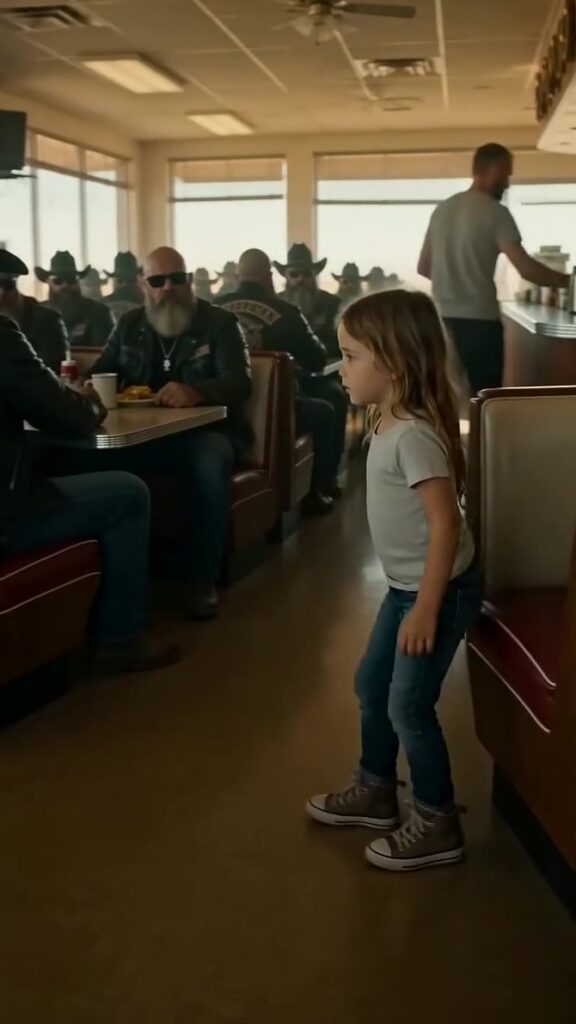
The girl sat rigid, knees pulled in, eyes fixed on nothing. For one heartbeat she looked like she might disappear. Then she slid off the booth, one careful motion, and started walking down the aisle between rows of men who could have been statues.
She moved like a person crossing a river on slick stones. Nobody stopped her. Nobody spoke. They watched, and in that watching there was something like permission. Like recognition.
She reached Travis’s booth and tugged the edge of his vest. His patch—Hale’s Highwaymen—was cracked from years of sun and rain, but the stitched letters still looked like a vow.
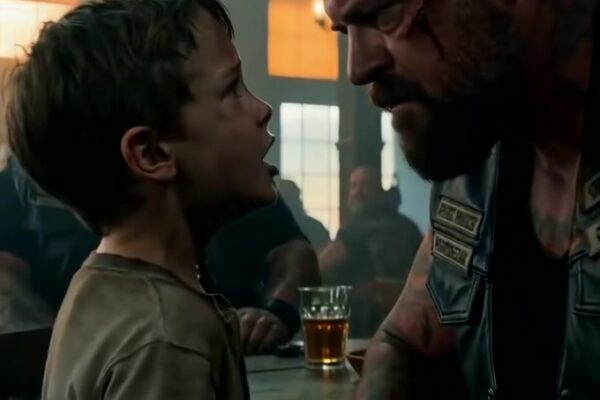
Travis leaned down, bringing his ear close to her mouth. Her lips trembled. “That’s not my dad,” she whispered.
Silence didn’t simply fill the diner. It detonated.
Travis rose so fast his chair snapped backward, scraping tile. In the same instant, the diner’s leather tide stood with him. Boots hit the floor in a single heavy wave that made the condiment bottles tremble. The thin man spun around, his smile vaporized into raw panic. His hand dove inside his jacket and came out with something metallic.
Marlene screamed.
For a sliver of a second, the shape in his hand promised a gun or a blade, some cheap ending. But it was smaller, gleaming in the fluorescent light: a silver baby rattle. Its surface was engraved with a name worn deep enough that time couldn’t erase it.
EMILY.
Travis stopped mid-step as if an unseen fist had grabbed his chest. Color drained from his face, leaving the lines around his eyes stark. Around him, men who had ridden into storms and bar fights and funerals held their breath like boys.
The little girl looked up at Travis, tears spilling without sound. “He said if I showed you that…” Her voice broke. She swallowed and tried again. “…you’d listen.”
The thin man backed toward the door, shaking the rattle as if it could protect him. “I didn’t hurt her,” he blurted. “I didn’t—this isn’t—” His gaze skittered to the bikers. “I’m just the driver. Just the driver.”
Travis’s voice came out low, the kind of quiet that made people step back. “…Where did you get my daughter’s rattle?”
The thin man’s eyes flicked to the girl, then away, and his throat bobbed. “I was paid,” he said. “I was told to bring her here. That’s it.”
“Who paid you?” Travis asked. He didn’t move closer, but the men behind him shifted, forming a net with their bodies.
The girl wiped her cheek with the back of her hand, leaving a wet streak. “He says my real mom is waiting outside,” she whispered, like the words were a match she was afraid to strike.
The diner’s windows were bright with sunlight; outside, the motorcycles glinted like a field of knives. Travis turned slowly toward the glass, the rattle’s faint jingle echoing in his head from years ago—a nursery light, a lullaby, a night he had tried not to remember because remembering was an open wound.
There, beside the line of bikes, stood a woman in the heat shimmer. She wore a wide-brim hat that shadowed her face, but Travis recognized the way she held her shoulders, as if she had been braced against the world for a long time. In one hand she held a child-sized pink backpack, faded and scuffed. Travis’s stomach dropped; he knew that backpack the way you know the outline of a scar on your own body. He had buried it seven years ago in a coffee can beneath a mesquite tree behind his old trailer, along with a tiny sock and a lock of hair, because he couldn’t bury what had been taken.
The woman raised the backpack slightly, a silent signal. The zipper dangled open. Something pale peeked out—paper? cloth? A corner of a photograph?
Travis’s throat tightened. The world narrowed to the glass, the woman, the backpack.
Behind him, Marlene whispered, “Travis… you okay?” as if the answer might keep the diner from breaking.
Travis didn’t answer. He looked down at the girl. Her eyes were too old for her face, but there was something else there, too—a stubborn spark that refused to die. “What’s your name?” he asked, and the question came out like a plea.
She hesitated, then said, “Lily.”
Travis flinched as if struck. “That’s… not the name on the rattle.”
“He said to say Lily,” she whispered, glancing toward the thin man. “He said it’s safer.”
Travis held his hand out, palm up. Slowly, like offering a truce, the girl placed her small fingers into his. Her grip was tight, desperate, real.
“Listen to me,” Travis said, voice steadying around the words like hands around a steering wheel. “Nobody is taking you anywhere you don’t want to go. Not today.”
The thin man’s back hit the door. The bell chimed weakly. “I did what I was told,” he rasped. “She—she’s out there. She’s waiting. She said you’d come if you saw the rattle. She said you’d—” His voice dissolved into a sob he tried to swallow.
Travis stepped forward at last, and his men parted around him like a curtain. “You tell me,” he said, eyes never leaving the thin man, “who gave you that rattle.”
The thin man looked past Travis, through the diner’s glass, toward the woman. His face twisted with fear—not of the bikers, but of whatever story stood outside with that backpack. “Her,” he whispered. “She said she had proof. She said the highway took your girl, but it didn’t kill her. She said you were the only one who’d understand what it costs to keep a secret.”
Travis’s fingers tightened around the girl’s hand. He stared at the woman beyond the window. The heat shimmer made her edges blur, as if the desert itself was trying to decide whether she was real.
Then she lifted her free hand and pressed her palm to the glass from the outside. A gesture both intimate and impossible—like touching a ghost. In the reflection, Travis saw his own face overlay hers: a man who had been mourning for seven years, suddenly asked to believe in a miracle shaped like a lie.
The bell above the door quivered as a breeze snuck in through the cracks. Somewhere outside, an engine revved, impatient. Inside, two hundred bikers waited without moving, like the world had hit pause.
Travis leaned down to the girl again, voice only for her now. “Do you want to go with her?”
The girl stared at the woman, then up at Travis, and a tear slid down her nose. “I don’t know,” she breathed. “But he told me to be scared of you. And I’m not. Not like I was with him.”
Travis closed his eyes for one second, the kind of second that held years. When he opened them, the grief was still there—but something else had joined it. Purpose. A plan forming in the quiet.
He set his coffee down, untouched. “Marlene,” he said, not turning, “call the sheriff. And don’t tell him it’s a domestic issue. Tell him it’s a kidnapping that just walked into my diner.”
Boots shifted. Leather creaked. The Highwaymen began to move—not rushing, not dramatic, just inevitable. They formed a line toward the door, blocking the thin man’s escape and framing Travis’s path.
Travis guided the girl forward, toward the sun-blasted entrance. The bell trembled above them, as if it remembered how hard the door had hit the wall. Through the glass, the woman stood motionless, waiting with the backpack held like an offering.
Travis’s hand found the rattle, still clutched in the thin man’s fingers. He took it gently, and the man let go too easily, as though relieved to be rid of the weight. The silver was warm from panic-sweat. The engraving bit into Travis’s thumb.
Outside, the desert light was so bright it hurt. Travis stepped into it anyway, the tiny hand in his, the rattle in the other. Behind him, the diner exhaled in one long, frightened breath.
The woman’s eyes met his from beneath the hat brim. He couldn’t read them—regret, triumph, desperation, something darker. She lifted the backpack higher, and the old buried past swung gently on its strap.
“Travis Hale,” she said through the glass, voice muffled but sharp enough to cut. “You finally came.”
Travis stopped at the threshold. He didn’t open the door yet. He looked down at the girl—at Lily, at Emily, at whatever name had been used to keep her alive. Then he looked back at the woman. His voice carried even through the diner’s hush and the engines’ rumble.
“If you’re lying,” he said, “the highway won’t hide you.”
The woman’s mouth tightened, almost a smile, almost a wince. “Then don’t let it,” she replied. “Because what’s coming doesn’t care what you believe.”
Travis pushed the door open. The bell rang once, clean and final, and the story he’d buried seven years ago stepped into the light with him.