The Aureline Hotel was built to make people behave. The ceilings were so high they pulled your voice down into a whisper. The chandeliers held their light like honey—thick and warm, never daring to flicker. Marble stretched from lobby to lifts to corridors in a single, unbroken promise: nothing here would ever crack, not even a soul. Guests drifted through it all with the practiced ease of people who believed the world existed to cushion their footsteps.
Helena moved through the same corridors with a cart that squeaked only when she allowed it to. Six years of learning the hotel’s moods had taught her which tiles sang beneath pressure and which swallowed sound. She knew when a suit wanted silence and when a suitcase wanted help without the embarrassment of asking. She learned to be absent in a way that looked like professionalism, to lower her eyes at the right time, to carry the scent of lemon polish like a veil.
To the guests, she was a reflection that didn’t quite reach the glass. To the staff, she was a reliable pair of hands and a set of keys that always came back. And to the system—the schedules, the payroll, the security cameras—she was one badge number among hundreds, easy to replace when the next shift arrived.
But on the top floor, past a private elevator guarded by a velvet rope and two men who never smiled, there were two boys who watched for her as if she were sunrise. Theo and Misha lived in the hotel’s penthouse suite, a residence disguised as a room. Their toys were arranged by designers. Their clothes were folded by people who never touched their hair with affection. Their lives ran on a schedule delivered by tablets and assistants who called them “sweetheart” without knowing what sweets tasted like.
Helena knew. She had learned their fevers with her fingertips, their nightmares with her own sleeplessness. She woke them before their tutor arrived, because no one else remembered that boys hated waking to a stranger’s voice. She cleaned the blood from Theo’s knee when he fell trying to impress his brother. She sat on the edge of the bed when Misha’s breathing went thin with fear, and she told him stories about rivers and small towns and loud kitchens where people argued and still loved each other at the end of the day. The boys called her “Lena” when no one was listening, as if shortening her name made her harder to take away.
Their father never spoke about her. He was the kind of man who wore calm like armor and smiled like a strategy. Elias Vane owned a chain of hotels and a reputation for mercy that always arrived late. He walked the Aureline’s corridors as though he had commissioned every stone personally. When he passed Helena, his gaze slid past her with the same disinterest he gave coat racks—useful, expected, unworthy of conversation. The closest he came to acknowledgment was the way his security detail never stopped her in the penthouse elevator. That small permission was the only sentence he ever granted her.
Helena told herself it was enough. That the boys were enough. That in a building designed to keep emotion out, she could smuggle it in a little at a time. Then one afternoon, the hotel filled with a gala that turned the lobby into a shimmering aquarium of sequins and smiles. Music drifted from the ballroom, all violins and softened applause. Helena pushed her cart along the grand corridor outside the event hall, shoulders tense beneath her uniform, listening for the faintest cry from above even though she knew the boys were safe behind locked doors.
She didn’t hear a cry. She felt something else—an invisible hand tightening around her ribs. The air thinned. Her vision narrowed until the gold lights became separate, trembling stars. The cart lurched. Bottles clinked. A mop handle struck the floor with a sound like a bell dropped in a church. Helena’s knees betrayed her, folding as if someone had cut the strings that held her upright. Her tools slid across the marble, fanning out like a desperate scatter of silver and plastic.
For a moment, the corridor remained what the Aureline demanded it be: quiet, controlled, dignified. Then the private elevator doors burst open and Theo was sprinting, his tie half-tied, his face bare of the polite mask he wore for strangers. Misha ran after him, smaller but faster, panic turning his limbs into arrows. “Lena!” Theo shouted, dropping beside her so hard his palms stung on the stone. Her eyes fluttered, unfocused. Her breath came in sharp fragments like torn paper.
“Dad! Help her!” Theo’s voice cracked on the word, as if it wasn’t used to asking for anything out loud. Guests turned their heads. A few staff froze, unsure whether to intervene or pretend they hadn’t seen a maid collapsing in a corridor meant for flawless people.
Elias Vane arrived as if dragged by the sound. He should have walked in controlled strides, should have looked like a man who never rushed. Instead, he ran. His jacket swung open. His hair, always perfectly kept, had escaped its discipline. He dropped to his knees beside Helena, ignoring the marble as if it were suddenly ordinary pavement. His hand hovered over her face, then landed with trembling certainty, cradling her cheek.
“Helena,” he said, and the hotel seemed to inhale at the sound of her name in his voice. It wasn’t the cold syllable of a man addressing staff. It was raw and unguarded. “Stay with me. Please. Don’t you dare leave.”
Helena tried to speak, but the effort turned into a thin rasp. Her fingers, slick with sweat, fumbled at her collar as if something there was burning her skin. A chain slipped free. Something heavy and warm dropped against the marble with a soft, terrible finality.
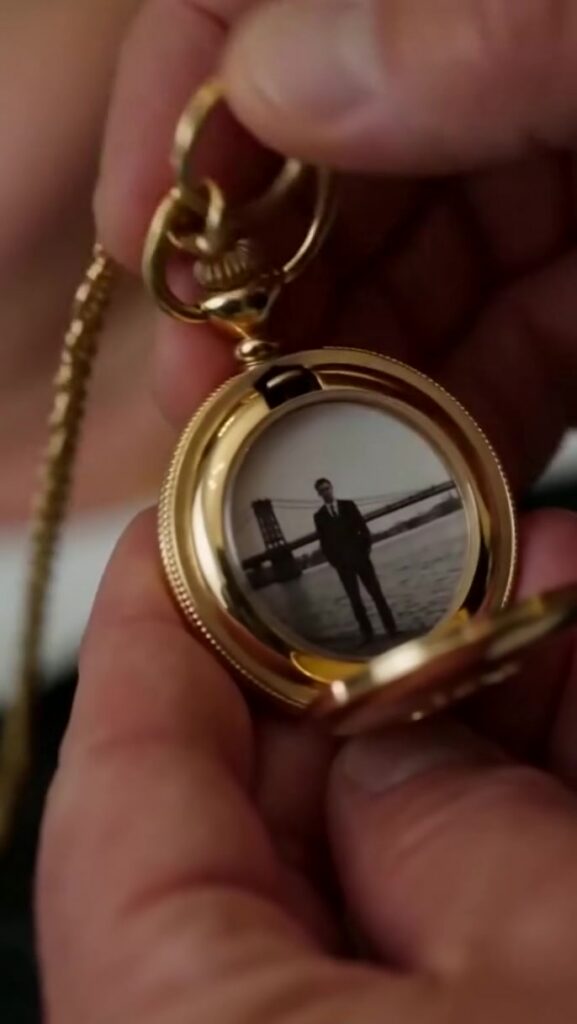
A golden locket.
Misha snatched it up before anyone else could. The metal was worn at the edges, as though it had been opened and closed so often the hinge had learned a new shape. His thumb found the tiny clasp. It clicked, loud as a gunshot in the corridor’s hush.
Inside were two photographs. One was old, faded at the corners: a younger Elias, softer around the eyes, arms wrapped around a laughing woman whose hair spilled like dark ink over his fingers. The woman’s smile was unmistakable, even under the years—Helena’s smile, brighter than the hotel’s golden lights. The second photograph was smaller, newer: two newborns bundled in white, their faces wrinkled and furious at the world. A hospital bracelet was visible in the corner, the surname printed in black—VANE.
Elias’s hand froze on Helena’s cheek. Theo leaned in, eyes wide, reading the truth the way children read wounds. “That’s… you,” Theo whispered, staring at the woman in the first photo and then at Helena’s face as if trying to align two impossible realities.
Helena’s eyes finally focused, not on Elias but on the locket in Misha’s hands. Something like surrender moved through her expression, a quiet collapse deeper than the one that had brought her to the floor. Her lips parted. This time words came, thin but clear. “Put it away,” she breathed, though the plea sounded less like a command than a broken promise.
“Why do you have that?” Theo demanded, his voice rising, cracking on the edge of grief. “Why are you in a uniform? Why are we—” He couldn’t finish. The thought lodged in his throat like a shard of marble.
Elias looked at the open locket as though it were a weapon. The corridor around them blurred: the gala guests, the staff, the glimmering walls that had always protected secrets by making them too expensive to confess. His jaw worked once, as if he had swallowed too much pride to breathe.
“Because she asked me to,” he said, each word costing him. He turned to Helena, and his voice softened into something that sounded like punishment. “You promised me you wouldn’t wear it outside the suite.”
Helena’s laugh was a ghost. “I didn’t mean to,” she whispered. “I just… wanted to remember what I was before…” Her eyes flickered to the boys. “Before I became someone you could hide.”
Misha’s small hands shook around the locket. “Hide?” he repeated, tasting the word as if it were poison. He looked from Helena to Elias, then back. “Are you our—” He stopped, because children know when a question can split a life in half.
Helena shut her eyes, tears slipping sideways into her hairline. Elias’s face—always carved into calm—twisted, unrecognizable. “Your mother isn’t dead,” he said, voice hoarse. “She’s been here the entire time.”
The corridor didn’t crumble. The chandeliers didn’t fall. The marble didn’t crack. The Aureline remained immaculate, untouchable, as it was designed to be. But something in the boys’ expressions changed, and something in Elias broke with a sound no one else could hear.
Helena’s breathing hitched again, shallow and frantic. Elias pressed his forehead to hers, desperation seeping into every controlled muscle. “Call an ambulance,” he barked to his security, then lowered his voice to a whisper only she could hear. “Stay. Don’t make me explain this without you.”
Helena’s eyes opened one last time, meeting Theo’s and then Misha’s with a tenderness so fierce it looked like pain. “I didn’t leave you,” she mouthed, as if the words could stitch up the years. The locket trembled in Misha’s hand, still open, still shining its forbidden proof into the air.
And as the first siren began to wail somewhere far below, the boys realized the most shocking thing wasn’t that their mother had been hiding in plain sight—it was that the man who owned the untouchable hotel had been living in the same prison, and the key had been hanging around Helena’s neck the whole time.