It started with a promise, spoken into the stale air of Room 417 as if the ceiling tiles were listening. Jonah Kline leaned over his daughter’s bed, his suit jacket slung on a chair like a shed skin, his knuckles white around a paper cup of cold coffee. The monitors chimed softly, indifferent. The girl in the bed—Mara—watched him with wide, unblinking eyes that had learned to do all the talking.
“I’ll give anything,” Jonah said, voice roughened by nights without sleep and days without answers. He wasn’t praying. He didn’t know who he was bargaining with. “Anything… if someone can help her speak again.”
He hated the way the sentence sounded when it landed—like a performance, like a plea meant for an audience. But no one was there besides a nurse charting at the doorway and Mara, who still didn’t flinch at his desperation. Mara had not spoken in 312 days. Not after the winter accident. Not after the neurologists nodded and shrugged and used careful phrases—no structural damage, no evidence of impairment, intermittent aphonia, psychogenic mutism—words that tried to be gentle and ended up sounding like blame.
People brought him remedies like offerings. A cousin pressed blessed oil into his palm. A colleague forwarded names of specialists in other states. A woman from his office left a stack of children’s books with hopeful sticky notes: read to her, spark the language centers. Jonah did everything, because doing was easier than sitting in the quiet with his own thoughts. Nothing worked. Slowly, friends stopped asking for updates. Slowly, even Jonah stopped believing there was an “again” waiting at the end of this.
So when the voice answered, it felt like the room itself had spoken back.
“I can.”
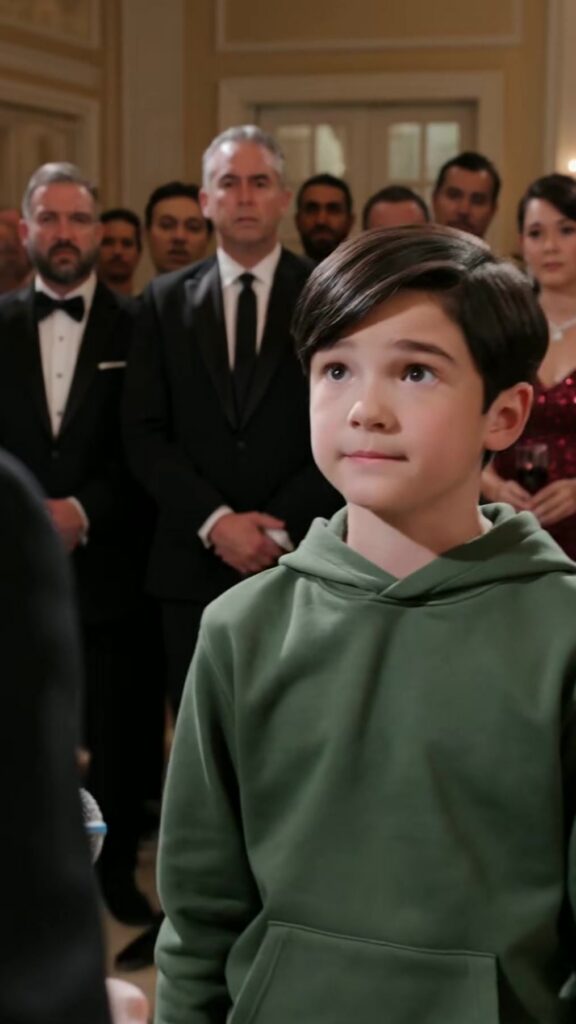
Jonah jerked around. A boy stood just inside the door—maybe seventeen, maybe younger, with dark hair pushed off his forehead as if he’d run his hand through it a dozen times and given up. He wore a thrift-store coat that was too thin for the season and carried no bag, no clipboard, no badge. He had the posture of someone who didn’t expect to be welcomed anywhere.
The nurse frowned. “Visiting hours—”
“He’s with me,” Jonah heard himself say, even though the boy wasn’t. The words came out like a reflex, like a door unlatching before Jonah could decide. Then his frustration surged up, hot and embarrassed. He turned fully toward the boy. “We’ve tried everything,” Jonah snapped. “Therapy. Tests. Medication. Specialists who cost more than my first house. If you’re here to sell me something—”
The boy didn’t flinch. His eyes moved to Mara, not Jonah, and for the first time in months Mara’s stare seemed to sharpen, as if she recognized a frequency she’d been missing. “She didn’t lose her voice,” the boy said quietly. “She chose silence.”
The sentence dropped into the room like a stone into still water. The nurse stopped writing. Jonah felt the blood drain from his face, not because the words were cruel, but because they were exact—too exact. That phrasing had been used once, and only once, in a private meeting with the hospital’s child psychologist when Jonah had been asked, gently, whether there was anything at home Mara might be reacting to. Jonah had shaken his head until his neck hurt. He had refused to admit the thought that had crept into his mind at three in the morning: that his daughter’s silence wasn’t injury, but indictment.
“Who told you that?” Jonah demanded. His voice cracked on the last word. He took a step toward the boy, then stopped, as if afraid the floor might give way. “Who are you?”
The boy didn’t answer. He didn’t look at Jonah at all. He moved past the nurse as though she were a curtain and came to Mara’s bedside. Up close, Jonah saw he was thinner than he’d seemed from the doorway, his cheeks hollowed by hunger or long illness or both. His hands were steady, though, the kind of steadiness Jonah envied—an absence of panic.
He knelt beside the bed, lowering himself until his face was level with Mara’s. He didn’t touch her immediately. He waited, as if asking permission without words. Mara’s fingers tightened on the sheet, the smallest movement, but it was movement. The boy leaned in and whispered something so softly Jonah couldn’t catch even a syllable.
Whatever it was, it threaded through the silence and found its mark. Mara’s eyes shifted—not away, not inward, but toward him, focused with a sudden, startling clarity. Her breathing changed, shallow at first, then deep, as if she’d been holding her lungs hostage and had finally decided to release them. The air in the room felt heavier, charged with the terrible possibility of hope.
Jonah stepped closer, unwilling, compelled. He watched Mara’s lips. Watched as they trembled like a door trying to open on rusted hinges. The boy whispered again. Mara’s throat moved. A sound came out—thin, imperfect, but real. Jonah’s heart seemed to stop and then lurch forward violently, as if trying to climb out of his chest to hear better.
“Dad,” Mara breathed.
The word was small, but it struck Jonah like a wave. His knees went weak. He grabbed the bed rail to keep himself upright. The nurse made a noise—half gasp, half prayer—and backed into the hallway to call someone, her shoes squeaking against the linoleum. Jonah hardly noticed. All he could see was Mara’s mouth, forming the name she had refused to give him for nearly a year.
“Mara,” Jonah said, and the sound of her name in his own voice was suddenly unbearable. He had been saying it every day into a void, and now it echoed back with meaning. He reached for her hand. Her fingers curled around his with a strength he hadn’t felt since before the accident.
The boy rose from his kneel, slow and careful, like someone standing up from a grave. Jonah rounded on him, shaking with a mixture of gratitude and suspicion. “That wasn’t coincidence,” Jonah said hoarsely. “You knew something. You said something.” He swallowed hard. “What did you tell her?”
The boy’s gaze finally met Jonah’s, and in it Jonah saw an exhaustion that didn’t belong to adolescence. “I reminded her,” the boy said. “Of the promise.”
Jonah frowned. “What promise?”
Mara’s eyes flicked between them, fear and fury battling behind her lashes. She drew in a breath that trembled. When she spoke, her voice scraped as if unused, but every syllable landed with purpose. “You promised,” she whispered to Jonah, “you wouldn’t lie anymore.”
The room tilted. Jonah’s mouth opened, but no sound came. His mind raced through months of denial, through the careful stories he’d told the police and the insurance company and even Mara’s doctors. He had wrapped the truth in layers and called it protection. He had convinced himself that if he could keep the world from knowing, he could keep Mara from carrying it.
Across the bed, the boy stood like a witness at trial. Jonah’s eyes found him again, desperate now for a name, an explanation, a way to categorize him as miracle or threat. “Who are you?” Jonah demanded, but the demand lacked its earlier force. It sounded like a man begging to understand the shape of his own guilt.
The boy’s expression softened, just slightly. “Someone who heard you,” he said. “Someone who knows what silence costs.” He glanced at Mara, and there was something like apology in the look. “I can’t make her speak for you. I can only open the door.”
Jonah felt the weight of that door—what would come through it once opened. Confession. Consequence. The crumbling of the story he’d built to stand between them and the truth. He looked down at Mara’s hand in his, the bones delicate, the grip stubbornly alive. Her eyes held him, unblinking, daring him to meet her where she’d been stranded.
“I’ll tell the truth,” Jonah said, the words tearing out of him as if pulled by hooks. “I swear. No more lies.”
Mara’s breath shuddered out, and for the first time since winter, her face shifted—not into a smile, not yet, but into something less guarded. As if she’d been waiting not for a cure, but for a surrender.
When Jonah looked up again, the boy was already moving toward the door. The hallway light swallowed him, and for a moment Jonah thought he might call out, might demand his name, might try to repay the impossible. But Mara squeezed Jonah’s hand, grounding him, reminding him where the real work was. Jonah’s promise hung in the air between them, fragile and sharp as glass.
Behind them, somewhere down the corridor, the boy’s footsteps faded—quiet, unclaimed, as if he’d never been there at all. Yet Mara’s voice remained, raw and real, and Jonah understood with sudden clarity that the miracle had never been the sound.
It had been the price.
And the promise, finally kept.