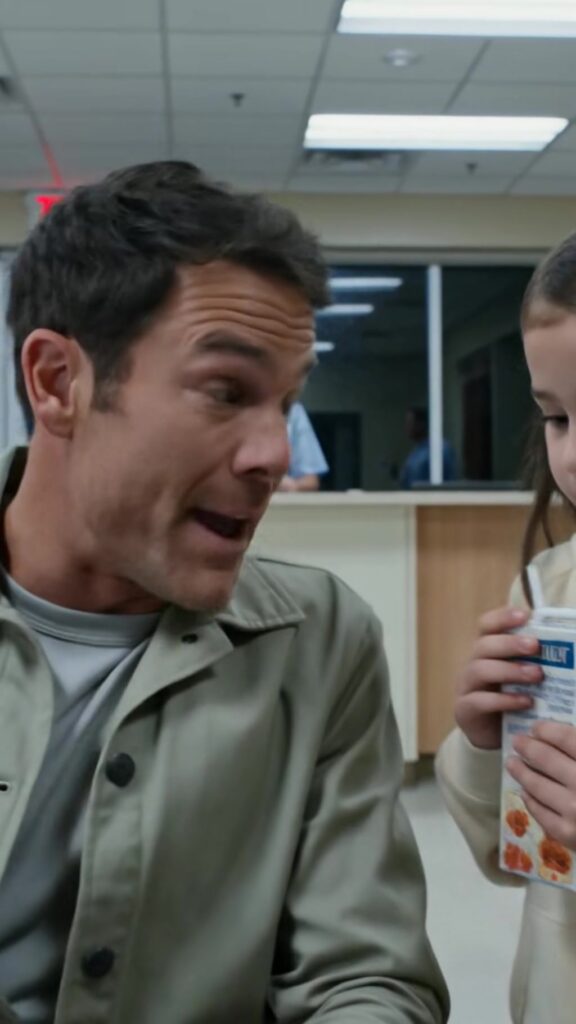
At 9:13 p.m., the last train emptied its tired souls onto Platform Six, and the station went back to its usual nighttime hush—broken only by the dull clack of a departure board and the slow wheeze of an old vending machine. Rowan Hale stood beneath a flickering fluorescent tube, waiting for a contact who was already late. He kept his hands in his coat pockets and his back off the wall, the way he’d learned in other cities, other winters, other lives.
He’d been trying to stay invisible for years. The kind of invisible that meant no questions, no recognition, no past. A new name, a small apartment above a closed bakery, and a job that kept him moving. Security consultant. Locksmith. Fixer. Whatever people wanted to call it, it meant he didn’t have to explain why he watched exits or why he measured strangers by the weight in their gait.
That was why, when the girl stepped out of the stream of commuters, Rowan noticed her immediately. She was too still among all that motion. Too deliberate. She wasn’t running, wasn’t looking around like a lost kid, wasn’t crying. She walked straight toward him as if the crowd had parted for her.
She stopped within arm’s length. Her coat was too thin for the season, the hem frayed, her hair gathered into a loose braid that had been fixed in a hurry. Her face held a calm that didn’t belong to children.
“Sir…” she said.
Rowan didn’t answer right away. He glanced past her shoulder, reading the platform like a page. Late-night travelers. A couple arguing softly near the kiosk. A man pretending to check his phone too often. “Are you lost?” Rowan asked, keeping his voice neutral. “Is everything okay?”
The girl shook her head once. Not panicked—decisive, like someone closing a door. “He is not my father.”
The words landed with the weight of a fact, not the tremble of fear. Rowan felt his posture tighten. He followed her line of sight to the man hovering behind her—two steps too far to be family, yet close enough to claim her. The man had the hard, polished look of someone who could smile in a photograph and hurt you in an alley. He didn’t wave. He didn’t call her name. He just watched, waiting for the moment Rowan would dismiss her.
“Stay behind me,” Rowan said quietly, shifting so his body became a barrier between the girl and the man.
But she didn’t listen. She reached out, small fingers tugging at Rowan’s sleeve with a familiarity that made his skin prickle. The fabric slid up just enough to expose the edge of a tattoo at his wrist—dark ink against pale skin.
A wolf’s head, half-hidden, teeth bared in a snarl that was more warning than rage.
The girl’s gaze locked onto it. Her calm didn’t break, but her eyes sharpened, as if she’d been searching for a particular shape in a crowd and had finally found it. “My mom told me… to find you,” she said.
Rowan’s throat went dry. There were only a few people in the world who knew what sat under his cuff, and fewer still who would send a child to look for it. “What’s her name?” he asked, unable to keep the edge out of his voice.
“Sarah.”
For a second, the platform noise faded—the distant announcement, the wheels of a suitcase, the hum of power lines—until all Rowan could hear was the name echoing through the years. Sarah: laughter in a cramped kitchen, cigarette smoke curling around a cracked window, the smell of rain on concrete, a hand gripping his before letting go.
He didn’t realize he had stopped breathing until his lungs burned.
Behind the girl, the man took a step closer.
Rowan saw it before most people would: the subtle shift of weight, the practiced approach, the angle that cut off the girl’s escape without looking like it. Rowan’s right hand moved inside his pocket, fingers closing around the cold outline of a small canister. Not a weapon that would make headlines. Something quieter. Something that bought time.
“Sweetheart,” the man said, voice smooth as a con, “come back. You’re upsetting people.”
The girl didn’t turn. “I’m not,” she replied, and there was a strange steadiness in her tone, as if she’d decided long ago that she would not be reshaped by anyone’s panic.
Rowan kept his eyes on the man. “She’s with me,” he said, though the lie tasted risky. “Walk away.”
The man’s smile didn’t reach his eyes. “You don’t want trouble, friend.”
“I never want trouble,” Rowan answered. “Trouble just recognizes me.”
The man’s gaze flicked to Rowan’s wrist where the wolf ink peeked out, and for the first time the smile faltered. Recognition sparked—then something colder. He hadn’t expected to find a story attached to this stranger. “You,” the man muttered, like a name he couldn’t quite pull from memory.
The girl tugged Rowan’s sleeve again, urgent now. “He took me from the bus stop,” she whispered. “He said he knew my dad. But he doesn’t. Mom said… if anything happened, I had to find the wolf. She said you’d know what to do.”
Rowan’s heart hammered against his ribs. Sarah hadn’t called in seven years. Not once. Not when he’d disappeared into a different state, a different name. Not when he’d burned every bridge to keep the fire from spreading to her. If she was sending messages through a child, it meant she couldn’t send them any other way.
Rowan’s eyes scanned for cameras: two on the far wall, one above the ticket machines, and a blind pocket near the maintenance door. He thought of pulling the girl into the lit area, forcing the man into the camera’s view. He thought of calling the police and explaining—what? That a child had found him by a tattoo and a name he wasn’t supposed to answer to?
The man behind her moved again, and this time Rowan saw the glint at his waistband, the hint of metal hidden under a jacket. The station suddenly felt too small.
Rowan lowered his voice. “What’s your name?” he asked the girl.
“Mara.”
Mara. The name hit him like a punch because he’d heard Sarah say it once, years ago, like a secret she was trying on. He had laughed then, told her it sounded like a storm. She’d smiled like she knew something he didn’t.
Rowan swallowed hard. “Mara,” he said, “when I say go, you run toward that kiosk and you don’t stop. Do you understand?”
She shook her head. “No. I don’t run,” she said, and she meant it. It wasn’t stubbornness. It was a rule she’d made to survive. “Mom said if I run, I look guilty. She said I have to walk like I belong to myself.”
Rowan felt something raw twist in him—admiration, grief, anger. Sarah had taught her that. Sarah had been planning for this. Sarah had been afraid.
The man’s hand slid toward his jacket pocket. “Last chance,” he warned Rowan, soft and deadly. “Give her back.”
Rowan exhaled slowly, letting the breath steady him. He stepped forward, just enough to shift the man’s focus onto him. “You picked the wrong platform,” Rowan said. He brought his wrist up, letting the wolf show clearly in the station light. “And the wrong girl.”
The man’s eyes narrowed. “Wolf,” he said, and the word came out like a curse. “So it’s true. She found you.”
Before Rowan could ask what he meant—before he could demand where Sarah was, what had happened, why a child was standing here like a messenger at the end of a world—the man lunged.
Rowan moved on instinct, knocking the man’s arm away as the station lights buzzed overhead. The canister in Rowan’s pocket was suddenly in his hand, his thumb poised. Mara didn’t scream. She didn’t run.
She walked—straight toward the maintenance door, toward the dark pocket beyond the cameras, toward whatever waited there with the confidence of someone who had been told the truth and refused to be frightened by it.
And Rowan, caught between a past he’d buried and a child who carried it like a compass, realized Sarah hadn’t sent Mara to find him for comfort.
She had sent her because Rowan was the only person left who could finish what Sarah had started.