Maria was already halfway into the river when the man’s voice tore across the winter air.
It didn’t sound like a plea. It sounded like a verdict read aloud so the whole valley could hear. The words whipped across the water with the sleet and struck her between the shoulders, as if a hand had shoved her back toward the bank she’d left behind.
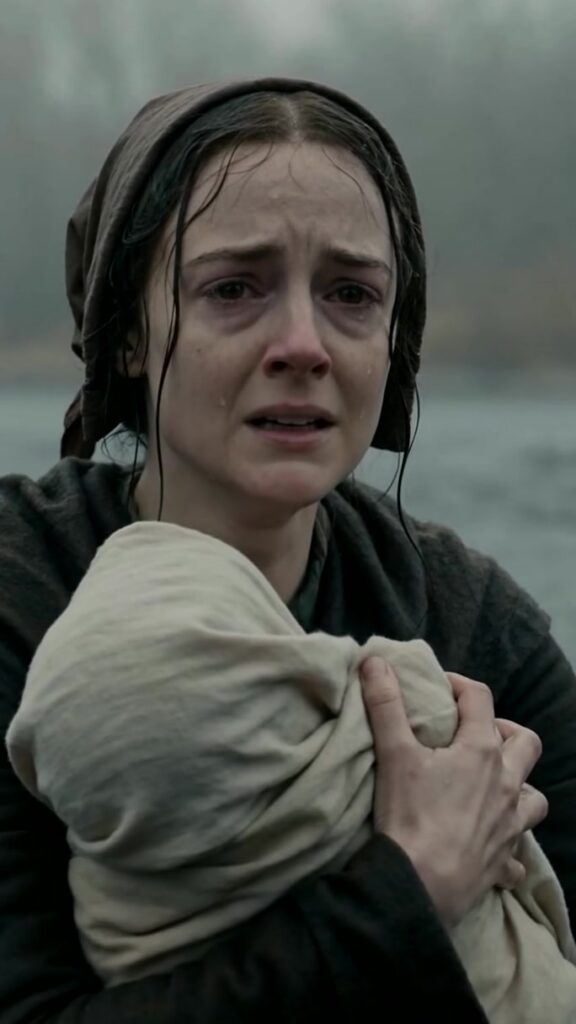
The water reached her waist, black and numbing, moving with a slow, brutal patience. It tugged at her skirt and the hem of her coat, heavy now with river and rain, trying to claim her the way winter claimed everything that dared to linger outside. She held the baby high against her chest, the bundle pressed tight beneath her chin. She could feel each small breath through the cloth, a warm thread in a world made of ice.
On the muddy bank, a line of people stood where the road ended. Her family. Their faces looked carved from the same gray the sky had been using all morning. Behind them, the old orchard bent in the wind, bare branches rattling like bones.
And before them—planted at the edge as if the river obeyed him—stood her father.
“Cross this river, Maria,” he called again, and this time he drew out her name as if he could drag her back by the sound of it, “and you are dead to this family!”
She turned slowly. Not because she’d been commanded to, but because she wanted to see his mouth form it. She wanted to see if his lips trembled with the weight of what he said. They didn’t. His jaw was set, the same jaw that had measured her worth in work done and silence kept.
Rain and tears mingled on her cheeks. She had cried until the inside of her felt rubbed raw, and still the water came. The baby shifted faintly in her arms, a restless flicker, and Maria tightened her hold as if the entire village were reaching out with invisible hands.
For one moment, she looked at the people who had raised her—her mother with her arms crossed like a locked door; her brothers staring past Maria’s face as if they could pretend she was a stranger; her aunt clutching her shawl and her rosary, beads clicking in prayer that sounded more like judgment than mercy.
Then she looked at the man who had condemned her, and she found that her fear had burnt down to a small, steady ember. It didn’t warm her, but it kept her standing.
Her lips trembled, but her voice didn’t.
“Better dead to them,” she said, loud enough for the river to carry it, “than alive with them.”
The words came out thin and clear, like glass. The river seemed to answer, swelling louder, shoving its shoulder against her thighs. She turned away from the bank and forced another step, teeth clenched as the cold bit deeper. The current wrapped around her legs and tried to twist her sideways. She set her feet wider, feeling the mud slip beneath her boots, and kept going.
She didn’t see her father’s face change until she heard it—the smallest hitch in his breathing, the first crack in his certainty.
“Maria,” he said, not as a command this time. As a warning. Or as something else he didn’t know how to name.
Behind him, her family stirred. They had been still as stones, but now they moved, a half-step forward in unison, as if the sight of her going where they couldn’t follow had awakened a fear they hadn’t expected. Her mother reached out, then stopped herself, as though touching Maria would mean admitting she was real.
Maria stopped in the middle of the river.
Not because she changed her mind. Because something inside the baby’s cloth caught the gray light.
A glint—small, sharp, wrong in a world of mud and wet wool.
She looked down, startled. Her fingers, stiff with cold, fumbled at the edge of the wrap. The baby’s blanket had shifted when she fought the current, and beneath the fold, tucked where a swaddled arm should have been, a piece of metal winked again.
Her breath caught.
She pulled the cloth aside just enough to see it.
Not a charm. Not a pin.
A key.
Old, iron-dark, with a head shaped like a small cross. It was tied to a narrow strip of ribbon, the ribbon knotted with the kind of careful hands that didn’t leave frayed ends.
Maria’s mind flashed backward through the morning in shards. Her mother’s sudden silence when Maria had refused to leave the baby behind. Her aunt hovering too close, fussing with blankets, insisting she wrap the child “properly.” The way her father had watched, not the baby, but Maria’s arms, as if counting what she carried.
The key was cold against her fingertip, colder even than the river.
She turned her head toward the bank. The family was closer now, their shoes sinking into the mud at the edge. Her father stood rigid, but his eyes—his eyes were fixed on the bundle.
He knew.
Maria’s stomach tightened so hard she thought she might fold in half. The river surged, and the baby made a small sound, a thin complaint. She pressed her mouth to the cloth, a kiss that tasted like damp wool and salt, and in that moment she understood the cruel neatness of what they’d done.
They’d hidden the key on the baby so she would carry it out of the house without realizing. So she could be punished for theft, hunted down like a criminal if she ever tried to return. So her name would be stained in the village’s mouth for years, long after the river forgot her footsteps.
Or—worse—they wanted the key to leave with her, to lock something behind her forever.
Maria lifted her gaze. Her father’s mouth parted, then shut again. He didn’t shout now. He didn’t need to. The river between them held every word.
Maria remembered the locked room at the back of the house—the one she’d never been allowed to enter, the one her mother crossed herself near without explaining why. She remembered hearing a low, steady cough some nights through the floorboards, and being told it was “pipes settling” though the house had no pipes.
She remembered, too, her grandmother’s last whisper when she’d pressed a hand to Maria’s hair: There are doors in that house that should not be trusted closed.
The river tugged at Maria, insistent. The cold was leaching into her bones. She didn’t have time to unravel mysteries in the water.
But she had time to choose what she would carry forward.
Maria slipped the key free of the ribbon with fingers that hurt. The knot resisted, then gave. She held the iron between her thumb and forefinger, and it looked suddenly heavy enough to sink her.
On the bank, her aunt’s eyes widened. Her mother’s hand flew to her mouth. One of Maria’s brothers took another step and stopped, as if a line had been drawn in the mud.
Her father found his voice at last, and it came out hoarse. “Don’t,” he said. Not “come back.” Not “please.” Just “don’t.”
Maria stared at him, the river roaring around her hips, the baby’s warmth fading against her chest as the cold stole it. She thought of how they had shouted at her when the village midwife came too late, how they had blamed her for the man who had promised marriage and left her with a swollen belly and a tarnished name. She thought of the way her father had said, without looking at the child, that shame could be washed away if she was willing to drown it.
She held the key up where they could all see it. It gleamed wetly, the river’s dark gloss on iron.
“What does it open?” she asked. Her voice was thin, but it did not break.
Nobody answered.
The silence was answer enough.
Maria’s hand closed around the key, and for a heartbeat she considered hurling it into the river, letting the current bury their secrets in silt. But a secret lost was still a secret. A door locked forever could hide anything inside it—anything alive, anything suffering, anything that might someday be blamed on her again.
Instead, she tucked the key into her own pocket, against her palm, so she could feel it and remember that they had tried to make her their scapegoat even as she fled.
Then she turned away from them for the last time.
The river struck her thighs and tried to push her back, but she leaned into it, one step, then another. The far bank was a low rise of stones and reeds, slick with winter. Beyond it, the road bent toward the pine forest and the distant lights of a town she’d only heard about from travelers—places where a woman could be nobody and therefore, at last, become someone.
Behind her, her father called her name again, smaller now, as if the river were already swallowing his authority. Her family’s shapes blurred in the rain, reduced to a smudge of gray against gray.
Maria didn’t answer. She couldn’t. The baby needed breath, and she needed will.
When she reached the far bank, she nearly collapsed. She dug her boots into the stones and hauled herself up, water streaming from her coat, her arms shaking with exhaustion and cold. She looked once over her shoulder.
On the other side, her father stood at the edge, powerless. He could not cross without losing face, without admitting he’d been wrong to try to drown a daughter’s life into obedience.
Maria pulled the baby closer and started walking into the winter, the key cold in her pocket like a second heartbeat.
She didn’t know what waited ahead—hunger, loneliness, perhaps worse. But she knew what waited behind her: a house full of locked doors and people who called it love.
The river kept roaring, as if it would always remember the moment a woman chose to live, and carried the sound of her footsteps away so no one could claim she’d never existed at all.