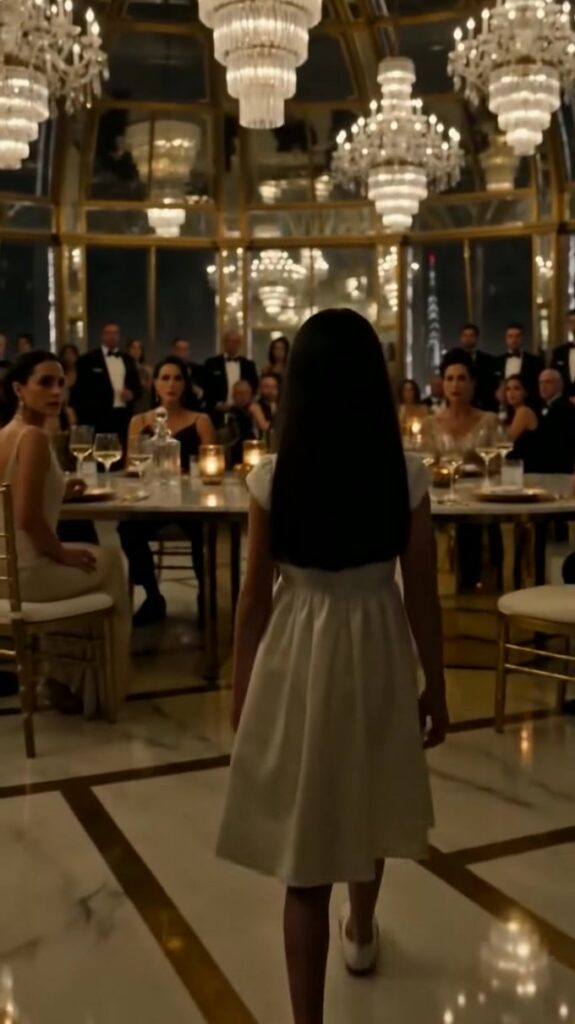
No one in the crystal ballroom noticed the girl at first. That wasn’t an insult so much as a feature of the place. The Crystal Ballroom was designed to erase anything inconvenient—sound, sweat, hunger, and especially people who didn’t fit the dress code. It was all angles and shimmer, like someone had built a cathedral for money and made sure the only god allowed inside was control.
The gala was called the Meridian Benefactors’ Evening, which meant it was a party where rich people donated to causes they didn’t have time to think about, in exchange for a seat near other rich people. The chandeliers hung heavy with warm light, turning every champagne flute into something holy. Servers moved like polite shadows. The floor looked less like marble and more like a frozen lake nobody dared step on too hard.
At the center sat Arden Vale, the man everyone kept orbiting without ever touching. He had the kind of presence that didn’t need volume. He didn’t laugh loudly, didn’t gesture too much, didn’t wear anything that wasn’t tailored into obedience. He just sat in his chair with a glass untouched beside him, and the room arranged itself around him like he was a gravity well.
They were all pretending not to be impressed. That was the point.
The girl came in through the main doors like she’d been assigned an entrance and simply forgot to read her cue. No escort. No sparkling gown. No glittering necklace borrowed for the night. She wore a simple dark dress that fit her like she owned it, and shoes that had seen too many sidewalks to be polite.
The first thing that happened was nothing. People kept talking. Someone laughed, bright and rehearsed. The string quartet continued to smooth out the air.
Then the room noticed her the way a dog notices a change in wind.
Whispers began as a ripple near the door. A few heads turned. A server paused, unsure if she should offer a tray or call security. A woman in emerald silk frowned as though the girl’s mere existence had ruined the lighting.
“She doesn’t belong here,” someone murmured, not quietly enough.
The girl didn’t blink. Her face stayed calm, almost blank, but not the empty kind—more like a door that was locked on purpose. Her gaze wasn’t wandering. It was fixed on the man at the center, and that certainty was what made people step aside without realizing they were doing it.
She started walking.
The Crystal Ballroom had a talent for making people hesitate. There were rules everywhere, invisible and sharp. Who approached whom. Who could stand too close. Who existed only as background. Yet she cut a straight line through those rules like they were drawn in chalk.
Conversations trailed off behind her. The quartet’s melody softened, either because someone signaled them or because even the musicians didn’t want to be the soundtrack to whatever was happening. The girl’s footsteps weren’t loud, but on that polished floor they sounded decisive.
Arden Vale watched her approach with the mild curiosity of a man used to being interrupted by praise. His mouth held the beginnings of a polite smile, something he could deploy if she turned out to be a donor’s child or an overeager intern.
She stopped directly in front of him. Too close for comfort. Close enough that people nearby stiffened, caught between the urge to intervene and the social terror of doing the wrong thing.
She reached into the pocket of her dress. A couple of guests flinched as if she might be pulling out something dramatic. But her hand emerged holding something small and old: a silver locket on a chain, dull at the edges, the kind of item that had been touched so often it had worn itself soft.
Without a word, she placed it on the table in front of him. Not gently, not aggressively—just matter-of-fact, like setting down a coin to pay a fare.
Arden’s eyes dropped to it with practiced boredom.
Then his gaze snagged.
It wasn’t the locket itself at first. It was the shape. The tiny crescent nick along one side. The almost-invisible engraving that caught the chandelier light at the right angle: a starburst with three prongs.
His expression emptied. The smile drained away as if someone had pulled a plug. His fingers, which had never once trembled while signing deals that ruined lives, lifted to his throat.
He tugged at his collar with an uncharacteristic clumsiness and pulled out his own chain. Hanging against his skin was another silver locket, nearly identical. The same starburst. The same worn edges. The same old dent like a bite mark from time.
The room didn’t breathe. People leaned in without meaning to, drawn by the rare sight of Arden Vale losing control of his face.
His voice came out rough, more human than anyone expected. “Where did you get that?”
The girl finally spoke. Her tone was steady, not triumphant. Almost tired. “My mother said you would react like this.”
A murmur ran through the guests. Mother. That word landed heavier than any accusation.
Arden swallowed. His eyes were locked on the locket like it might either save him or sentence him. “Your mother…?”
“Mira,” the girl said. “Mira Halden.”
A name few in the ballroom recognized, because the Crystal Ballroom didn’t keep space for people like Mira Halden. But Arden did. You could see it in the way his shoulders stiffened, the way his hand tightened around the chain at his throat as if holding on could undo history.
“That’s not possible,” he said, though it didn’t sound like denial. It sounded like a man trying to bargain with the past.
“She said you’d say that, too.” The girl’s mouth quirked, not quite a smile. “She had a list. It was annoyingly accurate.”
Someone in the crowd let out a small, shocked laugh and immediately smothered it.
Arden’s eyes flicked up to her face, searching for something familiar. He seemed to find it in her cheekbones, in the stubborn set of her jaw, in the way she refused to look away first. His composure returned in fragments, like a shattered mirror trying to pretend it was whole.
“What do you want?” he asked, and it was the kind of question that usually ended negotiations before they began. It had ended careers. It had ended people.
“Not money,” she said quickly, and a few guests looked almost offended on his behalf, as if rejecting wealth was the rudest thing you could do. “She didn’t send me for that.”
Arden’s fingers hovered over the locket on the table but didn’t touch it. “Then why are you here?”
The girl’s gaze flicked around the ballroom for the first time—over the chandeliers, the flawless dresses, the smiles made of porcelain. Then she brought her eyes back to him. “Because you’ve been living like this is the only version of the story.”
“I don’t know what you think you know,” he said, his voice sharpening, trying to reclaim the air.
“I know she kept this for twenty years,” she replied, tapping the locket on the table. “She kept it even when she sold furniture to pay rent. Even when she walked to work because the bus money had to go to groceries. She kept it because she said it was proof that once, you were a person.”
The sentence hit him like a slap disguised as a memory. Around them, the room held itself still, desperate not to miss whatever came next. The people who usually controlled headlines and courts suddenly felt like audience members at a play they hadn’t paid enough to understand.
Arden’s jaw worked. “Is she…?” He didn’t finish.
“She’s alive,” the girl said, and the relief that flashed through his face was immediate and shameful. “But she’s sick. She didn’t want to come. She didn’t want to see you. She just wanted you to see this.”
Arden stared at the two lockets—his against his throat, hers on the table—like they were a locked door and the keys had just been returned. “What is it?” he asked, softer now. “What are you?”
“I’m the part of your life you managed to misplace,” she said. Then, after a beat, she added, “My name is Lark.”
The room shivered. Not with cold, but with the unfamiliar sensation of consequence.
Arden’s hand finally moved. He picked up the locket she’d brought, turning it over as carefully as if it might cut him. The latch was stiff. It always had been. He remembered that now—some rainy afternoon, two decades ago, sitting on a cheap couch, laughing about how it never wanted to open for anyone who didn’t mean it.
He pressed his thumbnail into the seam and snapped it open.
Inside was a photograph, faded at the edges. A younger Arden, before the suits and the distance, holding a woman with bright eyes and messy hair. Mira. And in her arms, wrapped in a blanket too big for her, was a tiny baby with a scowl like she’d already been asked to be quiet.
Arden’s breath broke. Not a dramatic sob. Just a crack in the armor.
Lark watched him with an expression that held no cruelty, only a practiced patience. Like she’d had years to prepare for this one moment and wasn’t sure what to do with it now that it was real.
“She said you’d recognize it,” Lark said. “She said you’d remember.”
Arden looked up at her, his eyes glossy and furious at the same time. Furious at himself, at time, at all the careful choices that had led to this room and this chair and this lie of perfection. He glanced around, suddenly aware of the watchers, the power, the fragile illusion he maintained.
Then he did something nobody expected.
He stood.
The movement was small, but in that ballroom it was seismic. People stepped back instinctively, like standing too close might get them tangled in whatever real thing had just entered the room.
Arden Vale slid his chair away and faced the girl. His voice was low. “Tell me where she is.”
Lark didn’t smile, but something in her shoulders loosened, like she’d been bracing for a fight that didn’t come. “I will,” she said. “But not here.”
He nodded once, sharp and certain, and for the first time that night, he looked less like a man who owned the air and more like a man who’d finally realized he couldn’t buy it back.
As Arden moved from the center of the Crystal Ballroom toward the doors—toward the girl who had walked in alone—something invisible fractured beneath the chandeliers. Not the glass. Not the marble. The story everyone had agreed to live inside.
And in the sudden hush, Lark picked up her chain from the table, slipped it back into her pocket, and walked beside him like she’d always belonged exactly where she chose to stand.