The band was in the middle of something bright and reckless—brass yelling, drums kicking, a singer leaning into a note like she owned it—when the sound just… stopped. Not a graceful ending. Not a final cymbal kiss. More like somebody reached up and turned the entire room off.
At first people kept moving out of habit. A couple still swayed, laughing too loud. Then the quiet hit them, thick as a curtain, and everyone’s feet found the floor at the same time. The crystal chandelier above the ballroom threw prismatic specks onto tuxedos and sequins, but without music it looked less like a party and more like a display case.
“Is this part of it?” someone whispered, like they were afraid the silence might hear.
The conductor—hired, expensive, famous enough to have a Wikipedia page—stared at his baton as if it had betrayed him. The violinist tried a quick test note. Nothing came out. Not even a squeak. She drew the bow again, harder, and her face tightened with confusion. Still nothing. The bow moved. The string vibrated. The air refused to carry it.
Then the doors at the far end of the room eased open.
Not flung open. Not dramatic. Just a polite, almost hesitant motion, like the building itself was trying not to draw attention.
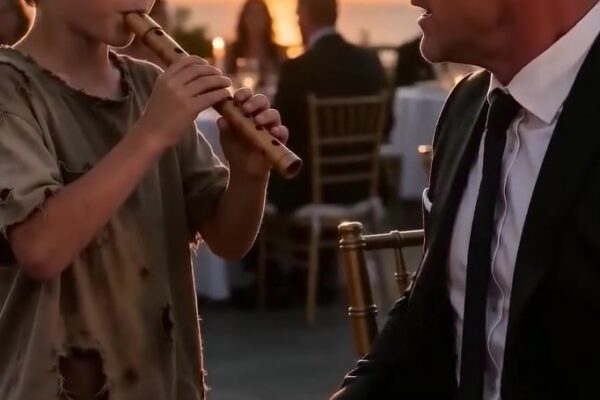
She stood in the doorway: a little girl in a plain gray cardigan that didn’t belong in a room like this, hair tied back with a black ribbon, shoes scuffed like she’d walked a long way to get here. She didn’t look scared. She looked… focused. Like she’d been given instructions and the rest of the world was background noise.
No one had seen her arrive. The ballroom staff were everywhere, hovering with trays and smiles, and yet none of them were near her. It wasn’t that she was invisible. It was that everyone’s attention had been carefully aimed elsewhere until now.
A nervous laugh popped from a group near the champagne tower and died immediately. The air felt colder around the doors. People shivered and didn’t know why.
The girl stepped into the room.
Her footsteps sounded wrong—too loud, too clean, as if the marble floor had been waiting for them. Each tap echoed back, sharp enough that a man near the front winced.
She walked straight down the center aisle that hadn’t existed ten seconds earlier. Guests drifted aside without thinking, like magnets repelling. A woman in a silver dress reached out as if to stop her and then froze mid-motion, fingers hovering, eyes unfocused, as though her arm no longer belonged to her.
At the center of the ballroom stood Lionel Vance, host of the gala, donor, builder of towers, collector of good publicity. He was the kind of man who looked like he’d practiced being unbothered in mirrors. He held a glass of champagne he hadn’t sipped from in ten minutes. Beside him was his wife, Darlene, immaculate and glittering and tense in a way that didn’t match the evening.
Lionel saw the girl coming and smiled at first—the public smile, the “aren’t children charming” expression he could switch on for cameras. Then the girl got close enough for him to see her eyes.
They weren’t eerie. They were ordinary. That was the problem. Ordinary, calm eyes in the middle of a room that had forgotten how to make sound.
Darlene leaned down, her face pinched. “Sweetheart,” she said, sharp around the edges, “you’re not supposed to be in here.”
The girl didn’t look at her.
“Someone find her parents,” Darlene added, louder, to the room.
No one moved.
The girl stopped directly in front of Lionel, close enough that he could smell shampoo and rain on her hair. She reached into her cardigan pocket and pulled out something small and dull.
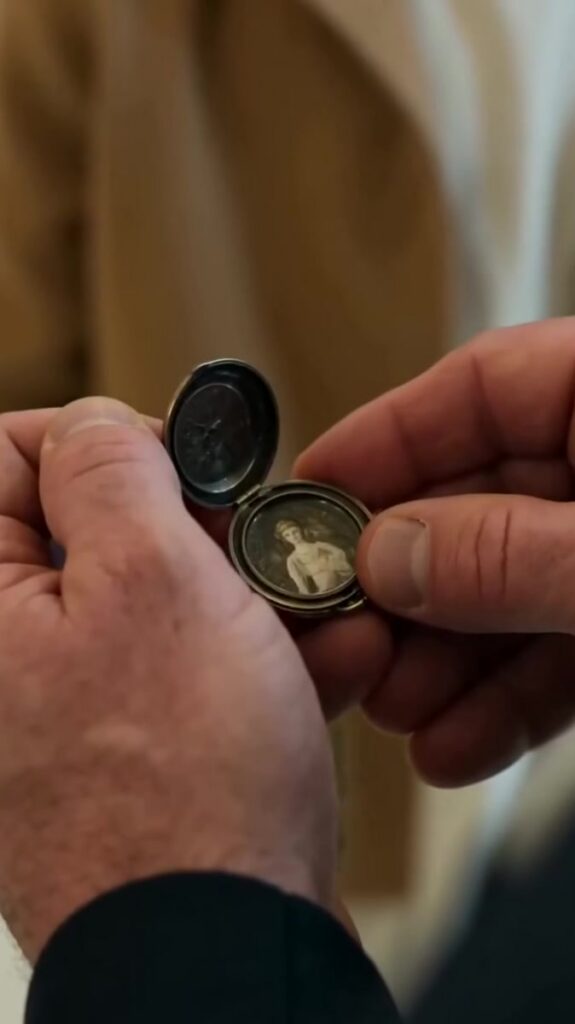
A locket. Oval. Brass or maybe copper, worn down by fingers over years. There was a scratch across the front like a tiny lightning bolt. The hinge looked tired.
She held it out on her palm.
Lionel’s smile fell apart in slow motion. His throat bobbed. The glass in his hand tilted and he didn’t seem to notice.
Darlene’s voice rose, suddenly too bright. “What is that?”
Lionel didn’t answer. His free hand went to his jacket pocket like it had its own memory. He pulled out another locket.
Same oval shape. Same scratch. Same tired hinge.
A sound tried to form somewhere in the room—someone inhaling too hard, a gasp, a stifled curse—but it didn’t fully become sound. The silence swallowed it, leaving only expressions behind.
Lionel’s fingers trembled as he held his locket up next to hers. The two pieces looked like twins separated by time.
“That’s not possible,” Lionel whispered, though the room’s quiet made his whisper feel like a shout.
The girl’s face didn’t change. “My mom told me to find you,” she said.
“Who… who is your mother?” Lionel asked, and the words came out thin, like his voice had aged ten years in one question.
Darlene stepped in, a hand clamped on Lionel’s arm. “Stop,” she hissed, the composure cracking. “Don’t entertain this. This is a stunt.”
The girl finally looked at Darlene, not with anger, not with fear—just with a kind of mild curiosity, like she was seeing a portrait in a museum and deciding if it matched the description.
Then she opened her locket.
The hinge clicked. That tiny sound was the first real noise anyone had heard in a full minute, and it made half the guests flinch as if a gun had gone off.
Inside was a faded photograph: a young woman laughing, hair blown into her face, cheeks round with happiness. She was holding the hand of a much younger Lionel Vance, both of them caught mid-run, like the world couldn’t keep up with them. On the other side of the locket, pressed under scratched glass, was a strip of paper with a name written in careful loops.
Lionel stared at it like it was a fire he couldn’t look away from. His face drained of color.
“Where did you get that picture?” he asked, even though he already knew.
“It was in my mom’s jewelry box,” the girl said. “She said you’d remember.”
He swallowed. “What’s her name?”
Darlene tightened her grip. “Lionel.” Her voice turned pleading, nearly childlike. “No. Don’t.”
The girl spoke the name clearly, like reciting something she’d practiced in the car on the way over.
“Maris Elowen.”
The room didn’t react with the chaos of a scandal. It reacted with the kind of stillness that means everyone recognizes the danger but can’t name it. Heads turned, not because they knew the name, but because Lionel did.
Lionel staggered back one step. His champagne glass slipped from his fingers and fell. It should’ve shattered and echoed. It hit the marble and made no sound at all—just a soft, silent bloom of liquid spreading like a dark flower.
Darlene went pale, her mouth opening and closing. She looked less like a wealthy hostess now and more like someone who’d just seen a ghost walk through her living room.
“That name…” Lionel said, and he didn’t finish because he couldn’t. Everyone in the city had heard of the Vance Foundation. Everyone had read the glossy profiles about Lionel’s “self-made” rise. Everyone knew he’d once been married young, briefly, before his first big fortune. But no one knew the name Maris Elowen, because it didn’t exist anymore in any article, any archive, any public record anyone could find.
It had been erased the way rich people erase problems: quietly, thoroughly, with paperwork and pressure and time.
The girl watched him like she was waiting for the correct response.
“She said you left,” the girl continued, her voice steady. “She said you promised to come back. She said you never did.”
Lionel’s eyes glazed with something that looked like panic and grief tangled together. “Maris is dead,” he said automatically, as if he’d said it to himself a thousand times. “Maris—”
“She’s not,” the girl replied. “She’s sick. She can’t get out of bed. She told me to bring you this so you’d believe me.”
She held out the open locket, and Lionel leaned closer despite himself. The photograph stared back with a truth he couldn’t buy his way out of. Beneath the picture, the paper strip held one more thing, smaller writing under the name: an address.
Lionel’s breath caught hard. “No,” he said, not to the girl. To the universe. “No, that place—”
“It’s still there,” the girl said. “Just smaller. And colder. She said you’d hate it.”
Someone finally managed a sound: a low, strained, “What is this?” from a man near the bar. But the question didn’t go anywhere. The silence kept pressing in, listening.
Lionel looked up at the band as if he’d forgotten they existed. The conductor stood stiff, eyes wide, baton lowered. The singer had both hands clasped in front of her mouth like she was praying.
“Why can’t we hear anything?” Lionel asked, and he wasn’t talking about the band anymore.
The girl glanced around the room like she was noticing it properly for the first time. “Mom said,” she began, then paused, searching for the words. “Mom said you built this place so you’d never have to listen.”
Darlene flinched as if slapped.
The girl added, almost apologetic, “She said the music would stop when you finally did.”
Lionel’s face crumpled in a way that didn’t seem possible for someone so practiced at control. His shoulders sagged. For a moment he looked like a man who’d been carrying something heavy for too long and had just realized he couldn’t pretend it was light.
“What’s your name?” he asked the girl.
She hesitated. That was the first crack in her composure, the first sign she was still a child. “June,” she said. “My mom calls me Junebug when she’s not mad at the world.”
“June,” Lionel repeated, and the way he said it made the name feel like a bridge. “How did you get in?”
June shrugged. “The guards didn’t stop me.”
Across the room, one of the security men blinked hard, then looked around like he’d woken from a nap standing up. His hand went to his earpiece, confused.
Lionel stared at June’s locket, then at his own, then at Darlene, whose eyes were glossy with fury and fear. The guests watched, hungry for explanation, frightened of what they’d do with it if they got it.
Lionel took June’s small hand gently, like he was afraid she might vanish if he held too tight. “Take me to her,” he said.
Darlene’s voice snapped. “Lionel, you are not leaving your own gala for a—”
He didn’t even turn to her. “The music is gone,” he said, strangely calm. “Do you hear that? There’s nothing left to dance to.”
He looked around the ballroom one last time, at all the money and light and rehearsed joy, and for the first time it seemed like he could see the thing hiding behind it all: a quiet, patient consequence.
June nodded once, satisfied, like the correct door had finally opened. Together they walked back toward the entrance, their footsteps still too loud, still too clean, as if the marble wanted everyone to remember each step.
Behind them, the band lifted instruments again, determined to fix the moment with professionalism. The violinist drew her bow. The trumpet player filled his cheeks. The drummer raised his sticks.
Nothing.
The music stayed dead, not because the instruments were broken, but because the room had stopped allowing pretty noise to cover up ugly truths. And as Lionel Vance followed the little girl out into the cold night, the silence in the ballroom felt less like a malfunction and more like a verdict.