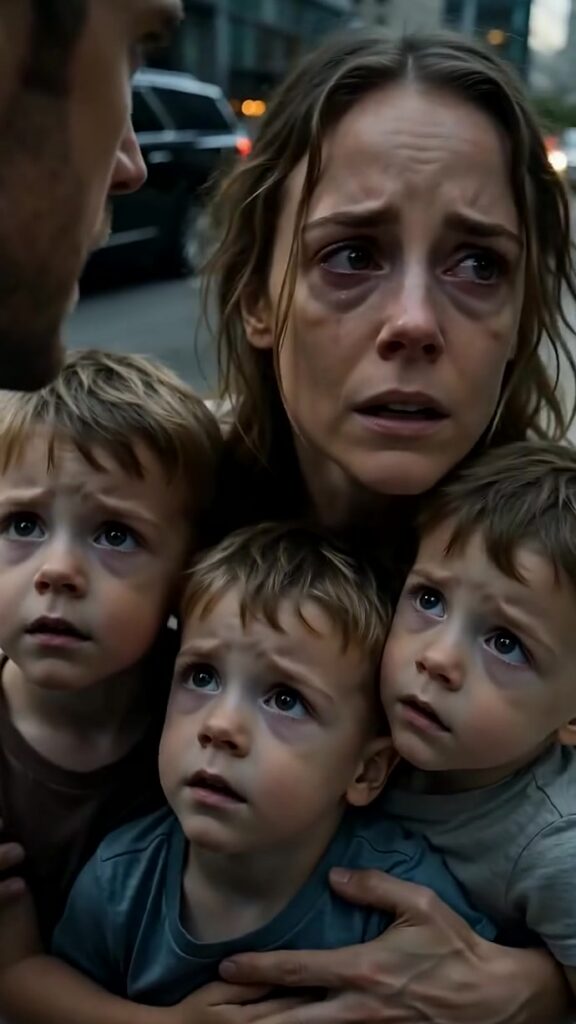
The city was doing what it always did—shouting, hurrying, forgetting. Sirens stitched their way through traffic. A bus coughed black breath at the curb. Somewhere above, an argument spilled from an open window like dirty water. Daniel Reyes walked through it all with his collar up and his mind elsewhere, rehearsing the meeting he was already late for, thinking about numbers and deadlines and the slow, steady climb he’d promised himself would make everything worth it.
Then a voice reached him, thin as a thread and yet sharp enough to cut: “Please… anything helps…”
It wasn’t loud. It wasn’t even desperate in the way people expected desperation to sound. It was tired. It was controlled, as if the speaker had spent days measuring how much pride she could afford to lose per syllable. And somehow that restraint—more than any wail—made Daniel stop dead in the flow of pedestrians. A man bumped his shoulder and muttered an insult. Daniel barely felt it. The city’s noise collapsed into a muffled roar, and the plea became the only clear thing in the air.
He turned, slowly, like his body knew what his mind refused to predict. On the sidewalk by a closed storefront, a woman sat on a flattened piece of cardboard. A paper cup rested in front of her, its few coins glinting like cold teeth. Beside her, pressed close on either side, were three boys no older than five. Not triplets in the way people used the word casually. True triplets—mirror-made, identical—each with the same dark hair, the same cautious gaze, the same small mouth trying to decide whether to smile at strangers or hide from them.
The woman looked up, and Daniel forgot how to breathe. Emma Hart. Emma, who used to chew on the end of a pen while she studied, who laughed into her sleeve at terrible jokes, who once told him she couldn’t live on promises. Emma, whose last text message still lived in the graveyard of his old phone: Don’t come back just because you feel guilty.
“Emma?” The name left him rough and disbelieving, like he’d scraped it from the back of his throat.
Recognition struck her with a visible flinch. Her chin lifted a fraction, as if she needed the extra height to face him. Her eyes, larger than he remembered, filled so fast with tears they seemed to appear from nowhere. The triplets—because he couldn’t call them anything else in his head—shifted closer to her, three small bodies syncing into a single defensive shape.
Daniel’s gaze dropped from her face to theirs and back again. Three. Not one. Not two. Three. The math rearranged itself in his mind, pulling dates, months, the old calendar of his choices into a new, horrifying alignment. He felt the sidewalk tilt.
“No,” he whispered, the word escaping before he could catch it. “That’s… no.”
One of the boys tugged Emma’s sleeve, not hard, just enough to anchor her. “Mama,” he asked in a voice so ordinary it hurt, “who’s that?”
Daniel stared. Mama. The word detonated quietly inside his ribs. He looked at Emma with a question too big to fit into polite language. “Whose children are these?” His voice sounded wrong—too sharp, too formal, as if he were interrogating a stranger instead of speaking to a woman whose favorite song he still remembered.
Emma’s arms curled around the boys, drawing them into her coat. Protective. Instinctive. As if Daniel’s presence itself was weather. She didn’t answer at first. She swallowed, and when she spoke, her voice trembled only at the edges. “You left.”
The accusation wasn’t shouted. It didn’t need to be. It landed with the weight of every unanswered call, every optimistic plan abandoned halfway built. Daniel rocked back like something had struck him in the chest. He remembered the day he walked out of her apartment, telling himself he’d come back after the job interview, after the training, after the move—after the version of himself he thought she deserved finally existed. He remembered, too, the way she didn’t cry then. She just watched him pack, eyes dry and exhausted, like she’d already mourned him in advance.
“I… I didn’t know,” he said, and hated himself because it sounded like an excuse dressed up as shock. “Emma, I didn’t—”
“Of course you didn’t,” she cut in softly. She brushed a thumb across one boy’s cheek, wiping away a smear of street dirt with an intimacy that made Daniel feel like an intruder. “I tried. Once. I called the number you gave me and got a message that it didn’t exist anymore. I emailed. The address bounced. I wrote to your mother—she sent it back unopened.” Her laugh, when it came, was sharp and small. “You didn’t just leave, Daniel. You vanished.”
Daniel’s throat tightened. He remembered changing his number the first week in Chicago because his new boss advised him to, “to keep distractions away.” He remembered not telling his mother his new address because he didn’t want anyone asking questions about his choices. He remembered all the ways he’d built a life out of closed doors and called it discipline.
His eyes returned to the boys. In each of their faces he saw something that wasn’t his imagination: the exact slope of a brow, the familiar stubborn set of a jaw even at five years old. It was like looking at the childhood photos he didn’t have. “Are they…” he started, and couldn’t finish. The question felt like a blade.
Emma held his gaze until he looked away. “Yes,” she said, and the single syllable was a verdict. “They’re yours. All three.”
Daniel’s vision blurred. He blinked hard, but the street didn’t sharpen. “Three?” he managed. “How—”
“Because life doesn’t care what you can handle,” Emma replied, and this time the bitterness showed its teeth. “Because I found out two weeks after you left, and then the doctor said there were three heartbeats. I sat on the exam table and laughed until I couldn’t. I thought it was a joke.” She inhaled slowly, pulling herself together by force. “They were born early. One of them needed a NICU stay. I worked nights from home and days at the diner. I did all the things people say single mothers do, except I did them alone because I couldn’t afford help.”
Daniel’s mind flashed with images: Emma rocking a baby in the half-light, Emma signing bills with shaking hands, Emma sleeping in a chair because there were three cribs and no room for her bed. And then the worse images: Emma here, on cardboard, asking strangers to notice her long enough to drop a coin and forget her again.
“Why are you here?” he asked, and immediately regretted how cruel it sounded. “I mean—Emma—what happened?”
She looked past him at the street as if the answer were written on passing license plates. “Rent happened. Medical happened. The diner closed. The landlord didn’t care that I had kids.” She glanced at the cup, then back at Daniel. “I said I’d never beg. Then winter came. Then one of them got a fever. So here I am.”
The boys watched Daniel with solemn curiosity. One of them, braver than the others, leaned forward. “Are you… my dad?” he asked, stumbling slightly over the word as if it were a foreign language he’d only heard in movies.
Daniel’s mouth opened, and nothing came out. He crouched slowly so he wouldn’t tower over them, his expensive coat creasing at the knees. Up close, the resemblance was unbearable. He saw himself in triplicate, multiplied by consequences. “I think I am,” he said at last, voice breaking on the truth. “I’m Daniel.”
Emma’s shoulders tightened, but she didn’t pull the boys away. She looked like she was holding her anger in her teeth to keep it from spilling onto her children. “Don’t,” she warned him quietly. “Don’t say anything you can’t do. Don’t promise them a world and then disappear again.”
Daniel reached into his wallet and stopped. Cash felt like an insult, like tossing a bandage onto a wound he’d made. He straightened, suddenly aware of every warm place he’d ever taken for granted. “You’re right,” he said. “I’m not going to fix this with a handful of bills.” He took off his scarf and held it out to the closest boy, who accepted it with startled fingers. “But I’m not walking away.”
Emma’s eyes narrowed. “What does that mean?”
Daniel pulled out his phone with hands that wouldn’t stop shaking. He dialed his assistant, ignored the calendar protest, and said, “Cancel my day. Cancel tomorrow too.” Then he looked back at Emma, at the bruised pride in her posture, at the three small lives orbiting her. “It means I’m taking you somewhere warm right now,” he said. “It means we’re getting food, and a doctor if we need one, and a room. And then—if you’ll let me—I’m going to start doing the work I should’ve done years ago. Not because it’s easy. Because it’s mine.”
Emma’s eyes glistened, but she didn’t let the tears fall. She studied him with the fierce intelligence he remembered, weighing him like a truth she couldn’t afford to misjudge. Around them, the city kept moving, indifferent, impatient. But for the first time in years, Daniel didn’t care about being late.
Finally, Emma nodded once—small, reluctant, not forgiveness but permission for the next step. “One day,” she said. “That’s all you get. One day to prove you’re real.”
Daniel exhaled, the breath shaking out of him like a confession. He held out his hand, palm open, not reaching for Emma but offering steadiness to the boys. After a moment, three small hands—hesitant, curious, warm—stacked onto his. The weight was almost nothing, and it nearly brought him to his knees.
“Okay,” he whispered, voice ragged with something dangerously close to hope. “One day. And then another. Please… anything helps, right?”
Emma’s lips tightened at the echo of her street-side plea, but her gaze didn’t turn away. “Then help,” she said. “Not with money. With staying.”
Daniel nodded, and in the roaring heart of the city, he made himself a promise that wasn’t a plan for someday. It was a vow for now. He gathered his new, fragile family from the cold sidewalk and walked with them toward warmth, knowing the past wouldn’t vanish just because he’d returned—but determined, at last, not to vanish again.