Rain battered the city like it was trying to wash something away—scrubbing the sidewalks, blurring the neon, shoving dirty water into storm drains that couldn’t keep up. The kind of rain that made even confident people hunch their shoulders like they owed the sky money.
On Crescent Avenue, where the buildings wore glass faces and the doormen looked like they could bench-press your regrets, the luxury watch boutique sat glowing like a jewelry box left open on purpose. Inside, everything was warm and honey-lit. The carpets were so thick they seemed to swallow footsteps. Every display case held a tiny universe of polished steel and handcrafted arrogance.
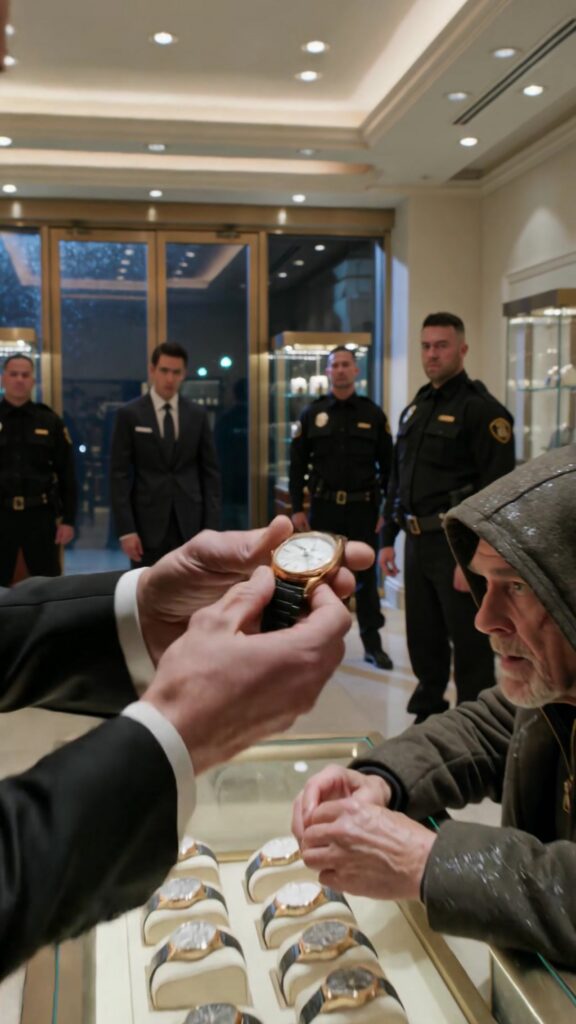
When the doors burst open, the whole place flinched. A gust of wet air barreled in, carrying the smell of rain and asphalt and panic. An old man stumbled through the entrance like he’d been thrown from the street. Water streamed off his coat in ribbons. It pooled beneath his boots, a dark lake spreading across the pristine floor.
The salesman snapped up from behind the counter, his expression already loaded with annoyance. He was the kind of man who looked like he ironed his face every morning. “Not here,” he said, voice sharp enough to cut a diamond. “Take whatever you’re selling and leave.”
The old man didn’t move. He stood in the doorway a beat too long, shaking. Not just cold—something deeper, like the trembling of a building that had already started to collapse.
The boutique’s golden light exposed details nobody in that neighborhood wanted to see: the torn edges of his coat, the red cut along his cheek, the hollowness under his eyes. He held his hands closed in front of him like he was protecting a small animal.
“Please,” he said. The word came out thin. “I just need someone to look at it.”
A couple of customers turned. A woman in a cream trench coat glanced at him, then at her own reflection in the glass, as if checking whether poverty was contagious. A man with cufflinks shaped like tiny anchors raised one eyebrow and smirked.
The salesman let out a dry laugh. “You think this is a pawn shop?”
The old man took a step forward anyway, slow and careful, like the floor might vanish. He reached the counter and opened his trembling fist. Something small landed on the glass with a soft, solid clink.
A watch.
Not shiny-new. Not the kind you saw on billboards. But the weight of it was wrong for an ordinary thing. Even from a few feet away, it had that quiet, expensive confidence—worn edges, old-world craftsmanship, and a face that didn’t need to scream to be heard.
For a moment, nobody spoke. Even the rain seemed to hush, tapping the windows instead of hammering them.
The salesman picked it up like it was a dirty spoon and flipped it over. “You came in here for that?” He sounded irritated and confused, like he’d been asked to admire a rock.
The old man swallowed. His throat worked hard, trying to hold back something huge. “It’s the last thing he touched.”
Something in the room shifted, subtle as a draft. At the far end of the boutique, a younger man in a dark suit lifted his head from the paperwork he’d been pretending to read. He’d been sitting in a low leather chair, half-hidden behind a display of limited-edition chronographs. His hair was neatly kept, his jaw tense, his eyes tired in a way money couldn’t fix.
The salesman scoffed and adjusted the watch in his hand. The engraving on the back caught the light—just a whisper of letters—but the effect was immediate. The salesman’s face emptied out. His mouth opened, then shut. His grip tightened like he was suddenly afraid to drop it.
Before he could say anything, the younger man was already moving, crossing the boutique with controlled urgency.
“Let me see that,” he said.
The tone in his voice snapped the whole store into stillness. It wasn’t loud. It didn’t need to be. It was the kind of authority that didn’t ask permission.
The salesman handed the watch over immediately, suddenly polite, suddenly sweating. The younger man took it with care that looked almost like fear. He turned it in his fingers, eyes scanning the engraving as if reading a message written in a language only he knew.
His breath caught. Color drained from his face.
“Who brought this in?” he asked, and his voice—just for a second—wobbled.
“I did,” the old man said.
The younger man stepped closer, staring now at the old man like he’d found a ghost wearing a stranger’s skin. “Where did you get this?”
The old man hesitated, and in that hesitation there were years. A lifetime of swallowed words. Finally he said, “I gave it to my son… before they took him.”
The boutique felt suddenly too bright, too quiet. The rain pressed its face against the windows, eager to listen.
The younger man froze. His fingers tightened around the watch. He looked down again, then back up, studying the old man’s face as if it was a puzzle missing one crucial piece.
“Only my father,” he whispered, “called me that.”
The old man’s knees seemed to soften. He took one fragile step forward. Tears broke through the rain on his face like they’d been waiting for permission. “Then… Daniel—”
Daniel’s mouth trembled, but he didn’t speak. His eyes were fixed on the old man’s cheek, on the cut, on the familiar shape of his nose, on the way his shoulders rounded like they were still carrying the same invisible weight. He looked like someone trying to remember a song from childhood, the tune right there but slipping away.
“They told me you were dead,” Daniel said, voice low, raw. “They sent a letter. There was… paperwork. A body.” His hands shook, betraying him. “I was sixteen. I didn’t even know where to start looking.”
The old man flinched at the word body, like it was a slap. “They gave us someone else,” he said. “Or they gave us enough to bury and enough to shut us up.” He swallowed hard. “Your mother… she didn’t survive the waiting.”
Daniel’s eyes glistened, but he blinked it back like he’d trained himself to never leak. “Who took me?” he asked.
The old man’s gaze flicked toward the ceiling as if the answer might be written there. “Men in uniforms with clean boots,” he said. “And men in suits who smiled too much. They said you were ‘bright.’ They said you’d have a ‘better life.’ They said I should be grateful.” His voice cracked on the last word. “Grateful.”
Daniel’s jaw clenched. The salesman, who had been hovering like a nervous bird, tried to insert himself. “Mr. Hale,” he said, addressing Daniel with sudden deference, “should I call—”
Daniel didn’t look at him. “Close the doors,” he said. “Now.”
The salesman hurried to obey. The customers murmured, annoyed and intrigued, but they were ushered out with apologetic hand gestures. The boutique emptied until it was just the three of them and the rain.
Daniel guided the old man to the leather chair as if he might shatter. “Sit,” he said, and it wasn’t a command, just a plea dressed like one. He crouched in front of him, still holding the watch. “This engraving,” he said softly, turning it so the old man could see. “It says ‘For D, so you’ll always find your way back.’”
The old man nodded, eyes squeezing shut. “You used to get lost,” he murmured. “Even in places you’d been a hundred times. You’d get distracted. You’d chase a dog or a kite or a shiny pebble.” His laugh was broken. “I thought a watch might anchor you.”
Daniel swallowed hard. “I kept it,” he said. “For years. Then it disappeared.”
The old man looked up, startled. “Disappeared?”
Daniel’s gaze shifted, and the boutique’s warm light suddenly felt colder. “A man donated a box of ‘estate items’ to a foundation I work with,” he said. “This watch was in it. I recognized the engraving. I traced the donation to a shell charity, then to a trust.” He huffed out a laugh with no humor. “That trust funds half the city’s ‘youth outreach’ programs.”
The old man stared. “You’re telling me…”
“I’m telling you they didn’t just take me,” Daniel said. “They built an entire machine around taking kids who wouldn’t be missed by the right people. And they laundered it through good intentions.”
The old man’s hands clenched on his knees. “I tried to fight,” he whispered. “I screamed. I went to offices. I begged. I got told to stop making trouble.” He looked down at his wet boots. “Then someone followed me home and left a dead cat on my doorstep. After that, I learned how to be quiet.”
Daniel reached out, hesitated, then placed his hand over the old man’s. It was careful, like touching something sacred and fragile. “You’re not quiet anymore,” he said.
The old man’s eyes filled again. “I saw your name,” he said. “On a building. A wing at a hospital. ‘Hale Family Donor.’ I thought—no. It couldn’t be. But the picture…” He shook his head. “I came here because I didn’t know where else to go. I thought maybe someone would at least tell me if it was real.”
Daniel looked at the watch again, then at the rain-streaked windows. The city outside was still trying to wash itself clean, like scrubbing harder would erase what it had allowed. “It’s real,” he said. “You’re real.”
He stood and paced once, two steps, then stopped like he’d hit an invisible wall. “I’ve spent my whole life thinking I owed my success to luck,” he said quietly. “To being ‘chosen.’ Turns out I was stolen.”
The old man’s voice was barely there. “I’m sorry.”
Daniel turned back, eyes fierce and wet. “Don’t be,” he said. “You came back anyway.” He held the watch out. “You brought me my way home.”
The old man didn’t take it. He just looked at it like it was a small sun he couldn’t stare at too long. “What happens now?” he asked.
Daniel’s fingers closed around the watch, then he slid it into his pocket like a promise. “Now,” he said, “we stop letting the rain do all the cleaning.”
Outside, thunder rolled over the rooftops, deep and impatient. The boutique’s lights hummed. And for the first time in a long time, Daniel didn’t feel like a polished object locked behind glass. He felt like a person—with a past, and a name spoken by someone who had never stopped waiting for him to answer.
He offered his arm to the old man. “Let’s get you warm,” he said. “Then we talk. And then we make some calls.”
The old man stood slowly, leaning into him like it was both unfamiliar and exactly right. Together, they moved toward the back of the boutique, leaving wet footprints on the expensive carpet. The rain kept battering the city, relentless. But inside, something unburied had finally surfaced, and it wasn’t going to be washed away again.