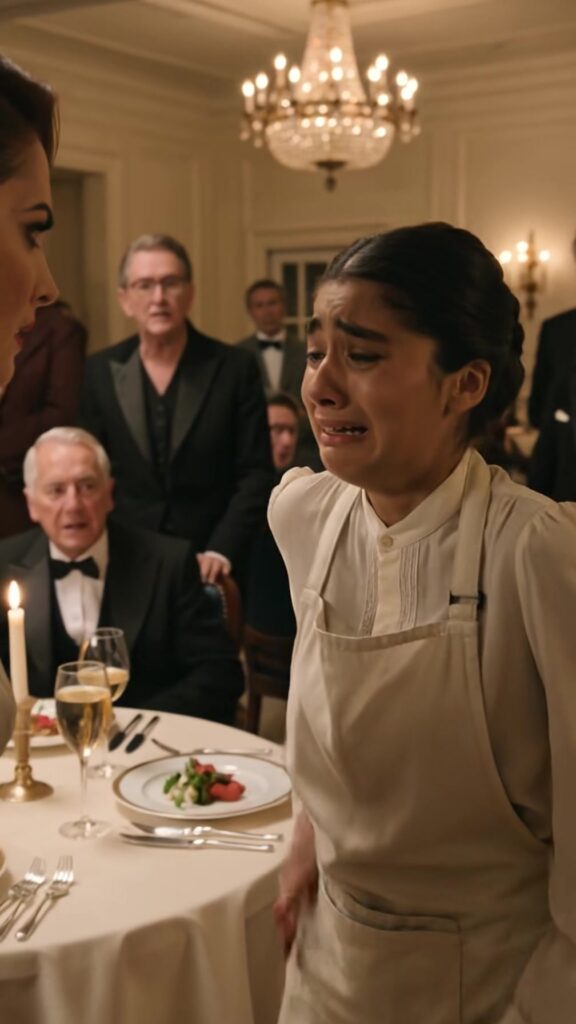
The first thing people noticed about Saffron Room was the chandelier. It wasn’t just big—it was dramatic, the kind of glittery monster that made everyone sit a little straighter, like the crystals were judging their posture. The second thing was the quiet. Not silence exactly, but the soft expensive kind, where forks clink like they’re afraid of getting sued.
I was in the corner booth with my friend Mina, who had invited me out because she said I’d been “working like a haunted printer.” Mina loved this place. She also loved watching rich people do rich-people stuff. “Just wait,” she murmured, leaning toward the aisle. “That table comes every month. Power couple. You can practically hear their stock portfolio breathing.”
The power couple was hard to miss. The husband had that tailored look—hair too perfect, watch too shiny, smiles handed out like business cards. The wife was glamorous in the way a lightning storm is glamorous: beautiful, sure, but you could tell it could hurt you. She wore a white dress that looked like it had never met a wrinkle in its life.
The waitress assigned to their section moved with a cautious intensity. She wasn’t clumsy, not at all. She was careful. Almost too careful, like each step was a decision. She kept glancing at the husband—not flirtatiously, not even boldly. More like she was checking whether he was real.
“See that?” Mina whispered. “That’s either a crush or a crime documentary.”
I was about to shrug it off when it happened so fast my brain needed a second to catch up. The wife stood up like she’d been launched. Her hand snapped across the waitress’s face with a sharp crack that seemed to echo off the chandelier itself.
The tray went airborne. Water glasses skated and shattered. A small cascade of lemon slices hit the floor like yellow coins. Every head turned at once, a synchronized swivel of shock. Somewhere near the bar, a violinist stopped mid-note, the sound clipping into nothing.
“Stay away from my husband!” the wife barked, loud enough to make the candle flames tremble.
The waitress stumbled back, eyes wide. A red mark bloomed on her cheek. She didn’t yell. She didn’t swing back. She just looked like someone had slapped the air out of her lungs and left her with the wrong weather inside.
The husband rose too, but slower, confused fury on his face. “Camille—what are you doing?”
Camille. The name suited her: crisp, sharp, meant to be spoken with authority.
Camille grabbed the waitress’s arm. Not hard enough to bruise immediately, but hard enough that everyone felt it in their own elbows. “Tell them,” she demanded, pulling the waitress closer to their table like she was dragging proof. “Tell everyone why you keep showing up. Why you keep staring. Why you’ve been ‘assigned’ to us three times this month.”
Phones came out. Of course they did. A couple near us stopped chewing like they’d forgotten the concept. The manager hovered at the edge of the room, taking one step forward, then stopping as if he couldn’t decide whether his job was to protect a server or protect the restaurant’s Yelp rating.
The waitress’s lips trembled. “I’m sorry,” she said, voice breaking. “I’m sorry. I didn’t mean to—”
“Not good enough,” Camille snapped. “Tell the truth.”
The husband looked trapped between embarrassment and irritation. “Camille, stop. We can handle this privately.”
“No,” Camille said, not taking her eyes off the waitress. “Public behavior gets a public answer.”
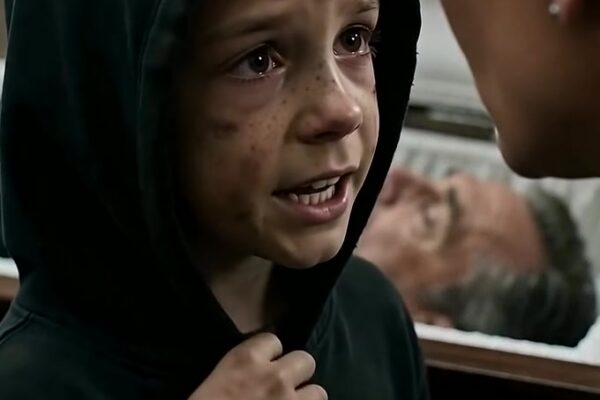
The waitress blinked hard, tears wobbling at the edge. Then she did something that didn’t fit the moment at all: she reached into the front pocket of her apron with shaking fingers, like she’d been practicing this movement in secret.
She pulled out a small photograph. Old. Faded. The corners soft from being handled too much. It looked like it had lived in a wallet through too many summers.
“Please,” she whispered, and held it up toward the husband. “Just look.”
He snatched it, reflexively annoyed, like it was a bill someone had slid under his door. “What is this supposed to—”
His sentence dissolved. His face changed in layers: irritation draining to confusion, confusion collapsing into something hollow. The kind of expression you see when someone realizes the story they’ve told themselves for years has been wrong.
He stared at the picture like it might bite.
In the photo was a baby wrapped in a pale knitted blanket, held by a woman whose face was partly obscured by a tear in the print. The baby’s eyes were shut, cheeks full and round. Nothing remarkable—except the blanket, a particular handmade thing with uneven stitches, like the maker had been in a hurry or crying while knitting.
The husband’s hand began to shake.
At the other side of the room, the pianist—an elderly man with silver hair and a crisp black suit—had stopped playing entirely. His hands hovered above the keys. He wasn’t looking at the scene in general. He was looking directly at the photo, as if he could see it from twenty feet away.
He stood up slowly, one palm resting on the piano’s edge like it was the only thing keeping him upright. “That blanket…” he said. His voice wasn’t loud, but the whole restaurant had gone so quiet it carried. “I’ve seen that blanket.”
Everyone froze harder. Even Camille’s grip loosened a fraction, like her muscles had finally gotten confused.
The pianist took a step forward. Another. He looked like he was walking toward his own past. “I wrapped a little girl in a blanket like that,” he said, eyes glassy. “Years ago. Night of the winter fundraiser. There was a baby in the coat room. A panic. Sirens. People shouting names.” He swallowed. “I remember because my wife knitted that blanket. She was proud of it, even though the stitches were crooked.”
The husband’s eyes flicked up, sharp and terrified. “That night…” he murmured, like he was speaking to himself. “That night they told me she—”
Camille’s face went pale. She wasn’t glamorous anymore. She looked suddenly human and frightened, like she’d just walked into a room and found a stranger wearing her life.
The waitress, still trembling, lifted her chin. Her voice came out thin but steady, as if she’d decided that if she was going to fall apart, it would be after she said what she came to say.
“My mom died last spring,” she said. “Cancer. She didn’t have a lot of time. She kept trying to say something, but she’d cough and get tired. The last week… she finally told me I wasn’t hers. Not really. She said she got me when I was a baby, and she spent every day after trying to earn the right to love me.”
The husband stared at her like he didn’t know how to breathe.
“She said my real father was a man with a name she only knew from an old invitation,” the waitress went on, eyes glossy. “An invitation to a fundraiser at this restaurant. She’d saved it like a secret.”
She reached into her apron again and produced a second item: a folded, yellowing piece of paper in a plastic sleeve. She held it out. It was the kind of thing you’d normally throw away without a thought. But her hands treated it like scripture.
The husband didn’t take it this time. He couldn’t. His fingers stayed clenched around the photo like a lifeline.
“My mom told me to find you,” the waitress said, voice cracking. “She said you were supposed to have a daughter who disappeared. She told me to look for a man who never stopped checking over his shoulder. A man who smiles like he’s trying to prove he’s okay.”
Her eyes darted to Camille, then back. “I’m not trying to ruin your life. I’m just… I’m tired of not knowing where I came from.”
The manager finally stepped forward, but it was half-hearted. Nobody was sure what the correct protocol was for a potential miracle in a dining room.
The pianist stood still, staring at the husband with dawning grief. “You came back every year,” he said softly. “You’d sit right there. Same table. Same month. You’d tip too much and leave too quickly. I thought you were just… haunted.”
The husband’s mouth opened and closed. His eyes rimmed red. “Her name was Lila,” he said, barely audible. “They told me she was gone. They told me it was an accident, that I’d never—”
The waitress flinched at the name, like it struck a chord in her ribs. “I don’t know my name from then,” she whispered. “My mom called me Nora. But she said the first lullaby she ever heard me stop crying to had ‘Li’ in it. Like someone kept saying it over and over.”
Camille looked between them, her breathing shallow. “This is insane,” she said, but it sounded like she was trying to convince herself. “You can’t just—she can’t just walk in with a photo and—” Her eyes darted to the pianist, who looked like a witness no one could bribe. “This is… this is some kind of scam.”
Nora—because that’s what everyone’s brain latched onto—shook her head quickly. “I don’t want money,” she said. “I’m not asking for anything. I just—” She swallowed hard. “I just wanted to see him. Once. To know if my mom was telling the truth.”
The husband took a step toward her. It looked like it hurt, like walking on a leg that had healed wrong. “If you are…” he started, then stopped, because the end of that sentence was too big for a restaurant.
He held the photo up next to her face, hands trembling. His eyes moved between the baby and the woman in front of him, searching for a map. “Those eyes,” he whispered. “That little crease here.” He pointed at his own cheekbone, then looked at hers. “I used to… I used to kiss that spot when she fell asleep.”
Nora’s breath hitched. The whole room stayed frozen, held together by the thin thread of not wanting to ruin whatever was happening.
Camille’s shoulders dropped, as if the anger had nowhere to land anymore. Her hand— the one that slapped—hung at her side like it didn’t belong to her. “Why didn’t you tell me?” she whispered to her husband, voice suddenly small. “About… about any of it.”
He didn’t look away from Nora. “I did,” he said, and the words sounded exhausted. “In the beginning. You didn’t want to talk about it. You said grief was ‘bad energy.’”
That landed like another slap, quieter but sharper. Camille’s face tightened, and she looked like she might bolt, or shatter, or both.
Nora wiped at her cheek with the back of her hand, leaving a streak through her tears. “I know this is a mess,” she said. “I know I shouldn’t have come like this. But I didn’t know how to get to you. I applied here because I saw you on the donor wall. I thought maybe if I served your table, you’d look at me and… I don’t know. Feel something.”
The husband made a broken sound, somewhere between a laugh and a sob. “I have felt something,” he said. “Every time you walked by.”
The pianist exhaled, long and shaky, like he’d been holding his breath for a decade. “Maybe,” he said softly, “this is the part where the truth finally gets to sit down.”
The manager cleared his throat as if remembering he was supposed to exist. “Sir,” he started, then stopped, because “sir” felt ridiculous in the middle of a family being unearthed.
The husband looked around, finally seeing the room full of witnesses. Phones. Eyes. Crystal light. He swallowed and did the simplest thing that somehow felt like the bravest.
He offered Nora his hand. “Come,” he said. “Not here. Not with everyone watching. But… come with me. We’ll talk. We’ll get a test. We’ll do this the right way.”
Nora stared at his hand like it might vanish. Then she took it, gently, like she was afraid to squeeze too hard and wake up.
Camille stood there, frozen in the wreckage of her own certainty, while the chandelier kept sparkling like it hadn’t just watched a life get rewritten.
And in the Saffron Room, where people came to celebrate deals and anniversaries, the most expensive thing on the menu that night turned out to be the past—served all at once, with a side of shattered glass and a truth nobody expected a slap to uncover.