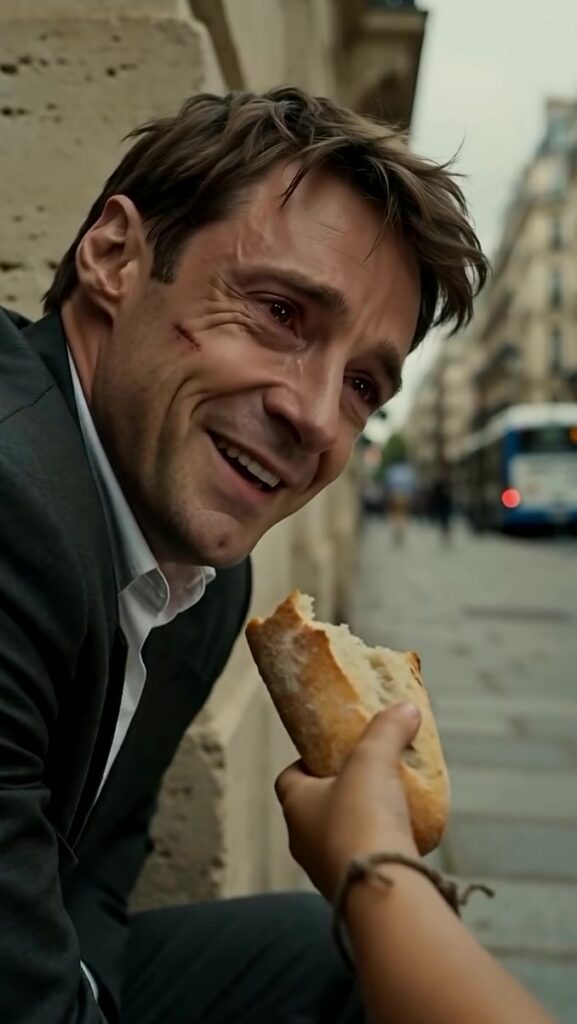
Adrian reached inside his jacket slowly and pulled it out like the motion belonged to someone else. He half expected the lining to snag, or for his fingers to come back empty, as if the last ten years had been a prank played by his own memory.
But there it was. Cold metal. Familiar weight. The old silver lighter caught the pale afternoon light, and for a second the entire street seemed to pause to admire it—traffic noise muffled, pigeons hanging mid-step, the air holding its breath.
The girl across from him—barely a woman, really, with windblown hair and a jacket that didn’t fit quite right—stared at the lighter like it was a photograph of someone she’d lost. Her eyes filled instantly. Not dramatic tears, not a sob, just that quick glassy sheen that comes when something hits too deep to explain.
“That’s it,” she whispered.
Adrian’s grip tightened. His hand began to shake, and he hated that it did. He was thirty-four years old, a person who paid bills and argued with customer support and pretended he didn’t care what strangers thought. He wasn’t supposed to tremble over a battered lighter he’d found in a thrift store a month ago.
Except he hadn’t really found it.
He’d been pulled toward it, like a magnet in his chest. A tray of mismatched keychains and tarnished rings, a few bent spoons, and then the lighter, sitting there with a faint scratch that formed a crescent moon near the hinge. He’d touched it and felt a warm flash behind his eyes—gasoline, ocean wind, somebody laughing with their mouth too close to his ear. He’d bought it without haggling, like it was already his.
Now the girl held up her wrist as if presenting evidence. A bracelet looped around it—thin leather, worn soft, with a small silver charm shaped like a crescent. The same crescent, the same scratch, the same little curve that made Adrian’s stomach flip.
He looked from the lighter to the bracelet, from the bracelet to the girl. The question rose up in him, already half-answered by the way her lower lip trembled like she’d been carrying it for years.
“Who are you?” he asked.
The girl opened her mouth—
Then froze.
Her gaze slid past him like someone had yanked her attention by the collar. Adrian followed it automatically, turning his head toward the opposite sidewalk.
Across the street, half-hidden beside a bus shelter, stood a woman in a dark coat watching them. Thin. Pale. Motionless, like she’d been painted into the scene and forgotten. Commuters flowed around her without seeing her, the way people do around someone who doesn’t belong.
Even from that distance, Adrian knew her.
Elena.
The name didn’t arrive politely. It slammed into his chest, made his ribs ache. Elena with the quick hands, the crooked grin, the habit of stealing sugar packets and stuffing them into his pocket like it was a love language. Elena who disappeared one winter morning and left nothing behind but a voicemail that cut off mid-sentence and the faint smell of smoke in their apartment.
The girl grabbed his sleeve with sudden panic. Her fingers were cold, nails bitten down. “Don’t let her run again,” she said.
Again.
Adrian’s mind tried to stand up too fast, like he’d gotten off a couch after hours and the room tilted. He stared at Elena across the street. She didn’t wave. She didn’t smile. She just watched, eyes fixed on the lighter in his hand as if it was the only real object left in the world.
“Elena!” Adrian called, and his voice sounded rough, like it hadn’t been used in years.
Elena’s head angled slightly, acknowledging the sound without committing to it. Then she stepped back, slipping behind the bus shelter’s glass panel.
Adrian moved without planning to. He crossed the street too fast, ignoring a honking car and the driver’s shouted insult. The girl kept up, still attached to his sleeve like she was afraid he’d evaporate.
When he reached the shelter, Elena was gone.
Of course she was.
Adrian spun in place, scanning the sidewalk, the alley mouth between a bakery and a pawn shop, the corner where a delivery van idled. No dark coat. No pale face. Just normal people on a normal afternoon, clutching coffees and checking phones and stepping around a puddle that reflected the gray sky.
He laughed once—sharp, humorless. “I’m losing it,” he muttered, though it didn’t feel like losing. It felt like being handed something that had been hidden.
The girl tugged him toward the alley. “She goes that way,” she said, like she’d seen it happen enough times to map it.
“How do you know?” Adrian demanded. “How do you know her?”
The girl swallowed, looking anywhere but his face. “Because she’s… because she’s the reason I’m here.”
Adrian followed her into the alley anyway, because his feet had stopped obeying logic the moment he’d spoken Elena’s name out loud. The alley smelled like yeast and wet cardboard. A cat darted away, vanishing under a dumpster. At the far end, an old fire door stood slightly ajar, as if inviting them into a building that didn’t want visitors.
The girl pushed it open with her shoulder. Inside was a narrow stairwell lit by a flickering bulb. Footsteps echoed above them, quick and light.
“Elena!” Adrian called again, taking the stairs two at a time. The girl stayed close, breathing fast.
They emerged onto a hallway that should’ve led to storage rooms. Instead, it opened into a wide space that looked like an abandoned dance studio—mirrors cracked, a barre sagging, dust floating in slow spirals. In the center, Elena stood with her back to them, coat hanging off her shoulders like it was too heavy.
She turned.
Up close, she looked like she always had and not at all. Same sharp cheekbones, same dark hair, but her eyes were brighter, almost feverish. She didn’t look older. She looked paused, caught mid-year, like someone had hit stop on her life and forgotten to press play.
Her gaze dropped to Adrian’s hand. “You kept it,” she said softly.
“I didn’t,” Adrian shot back. “I found it. In a thrift store. Like the universe threw it at my head.” His throat tightened. “Where were you?”
Elena’s expression flickered—guilt, pain, something like relief. “Not gone,” she said, which was the least helpful answer in the history of answers.
Adrian took a step forward, then stopped. Because the girl had moved too, and Elena’s eyes jumped to her with a look Adrian couldn’t name.
The girl lifted her wrist, showing the bracelet. “You promised,” she said, voice cracking. “You said you’d stop running.”
Elena’s shoulders sagged. “I tried,” she murmured.
Adrian’s brain finally caught up to the scene—the bracelet, the lighter, the shared crescent mark like a signature. “Who is she?” he demanded, the question now aimed at Elena as much as the girl.
Elena’s eyes returned to Adrian’s. For a second, the old Elena was there, the one who’d smirk and dodge and pretend secrets were romantic.
But she didn’t smirk.
She reached into her own coat and pulled out something small and folded. A photograph, edges softened with handling. She held it out with shaking fingers, and Adrian saw a snapshot of himself—him and Elena on a beach, wind whipping their hair, his arm around her shoulders.
And between them, grinning like she belonged there, was the girl.
Adrian’s mouth went dry. “That’s not possible,” he whispered, though his eyes knew the truth before his mind did. The girl in the photo looked younger, but it was her. Same eyes. Same stubborn chin.
Elena’s voice came out like it hurt. “It wasn’t supposed to happen like this,” she said. “I was trying to fix something. I was trying to give you a life where you didn’t—” She stopped, swallowed hard. “Where you didn’t lose her.”
The girl’s grip tightened on Adrian’s sleeve, not letting go. “Tell him,” she said. “Tell him before she disappears again.”
Elena stared at the lighter in Adrian’s hand as if it was a key and a weapon at the same time. “It’s tied to you,” she said. “To your choices. That lighter is how you remember. And remembering is how you keep me from slipping away.”
Adrian looked down at the old silver lighter. He thumbed it open. The lid clicked with a sound that hit him right in the ribs. A flood of images pressed against the inside of his skull—Elena laughing, Elena crying, Elena saying, Run when the door opens, Adrian, don’t look back. A tiny hand in his, sticky with ice cream. The scent of smoke and sea salt.
He snapped it shut, breathing hard.
“You didn’t just leave,” he said, voice breaking. “You were taken. Or you… you chose something else. Something that made this happen.” He nodded toward the girl, because he couldn’t say the word yet. Daughter. He couldn’t fit it in his mouth without choking.
The girl blinked rapidly, tears finally spilling over. “Adrian,” she said, like she’d practiced his name in secret, “I’m not here to ruin your life.”
Elena let out a shaky laugh that wasn’t funny. “She’s here because you already did,” she said, then immediately looked sorry she’d said it. “No. That’s not fair. It’s complicated.”
Adrian held the lighter tighter, like it might anchor him. “Then uncomplicate it,” he said. “Tell me who she is. Tell me what you did. Tell me why you’re standing here like a ghost.”
Elena’s eyes glistened. “Because I am,” she admitted. “Not dead. Not alive the way you are. I’m… in between. And she shouldn’t be here either. But she came anyway.”
The girl stepped forward, voice small but fierce. “I came because you keep running and it keeps resetting,” she said. “Every time you vanish, everything fractures. I remember it. I remember you leaving over and over, and I’m tired.”
Adrian felt the room tilt again, but this time he didn’t fight it. He looked at the girl, really looked, and saw his own mouth in hers, his own stubborn eyebrows. He saw Elena’s eyes in the way she held herself like she was bracing for disappointment.
“What’s your name?” he asked, gently, like approaching a scared animal.
The girl hesitated, then answered, “Mara.”
Elena flinched at the name like it had weight. Mara glanced at her, then back at Adrian. “You named me,” she said. “Before everything went wrong.”
Adrian swallowed. The lighter clicked open again in his hand, almost by itself, and in the reflection of the small mirror behind Elena, he saw three of them standing in a triangle—past, present, and whatever the heck this was.
Elena took a step back, eyes darting toward the cracked window at the far wall. “I can feel it,” she whispered. “The pull. It’s starting.”
Mara’s panic returned full force. “No,” she said, grabbing Adrian’s sleeve again like that alone could hold the universe together. “Don’t let her run again.”
Adrian looked from Mara’s bracelet to the lighter, then up at Elena. His heart hammered like it was trying to break out and chase her itself.
“I’m not letting anyone disappear,” he said, surprising himself with how certain he sounded. He took a step toward Elena, holding the lighter out between them like an offering. “If this thing is a key, then we use it. We don’t throw it away. We don’t hide. We don’t run.”
Elena’s breath hitched. Her fingers hovered, trembling, as if touching the lighter might burn her.
Outside, a bus sighed to a stop, brakes hissing. The studio’s light flickered, once, twice—like a countdown.
Elena’s eyes met Adrian’s, and for the first time since he’d seen her across the street, she looked afraid.
“Okay,” she whispered. “Then listen. Because if I start to fade, you have to remember everything. Even the parts you hate.”
Adrian nodded, throat tight.
Mara stepped in close on his other side, shoulder brushing his. She didn’t let go of his sleeve. Not even for a second.
Elena placed her fingertips on the lighter, and the metal flashed coldly, catching the pale afternoon light one more time—bright enough to make Adrian blink, bright enough to make the world feel thin at the edges.
And then Elena began to speak.
“It started the night you decided to follow me onto the ferry…”