When Adrian Vale stepped into the alley, the children were the first thing he saw.
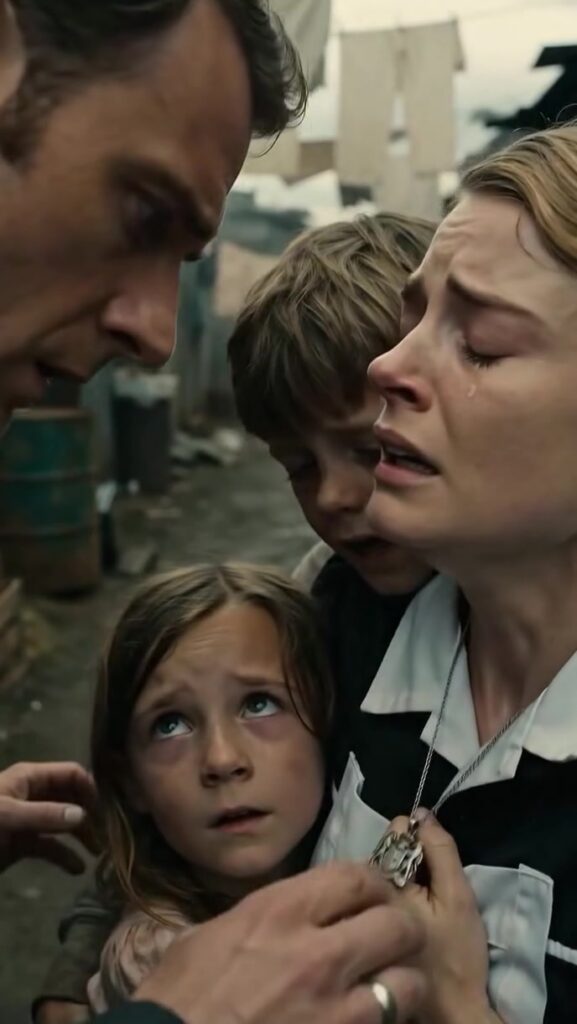
Not the puddles reflecting a dull sky. Not the ropes of laundry cutting the space into sagging banners. Not the tinny clatter of a loose sheet of metal somewhere up high. Kids first—because kids had a way of hijacking your eyes, especially when they were small and scared and holding on to someone like she was the only solid object in the world.
They were wrapped around Lina.
Lina, his housemaid. Lina, who walked through his marble hallway like she was trying not to take up oxygen. Lina, who never met his gaze unless spoken to. And Lina, who had been—according to the very confident head cook—stealing food from the pantry and vanishing on her breaks like she had someplace important to be.
Adrian had a whole speech loaded in his chest on the ride over. Angry words that felt righteous when he practiced them in the car. Rules. Trust. His father’s voice in his head: If you let one person bend the standards, you teach everyone to snap them.
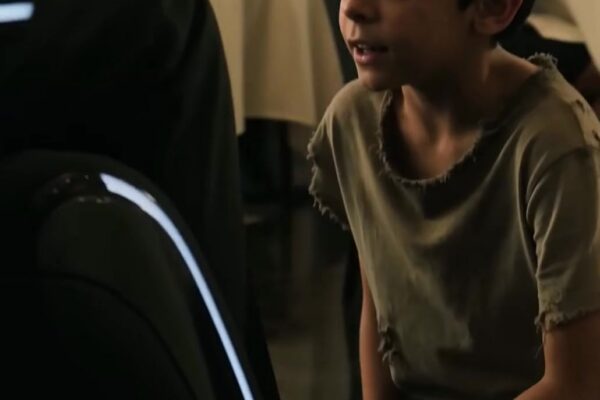
Then a boy’s thin arms tightened around Lina’s waist and the kid’s whole face crumpled.
“Mom,” he wailed, and buried himself in her apron like he could disappear into the fabric.
The word hit Adrian weirdly—like a thrown stone you don’t see coming. Lina’s shoulders went rigid. She looked up at him, and for a second the alley’s gray light made her look almost translucent, all fear and exhaustion held together by stubbornness.
“Please,” she said, too fast. “I can explain. I’m not— I didn’t mean— I needed the job. I needed it.”
Adrian stopped where he was. He’d stepped into a lot of rooms in his life—boardrooms, kitchens, clinics, even a court once for a charity thing—and he’d learned to read a situation in about three heartbeats.
This wasn’t a thief caught in the act.
This was someone who’d been running on panic for so long she’d forgotten what calm felt like.
He lowered his hands, palms out, a dumb gesture he hadn’t used since he tried to coax a neighbor’s dog out from under a porch as a kid. “Lina, I’m not here to… I’m not going to hurt anyone.”
The girl—maybe five?—peeked around Lina’s hip. Her dress was faded to a color that used to be pink. Her face was smudged, her hair a tangled halo. She didn’t cry. She just stared at Adrian like she was trying to solve a puzzle.
The boy sniffed hard, eyes red. He glanced at Adrian and asked in a shaky voice, “Is he bad?”
Lina flinched as if the question itself was a slap. “No, no,” she whispered, but there was no confidence in it. Just hope.
Adrian swallowed. He’d come to an address scribbled down by his driver after following Lina on her “break.” He’d pictured some secret boyfriend, some gambling debt, maybe an organized theft ring—something dramatic enough to justify his irritation. Instead he got a damp alley, a door that didn’t quite close, and a mother-shaped woman holding her world together with her arms.
“Why are you here?” he asked, voice softer than he intended. “Why didn’t you tell anyone you had… a family?”
Lina’s laugh came out sharp and broken, like it scraped her throat. “Because that’s how you lose the job. Because people hear ‘children’ and they hear ‘late’ and ‘sick days’ and ‘problems.’ Because I can work, Mr. Vale. I can work harder than anyone. I just—”
Her voice faltered. Her eyes flicked to the shack behind them: patched boards, an old blanket for a curtain, a plastic bucket catching drips from somewhere overhead. Adrian’s gaze followed and his anger, which had felt so organized earlier, started to dissolve into something messier.
He noticed details with a kind of reluctant clarity: the boy’s cheeks too hollow, the girl’s shoes two sizes too big, Lina’s skirt hem stained with alley mud. He noticed how her hands shook even as she tried to steady the kids.
And then he noticed the pendant.
It was half-hidden under the white collar of her uniform, a little silver oval on a chain that looked older than both children combined. As Lina shifted, it slipped into view. A tiny crest caught the light—a mark Adrian had seen stamped into stationery and pressed into wax, stitched into suit linings like an invisible signature.
The Vale crest.
His stomach dropped so fast he almost felt sick.
Adrian’s fingers went to his ring without thinking. Same mark. Same little lion shape with the odd notch in the tail, a mistake in the original design that his grandfather had insisted was “character.”
“Where did you get that?” Adrian asked. He heard the change in his own voice—less boss, more… something cracked.
Lina went completely still. The boy’s crying quieted into sniffles, like even he sensed the air shift. The girl tilted her head, studying Adrian with those solemn eyes.
Lina’s lips parted, then closed. She looked like she was deciding which lie would hurt least.
Adrian took one careful step closer and stopped when Lina instinctively moved back. That tiny retreat did something sharp to him. He didn’t like it. He didn’t like that his presence felt like danger to her.
“Lina,” he said, keeping his voice low. “I’m asking because… because that’s not something you just find.”
Her gaze flicked to his hand. His ring. Her throat bobbed as she swallowed.
“It was mine,” she said finally. “And it wasn’t supposed to be.”
Adrian blinked. “What does that mean?”
She exhaled like she’d been holding her breath for years. “I used to work at the lakeside estate. Before your father sold it. I was younger. I was stupid.” She paused, eyes glistening. “You were there for the summer. You were… kind to me.”
Adrian’s mind scrambled, flipping through old memories like a book he’d never reread. Sunlight on water. The smell of cut grass. A girl in uniform laughing at something he’d said because he’d been trying too hard to sound charming.
He remembered a pendant once, on a chain he’d stolen from his own jewelry box because he wanted to impress someone. A childish, ridiculous gesture. He’d given it away like it was nothing.
“No,” he said, but it came out as a breath. Not denial—just disbelief.
The girl stepped forward an inch, still holding Lina’s hand. Up close, Adrian saw it more clearly: the same heavy-lidded shape to the eyes, the same slight downturn at the corners of the mouth when thinking. Features that mirrored his own face in a way that made his skin go cold.
He looked at the boy too. Different, maybe, but there was something familiar there as well—the brow, the stubborn set of the chin.
Adrian’s heartbeat turned loud. He hated that the alley felt suddenly small, like the walls were leaning in to hear.
“How old are they?” he asked.
“Six,” Lina whispered, nodding at the boy. “And five.”
Adrian did the math without meaning to. The answer landed with a thud in his chest. He remembered that summer, how he’d left early because his father called him back for “real responsibilities.” He remembered telling himself it was just a flirtation, a sunny little mistake that didn’t count as life.
Lina’s eyes shone with tears she refused to let fall. “I didn’t come after you. I didn’t ask for anything. I didn’t want them to be… a weapon. I just needed to keep them fed.”
“So you took food from my house,” Adrian said, not accusing—trying to understand.
“I skipped meals,” Lina said, voice cracking. “Until skipping stopped working. I stole bread. Apples. Whatever I could hide.” She pressed her forehead to the boy’s hair for a second. “I’m sorry. I’m so sorry.”
The girl looked up at Adrian then, eyes huge, and said matter-of-factly, “Mom cries when she says your name.”
Adrian felt something inside him give way. Not a single dramatic snap—more like a seam tearing slowly, quietly, until everything he’d stitched into place started spilling out.
He crouched down so he wasn’t towering over them. The alley smelled like damp wood and soap, and somewhere far off a vendor shouted prices like life was normal.
“Hey,” he said gently to the kids, and was surprised his voice didn’t shake. “I’m Adrian.” He glanced up at Lina. “I didn’t know. I swear to you, I didn’t know.”
Lina stared at him like she didn’t trust the words to be real.
“You’re not going to take them,” she said. It wasn’t a question. It was a plea dressed up as a statement.
Adrian swallowed. A dozen options raced through his head—lawyers, headlines, his father’s icy disapproval, the way society people loved a scandal as long as it wasn’t theirs. And underneath it all, a much simpler thing: two small hands gripping their mother like the world was slippery.
“I’m not here to steal anyone,” he said. “I’m here to stop you from having to be afraid.” He paused, then added, because it mattered: “If they’re mine… I want to do this right. With you. Not to you.”
Lina’s breath hitched. She blinked fast, and finally a tear fell, tracing a clean line down her cheek through the grime.
Adrian looked at the pendant again, the old crest dull with time. He thought about how he’d worn his family name like armor for so long he forgot it could also be a promise.
“Come with me,” he said quietly. “Not as my employee. As Lina. As their mom. And… if you’ll let me figure out how to be it—” He hesitated, feeling ridiculous and unprepared. “As whatever I’m supposed to be to them.”
The boy sniffed and peeked out, studying Adrian with suspicion that belonged to someone much older. “Are you rich?” he asked.
Adrian almost laughed, but it turned into something closer to a sigh. “Yeah,” he admitted. “But I’m also new at this.”
The girl squeezed Lina’s hand, then looked at Adrian again, as if filing him away for later. Lina didn’t answer right away. She just held her children and watched Adrian like he might vanish if she blinked.
In the narrow, damp alley where he’d come to deliver a lecture, Adrian Vale stayed crouched in the mud and waited for Lina to decide whether to trust him with the rest of her life.
For the first time in years, he didn’t feel like the one in control. And somehow, that felt like the start of something honest.