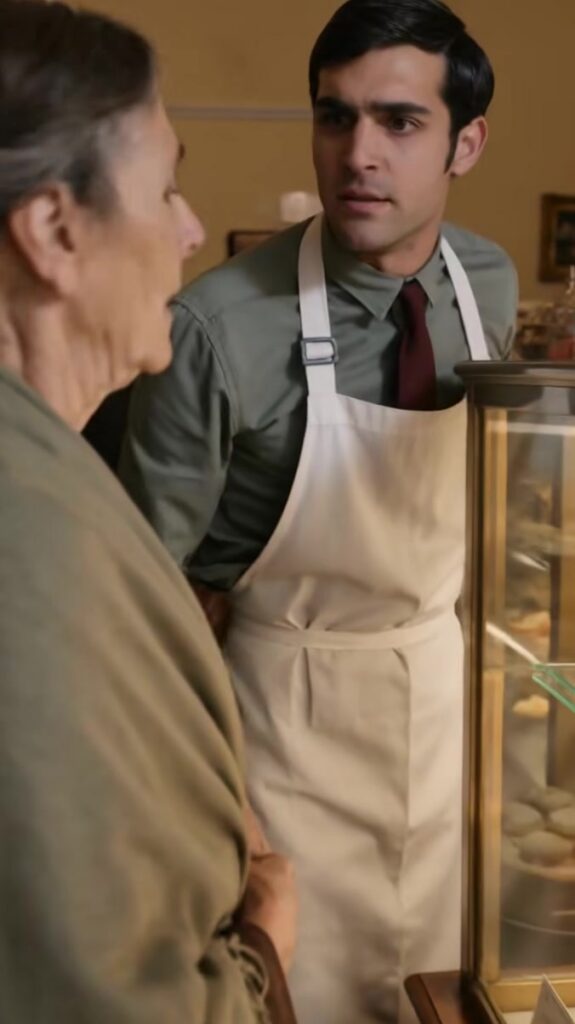
The bakery smelled of warm bread, vanilla cream, and fresh strawberries, and for a moment it fooled Lina into believing she had stepped into a kinder world. Golden light pooled on the tiled floor, catching sugar dust in the air like tiny falling stars. Behind the glass, cakes stood in neat ranks—glazed fruit tarts, towering chocolate spirals, and one pink birthday cake crowned with white roses so delicate they looked alive.
“Grandma,” Lina whispered, eyes wide as the roses, “do princesses get cakes like this on their birthdays?”
Mara’s answer lived somewhere behind her teeth. It pushed against her throat, trying to climb out. Her lips trembled, and the hand holding Lina’s tightened as if Mara could keep the past from leaking through her fingers.
Before she could speak, a young employee snapped from behind the counter, voice sharp enough to cut fondant. “Don’t stand there pressing on the glass if you can’t buy anything!”
The bakery’s brightness shifted, as if someone had turned a dimmer switch. Heads turned. A man by the register paused mid-count, coins stacked like a fragile tower. A child in a school uniform stopped licking frosting and simply stared. Lina recoiled and tucked herself behind Mara’s skirt, her small shoulders curling inward.
“She was just looking,” Mara said quietly, the words carried on a breath that shook.
The employee’s laugh came out dry. “Then look faster and leave.”
The sentence landed in the space between Mara and Lina, heavy as a door slammed. Lina’s fingers clutched tighter, and when she glanced down, it wasn’t at the cakes anymore—it was at her own shoes, as if she could apologize by shrinking.
Mara’s hands began to tremble. Not with fury. With a hurt so old it had layers, like pastry folded and refolded until it became something that could shatter at the slightest pressure.
A door swung open behind the counter. A man stepped out with a cake box cradled in his arms, his apron tied neatly, his sleeves rolled as if he had been working too hard to notice the world. He heard the last words and stopped as though the air had turned solid.
His gaze went from the employee’s face to Lina’s hiding place and then to Mara’s hands—those hands, thin and veined, but still shaped by years of work, still marked with tiny pale scars from burns and blades. His breath caught.
“Wait,” he said, the box lowering an inch. “She taught my mother how to bake.”
Silence fell. Even the espresso machine seemed to hold its hiss. The employee’s cheeks drained of color.
Mara lifted her eyes, confusion and alarm mixing like batter. “I… I don’t know you,” she said, but her voice cracked on the last word.
The manager set the box down and came closer, slow, as if approaching an animal that might bolt. His own hands trembled now. “I do,” he whispered. “I know those hands. My mother used to say no one in this city could pipe roses the way you did. She said you made flowers that looked like they remembered how to bloom.”
Mara’s breath stuttered. Her shoulders drew back as if struck. “No,” she said faintly. “That bakery is gone.”
The manager’s eyes shone, not with salesmanship, but with something raw. “My mother never forgot you. She said you vanished the night the fire happened.”
At the word fire, Mara’s face broke open. Her mouth tightened, then softened, then tightened again as she fought for control and lost it. Lina leaned out from the skirt, brow furrowed with a child’s sharp instinct for a secret.
“Grandma,” Lina asked, voice barely above the hum of the lights, “what fire?”
Mara squeezed her eyes shut, because she had built Lina’s life on carefully chosen omissions. Because truth, she had thought, was a knife that only cut deeper when a child tried to hold it. But the manager’s voice had already pulled the blade halfway free.
He glanced toward the gawkers and, with a firmness that made the employee flinch, said, “Everyone—please. Give them a moment.” It wasn’t a request; it was an order. People looked away, suddenly fascinated by labels and napkins and their own guilt.
He guided Mara and Lina toward a small table by the window, away from the glass. A pot of strawberries sat nearby, their red skins glossy as lacquer. The manager brought water, then, without asking, a plate with two small pastries—plain, unsponsored by frosting, modest as a confession.
“My name is Tomas,” he said. “My mother is Eliana.”
Mara’s lashes lifted. Her eyes, wet and dark, found his. “Eliana… with the laugh that filled the ovens,” she murmured, as if remembering a sound could keep ash from settling on it. “She was just a girl when she started.”
“She’s still baking,” Tomas said softly. “In her kitchen. She can’t stand too long, but she insists. She tells me stories about you like you were a saint who wore flour on her sleeves.”
Mara’s fingers worried the edge of her coat. “Saints don’t run,” she said.
Lina climbed onto the chair, knees drawn up, eyes darting between the two adults. “Grandma ran from a fire?” she asked, careful, as if the wrong word might make the room explode again.
Mara stared at her granddaughter’s face—the same soft mouth Lina’s mother had as a child, the same questioning gaze. Her throat tightened so hard it hurt. “I ran,” she admitted. “But not from the flames.”
Tomas swallowed. “My mother always said the fire was wrong. The inspectors said faulty wiring, but she said you’d warned the owner about the smell of gas weeks before.”
Mara’s jaw trembled. “I did,” she said. “He laughed. Said I worried too much. Said a woman who kneaded dough all day didn’t know anything about pipes.” She took a breath that sounded like it scraped something loose in her chest. “That night, I stayed late. Your mother was gone already. I had… I had someone waiting.”
Lina’s eyes widened. “Who?”
Mara’s gaze fell to Lina’s hands—small, clean, unburned. “Your mother,” she said, and the words made the air change. “My daughter. She was pregnant with you. She said she wanted to surprise me after my shift.”
Tomas’s face tightened, understanding blooming painfully. “You never told her you were there,” he said, not accusing—placing the pieces down gently, like fragile cups.
Mara shook her head. “I never told anyone. Because if I spoke, the man who owned the bakery would have found a way to make it my fault. Because if I spoke, I would have had to say that my daughter was inside when the smoke came.” Her voice thinned to a thread. “And I couldn’t carry that story and also carry you.”
Lina went very still. The bakery noises returned in distant layers—the clink of a tray, a muted cough, a whispered apology somewhere at the counter. Lina’s small mouth opened and closed once, like a door that didn’t know whether it was safe to swing.
“My mom,” Lina said slowly, “she… she didn’t just leave?”
Mara’s eyes filled again, but this time she let the tears come. “No, sweetheart,” she said. “She didn’t leave you. She fought to stay. The fire took her. And I have been afraid that if you knew, you would blame this world for being cruel. But it’s cruel whether you know or not.”
Tomas leaned forward, voice low. “My mother said you got people out. That you went back in when everyone else ran.”
Mara’s hands curled, remembering heat. “I heard a baby crying,” she whispered. “Not yours—someone else’s. I found him under a table, wrapped in a towel. I carried him out. Then I went back because I thought… I thought my daughter—” Her voice broke cleanly, like glass. “There was only smoke and the sound of the roof giving up.”
Lina slid from her chair and climbed into Mara’s lap, pressing her face into the faded coat. Mara held her as if she were holding the last unbroken thing in the world.
Across the bakery, the employee hovered, pale and rigid, shame stapled to his posture. Tomas looked over and said, not loudly but clearly, “You will apologize. And you will learn what it means to see people.” The employee’s throat bobbed; he nodded, eyes down.
Tomas returned his attention to Mara and Lina. “I can call my mother,” he offered. “If you want. She’s been waiting for an ending to her story for twenty years. Maybe this is it.”
Mara blinked, as if waking from a long, punishing dream. “And the cake?” Lina asked into her coat, voice muffled but hopeful in a way that hurt.
Tomas stood, reached behind the counter, and returned with the pink cake in its box, the white roses untouched. He set it on the table as though placing a crown. “Princesses do,” he said, meeting Lina’s gaze, “but so do brave girls. And so do grandmothers who carried smoke in their lungs and love in their hands.”
Mara’s fingers hovered over the lid, shaking less now, not because the past was lighter, but because it had finally been spoken aloud. When she lifted the box, the scent of vanilla rose like a promise. Outside, the world continued to rush and scrape and bruise, but inside this small pool of warm bread and strawberries, a truth sat down beside them—terrible, tender, and no longer alone.