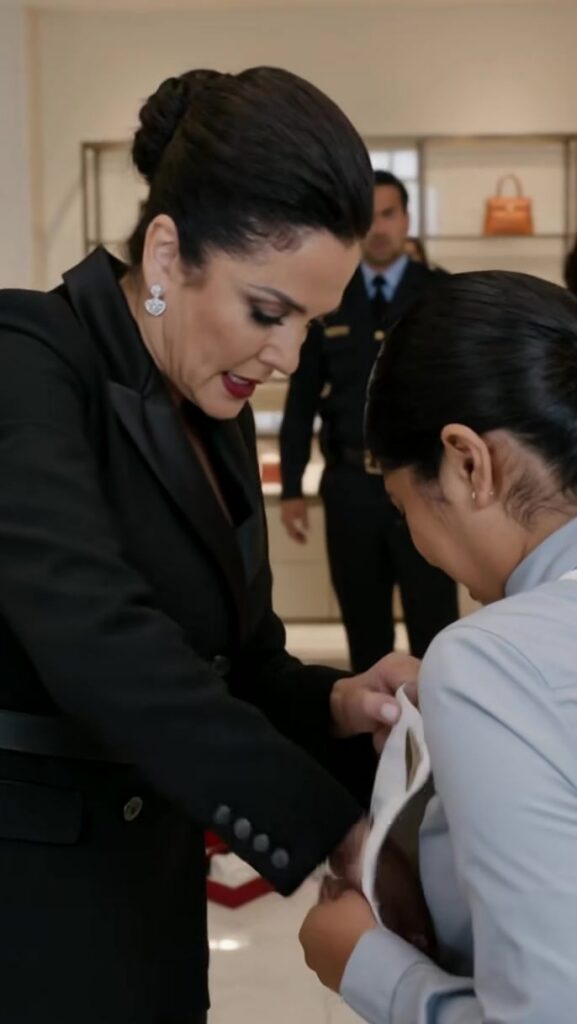
The luxury fashion boutique looked flawless, the kind of flawless that made you forget the street outside existed at all. Light fell from designer fixtures in clean, calculated beams. The marble floor wore a mirror-sheen that returned every stiletto step as a soft echo. Handbags perched on velvet plinths like prizes in a museum. Diamonds and gold sat under glass, each piece lit as if it were the only important object in the city.
Alina kept her smile pinned in place the way the boutique taught her: gentle, unobtrusive, grateful. She was new—new enough that the managers still spoke to her in warnings rather than instructions, new enough that she still smelled of laundry detergent and the bus. Her black apron held a tape measure, a tiny notebook, and a pen that had stopped clicking properly. She kept her hands folded at her waist, the way Madame Sorrel insisted, so her fingers wouldn’t betray how nervous she felt.
On Saturdays the boutique filled with champagne confidence. Women slid through the aisles with practiced patience, as if the world would wait until they decided. A man in a tailored jacket spoke into his phone like he owned both ends of the conversation. Soft music drifted from hidden speakers—something silky and old, a soundtrack to money.
At 2:17 p.m., the boutique’s perfection broke like glass.
The woman arrived like a storm contained in couture: towering heels, a white coat so sharp it looked cut from bone, hair glossy enough to reflect the lights. She didn’t so much enter as claim the air. Alina stepped forward, offered the standard greeting, and received only a quick scan—eyes that measured, judged, dismissed. The woman’s wrist glittered with bracelets that chimed together when she moved, as if announcing her presence.
She leaned over the handbag counter, asked to see a limited-run clutch, then, in the same breath, froze. Her gaze sharpened into something predatory. “My bracelet,” she said. Not loud at first—just certain. “Where is it?”
Alina blinked, confused. “Madam, I haven’t—”
“Don’t lie.” The woman’s voice cracked like a whip. In a violent second she lunged, hand snaking across the counter, fingers tangling in Alina’s hair. Alina’s scalp screamed with pain as she was yanked forward, her knees knocking the lower cabinet. The boutique’s music kept playing, absurdly calm, while everything else turned frantic.
“Thief!” the woman shouted, and the word detonated against the polished walls. “I saw you hide my bracelet!”
Alina’s mouth opened, but before sound arrived the woman slapped her. The sting landed with a crack that made nearby customers flinch. Display boxes scattered when Alina stumbled backward, her elbow clipping a tower of silk-lined cartons. Tissue paper fluttered like startled birds.
A girl near the fitting mirror covered her mouth. The man in the tailored jacket froze mid-step, phone suspended near his ear. Even the security guard, Tomas, hesitated—his hand half-raised as if deciding whether to intervene or obey.
“Search her now!” the woman commanded, pointing at Alina as if she were an object to be inspected.
Tomas’s jaw tightened. Then he stepped in, apologizing under his breath the way employees did when humiliating someone. His fingers reached for Alina’s apron pocket. Alina flinched away, but his grip was firm. He reached in and pulled out a diamond bracelet.
For an instant it seemed the entire boutique inhaled at once. The bracelet caught the light and threw it back as cold fire. Perfect stones, set with an artistry that made the piece feel alive. Gasps burst from every direction. The rich woman’s face lit with triumph.
“I knew it,” she said, the smile returning like a blade sliding into its sheath.
Alina stared at the bracelet as if it were a snake. Her throat closed. Tears blurred the stones until they became a constellation. “That… isn’t yours,” she whispered. The words were too small for the room, but they landed anyway, because something in her voice wasn’t defensive—it was horrified.
“Of course it is,” the woman snapped. “You thought you could hide it and—”
The boutique owner arrived at a run, coat unbuttoned, tie crooked, the look of a man dragged from the safety of the back office by disaster. Mr. Vance did not ask what happened. He didn’t need the explanation. His eyes locked on the bracelet the moment he saw it.
All the blood left his face. His lips parted, then closed again, as if speech required a permission he no longer had.
“Where did you get that?” he asked Tomas, voice thin.
“It was in her pocket, sir,” Tomas said, sounding suddenly uncertain.
Mr. Vance didn’t look at Alina. He looked at the bracelet like it had crawled up from beneath the floor. “That piece was locked in our private vault,” he said, each word dropping with unnatural weight. “Only family has access.”
Silence slammed down. The boutique’s music kept playing, oblivious, but it sounded far away, like it belonged to a different room.
The rich woman’s smirk faltered, then melted. She took a small step back, the heel of her shoe skidding on the polished marble. Around her, heads turned. Eyes narrowed. The mood shifted from spectacle to suspicion in a single shared thought: if Alina didn’t steal it, who did?
Alina pressed her palm to her burning cheek, trying to stop the tremor in her fingers. “I told you,” she said, voice breaking. “It wasn’t hers.”
Mr. Vance reached out, not to take the bracelet, but to hover a hand above it as if afraid it might bite. “This isn’t just any bracelet,” he said, quieter now. “It’s unfinished. One-of-one. Never released. Never displayed. It wasn’t meant to leave the vault.”
The rich woman’s throat bobbed. “I don’t know what game you’re playing,” she said, but her certainty was gone. Her eyes flicked toward the door, calculating distance.
Mr. Vance’s gaze lifted to her face, and something in him hardened. “That bracelet disappeared the same night my brother’s wife was found dead,” he said, his voice low and dangerous. “And our niece vanished with her.”
The air turned glacial. A few customers shifted away instinctively, as if the boutique had become a crime scene. Tomas lowered the bracelet, suddenly unsure where to put it—as if any surface would be contaminated.
Alina’s mind snagged on the words: dead, vanished. She swallowed. She had never heard this story. She hadn’t even known Mr. Vance had a brother.
In the back, near the alteration alcove where garments waited in plastic, an older seamstress—Mrs. Irena—dropped a garment bag. The hanger clattered on the floor. She had been watching, hands still in mid-stitch. Now her eyes were wide, locked not on the rich woman, not on the bracelet, but on Alina.
“No,” Mrs. Irena breathed, voice trembling. “No… she’s wearing Elena’s face.”
The boutique tilted. Alina looked up, startled. “What?”
Everyone turned toward her—toward the trembling assistant with tear-streaked cheeks and tangled hair. Mrs. Irena’s expression was not accusation. It was terror mixed with recognition, as if she were staring at a photograph that had stepped out of its frame.
“Elena,” Mr. Vance echoed, as if the name had been locked somewhere deep inside him. His eyes moved over Alina’s features with sudden, clinical attention: the curve of her brow, the shape of her mouth, the tiny notch at the tip of her left ear that her hair had always covered until the slap dislodged it.
Alina’s pulse thundered. She had lived twenty-two years believing she knew what she was. She had a foster-file last name, a birthday that felt borrowed, a childhood filled with paperwork and people who never met her eyes long enough to know her. She had always assumed the emptiness was normal.
Now the emptiness felt like a room with a hidden door.
“That’s impossible,” Alina whispered. “My name is Alina.”
Mrs. Irena stepped forward, trembling hands lifted as if to touch Alina’s face and confirm it was solid. “You have her eyes,” she said. “The same storm-grey. And that scar—” Her gaze flicked to the faint mark along Alina’s hairline, usually concealed. “Elena’s daughter fell on the stone steps when she was little. Elena cried for an hour. I held ice to her head.”
Alina’s breath came shallow. She had no memory of stone steps. But she did have dreams—always the same: cold stone under her palms, a smell like roses and metal, a woman singing softly in a language Alina didn’t know, and a man’s voice saying, “Hush. Don’t make a sound.”
“Stop,” the rich woman snapped, and the word came out too sharp, too desperate. She backed toward the door again. “This is absurd. You’re all insane.”
Mr. Vance’s gaze did not leave her. “Your bracelet,” he said, and there was contempt in the way he spoke the phrase. “Tell me, madam—how did a piece from my family vault end up in my employee’s pocket? And why did you come in here ready to accuse her?”
The rich woman’s eyes darted to Tomas. To the customers. To the cameras in the corners. Her polished composure cracked, revealing something frantic beneath. “She planted it,” she said, but it sounded like a guess.
Alina looked at Tomas helplessly. “I didn’t,” she said. “I swear—someone must have—”
Mr. Vance raised a hand, cutting through the chaos. “Lock the doors,” he ordered, voice suddenly steady. Tomas moved at once, adrenaline overtaking hesitation. The boutique’s entrance clicked as the magnetic locks engaged.
The rich woman spun. “You can’t—”
“I can,” Mr. Vance said. “And I will.” He reached into his pocket, pulled out his phone, and dialed with fingers that did not shake. “Police,” he said into the call. “This is Marcus Vance at Vance Atelier. I need officers immediately. A family heirloom stolen years ago has resurfaced, and I believe I am looking at the person connected to my sister-in-law’s death and my niece’s disappearance.”
Alina’s knees threatened to buckle. The boutique lights above her suddenly felt harsh, like interrogation lamps. She stared at the bracelet in Tomas’s hand, at the diamonds that seemed to pulse with an older, darker story.
“Mr. Vance,” she managed, voice ragged, “what are you saying?”
His eyes met hers, and the look in them shifted—grief, shock, a fragile hope he didn’t dare name. “I’m saying,” he replied softly, “that you may not be who you think you are.”
Across the boutique, the rich woman’s face twisted—not with offense, but with fear. The flawless room, built to sell perfection, had become a trap. And in its gleaming center stood a young woman with a stinging cheek, a borrowed name, and a bracelet that belonged to a life stolen from her.
When the sirens began in the distance, Alina realized she was shaking not because she was afraid of being blamed, but because some buried part of her recognized the sound—as if it had been chasing her for years, and had finally found her.