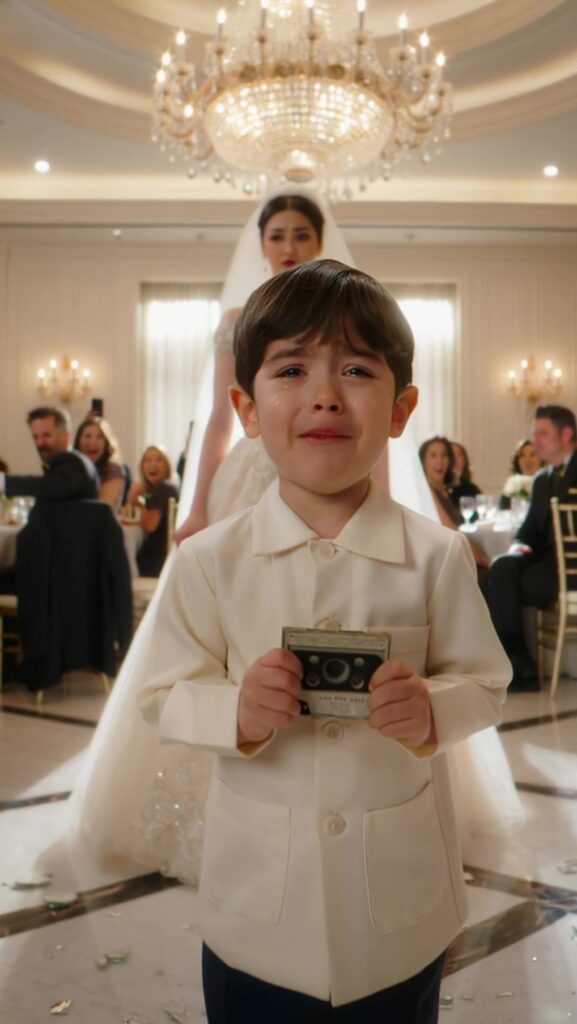
The ballroom looked perfect, arranged with the sort of careful precision that made flaws feel like a moral failure. White roses climbed the columns as if they’d grown there naturally. Crystal chandeliers hung like frozen fireworks, scattering light across the marble floor in clean, obedient shapes. Even the air smelled curated—vanilla, lilies, money.
Lila Harrow stood at the threshold and took it all in like a verdict. Her veil trembled slightly with her breath, and the seamstress’s last pin pricked her scalp as if reminding her this moment had a cost.
“You’re luminous,” her maid of honor whispered, already crying as though tears were part of the decor.
Lila didn’t smile. She watched the guests glide, watched their laughter rise and fall on the string quartet’s soft current. She saw glassware held at the right angle and shoulders squared for photographs. Everything performed its role. Everything stayed in its place.
At the front, beneath an arch of flowers, Miles Kline waited in a black suit that made him look calmer than he ever was. He had the face of a man who had been forgiven often. His hands were clasped in front of him, knuckles bright. When he saw Lila, his expression warmed in that way that had won her over—an intimacy offered like a promise.
She stepped forward, the first measured stride of the rest of her life.
And then—
A plate shattered across the marble.
The sound was obscene. It didn’t belong to this room. It cut through the music, split laughter in half, and left only the hiss of air conditioning and the suspended ringing of porcelain.
Heads turned in unison, like a flock obeying a signal.
At the center of the broken white pieces stood a boy.
He looked eight, maybe nine, too thin for his dress shirt, sleeves riding up to reveal narrow wrists. His hair was dark and damp at the temples, as if he had run hard to get here. He didn’t hold a phone. He didn’t hold a gift bag. His hands were empty except for one thing: a small cassette tape clutched so tightly his fingers blanched.
He stared up at the bride with the kind of focus children have when they have decided not to cry, and are failing.
Lila felt her own hand still raised, as though she had thrown something. She hadn’t. The plate—she didn’t even know who had dropped it. But the timing felt like accusation.
“Who let this filthy child in here?” she heard herself say, the words leaving her mouth sharp enough to draw blood. The room inhaled. The quartet stopped as if someone had reached into their instruments and snapped the strings.
Phones rose. A dozen tiny lenses blinked awake.
Security moved in, black suits cutting through the guests, but even they slowed, uncertain. There was something about the boy’s stillness, about his refusal to plead or duck his head, that made grown men hesitate.
“Throw him out,” Lila ordered. Her voice echoed, too loud against the chandeliers. “Now.”
The boy swallowed. His throat worked like it hurt. When he spoke, his voice cracked so painfully that Lila flinched in spite of herself.
“My mother… she died this morning.”
Silence fell, thick and sudden. The words didn’t fit the room any more than the broken plate did. The guests’ faces rearranged themselves; pity tried to bloom and was smothered by curiosity.
Lila’s heart gave a small, irritated knock—sympathy, unwanted. She hardened against it. People lied all the time. People invented tragedies when they wanted something.
The boy lifted the cassette slightly. It looked old, scuffed, the label almost worn blank. “She told me to give this to him,” he said. He nodded toward the groom. “Before you say… the words.”
Miles’ brows drew together. Annoyance flashed first, like a match. Then his gaze landed on the tape and something in him changed. His mouth parted. The match sputtered out and left only the pale residue of dread.
Recognition.
Lila’s chest tightened. She turned her head slowly, watching Miles as if the man beside her had been replaced without warning.
The boy’s small fingers shook harder. “She said if he hears her voice,” he whispered, “he’ll know why I have his eyes.”
It was a ridiculous line, melodramatic—something from a cheap movie. Yet it landed with the weight of a confession.
Lila stared at Miles’ face and watched the color drain out of it. He looked suddenly younger, stripped of polish. His eyes—those steady eyes she’d trusted—flicked between the boy’s face and the cassette like an animal searching for an escape route.
“What is he talking about?” Lila asked, but the words came out smaller than she meant them to.
Miles didn’t answer. His hands, still clasped, began to tremble.
Guests leaned closer, scenting scandal the way sharks sense blood. The officiant had gone perfectly still, lips pressed together as if prayer could glue this moment back into place.
“Miles,” Lila said again, and this time she reached for his arm. “Say something.”
He gently pulled away, as though her touch burned.
The boy took one step forward. He moved carefully, like the marble might swallow him. Tears finally slipped down his cheeks, leaving clean tracks through the faint grime there.
“Please,” he said. “She said you have to listen.”
Miles’ breathing turned shallow. He stepped down from the platform, closing the distance. When he reached out, his fingers hovered over the cassette, not quite daring to touch it.
“That voice,” Miles whispered, raw. “No…”
Lila’s stomach dropped. Not because of what the boy claimed, not yet, but because of the sound in Miles’ voice. It wasn’t denial. It was surrender.
“What voice?” Lila demanded, turning on him. “Miles, look at me.”
He didn’t.
He took the cassette from the boy as though accepting something fragile and explosive. For a second their hands touched. The boy flinched at the contact, but he didn’t pull away. He watched Miles with a fierce, wounded hope.
“We don’t have—” Lila started, but her throat tightened. She did have the power, didn’t she? The power to stop this, to insist the doors be opened and the child removed, to force the room back into its perfect script.
But the ballroom had shifted. Perfection was already broken, glittering shards everywhere you looked.
“Do you have a player?” Miles asked, voice hoarse.
A ripple moved through the guests. Someone pointed toward the corner where the DJ’s equipment sat. A younger cousin, eager to be useful, rushed to a storage closet and returned with an old portable recorder used for speeches—kept for nostalgia at the country club, of all ridiculous things. He held it out as if offering a weapon.
Miles inserted the tape with hands that couldn’t quite stop shaking.
Lila felt her pulse in her ears. She watched the little plastic window of the cassette, the tiny spools visible like eyes staring back.
When he pressed play, the machine hissed, and for a heartbeat there was only static—the sound of time corroding memory.
Then a woman’s voice emerged, thin but unmistakably alive.
“Miles,” it said, soft as a hand against a fevered forehead. “If you’re hearing this, then it means you’re standing in a room you think you’ve earned. It means you’ve dressed your life in white and called it clean.”
Miles’ face crumpled.
Lila’s fingers went numb at her sides, as if her body wanted to pretend it wasn’t there.
The voice continued, steadier now. “You told me the past doesn’t matter. You told me you were done making mistakes. You promised me you were free. But you left me with more than a memory, didn’t you?”
The boy’s breath hitched. He stared at the recorder like it might finally prove he existed.
“This is not a request,” the voice said. “This is the truth. This is my son. Your son. You don’t get to bury him under flowers and champagne. You don’t get to start over without paying what you owe.”
The room seemed to tilt. Lila gripped the edge of her bouquet, crushing stems until sap slicked her palm.
“I’m sorry,” Miles whispered, not to the crowd, not to Lila—into the air, into the decade between that voice and his present life.
Lila stared at the boy again and saw it now, clear as a mirror held too close: the curve of his brow, the familiar set of his eyes. Not just resemblance, but repetition.
“Miles,” the recorded voice said, quieter, almost kind. “You can still choose what kind of man you are. But you can’t choose what you’ve done. Don’t you dare let them call him dirty. Don’t you dare let him learn shame from your silence.”
Lila’s throat burned. She wanted to speak—apology or fury, she couldn’t tell which—but no sound came.
The tape clicked as it reached the end, the finality of it sharp and small.
Miles stood with the recorder in his hands as if it weighed more than his own body. Across from him, the boy wiped his face with his sleeve, blinking hard, waiting for a reaction like a verdict from a judge.
Behind them, the ballroom still looked perfect. Chandeliers still shimmered. Roses still opened their mouths in silent, expensive bloom.
But the perfection had become a costume on a corpse.
Lila turned toward the guests—toward the raised phones, the whispering mouths, the sudden hunger for spectacle—and felt something in her settle into place, cold and sharp. She looked back at Miles, then down at the boy.
“What’s your name?” she asked him, and her voice sounded different, steadier, as if it belonged to someone who had just discovered how quickly a life can split.
The boy hesitated, then answered, barely audible. “Evan.”
Lila nodded, once. She took a step forward and, to her own surprise, reached out her hand—not to push him away, but to offer it.
“Evan,” she said, and the room strained to hear. “Come with us.”
Miles’ eyes snapped to hers, wide with fear and relief and something like awe, but she didn’t look away. She held his gaze as if daring him to deserve the mercy he’d never earned.
“The ballroom can be perfect,” Lila said, low enough that only he could hear, “or it can be honest. Choose.”
Miles swallowed, his jaw trembling. Then, slowly, he reached for Evan’s other hand.
Together, with the tape’s ghost still hanging in the air, they turned away from the arch of flowers—away from the script, away from the applause that never came—and walked down the aisle into the stunned silence, leaving perfection behind like shattered porcelain on marble.