The ballroom was still glowing like a dream—too perfect, too polished, too fragile to survive what was about to happen. Sunset poured through the arched windows as if the sky itself had paid for a seat, turning every crystal strand on the chandeliers into a small, obedient flame. The air smelled of lilies and expensive sugar. Laughter bounced off gilded moldings and returned sweeter than it left. Even the orchestra seemed reluctant to move on from a waltz that had been rehearsed for an entire month, each violinist paid to pretend tonight was effortless.
At the center of it all stood Celeste Harroway, who wore her age—fifty, tonight—like a private joke. Her gown glittered with a patient cruelty, the kind that said nothing in the room was allowed to outshine her. She lifted a glass not so much to toast as to remind everyone that the glass existed because she had purchased it. Around her, the city’s most careful people leaned in, performing warmth and admiration with polished teeth.
Then the music stopped as though someone had cut the string holding it aloft.
For a beat, no one understood. A single note trembled in the air, broken, and the last laugh was caught in someone’s throat. Champagne, mid-pour, hung suspended in a narrow arc from bottle to flute. On the far side of the room, the doors—tall, thick, and carved with curling leaves—shuddered once.
They burst inward with a sound too large for a celebration.
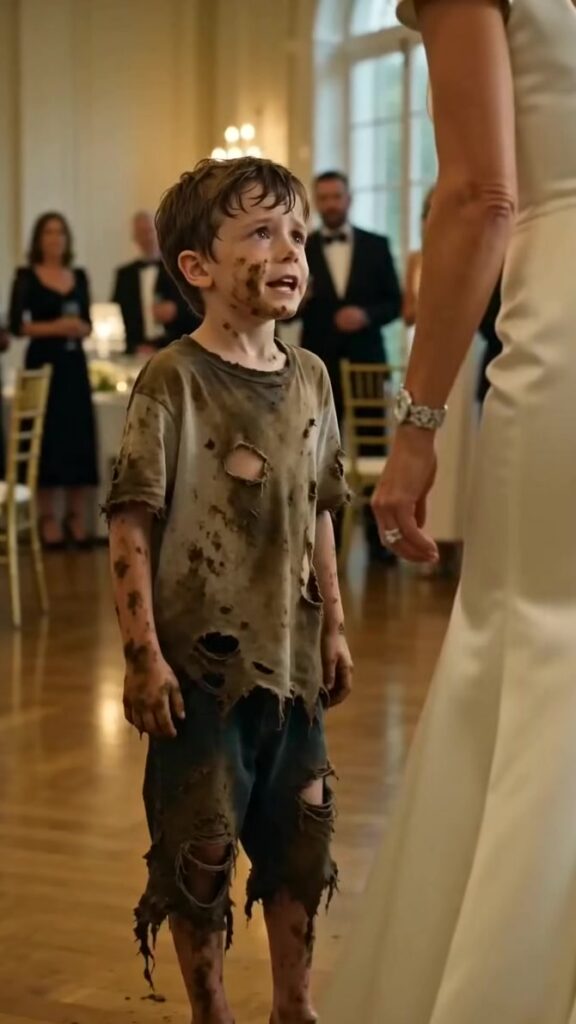
Cold air and rain rushed in, dragging the smell of wet pavement across the lilies. Splinters slid over the marble like pale insects. In the widening gap stood a boy no older than seven or eight. Barefoot. Soaked through. His shirt clung to him in ribbons. His knees were raw, as if the world had been gravel for miles.
Security moved first, because security always moved first. Two men in dark suits crossed the distance fast, hands already reaching, faces already arranged into calm authority.
The boy flinched when they grabbed him, but he didn’t shrink. He fought with a frantic strength, twisting like a trapped animal. “Let go!” he shouted, voice high and hoarse, as if he’d been screaming into the rain for hours. “I need to see her! I have to see her!”
Celeste didn’t take a step. She didn’t need to. The room had been trained for years to respond to her smallest change in expression. She looked toward the interruption the way someone might glance at a stain on a sleeve.
“Remove him,” she said, tone clipped, almost bored. “And find out which caterer’s child this is.”
The boy’s struggling stilled, not from surrender but from remembering. His breathing hitched. He swallowed hard, eyes shining with panic and something sharper underneath. Slowly, deliberately, he lifted his trembling hand.
From his palm dangled a tiny charm on a thin chain: a baby shoe cast in silver, the toe scuffed as if it had been worn in another life. It caught the chandelier light and threw it back in a cold flash.
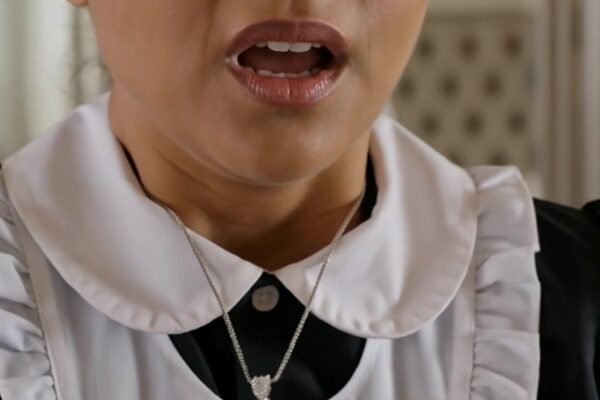
Something in the room shifted. Whispers snapped into being, passing from mouth to mouth like a sudden draft. A woman by the cake—one of the hired staff, a nanny in a gray uniform—went so pale it looked like the frosting had leached into her skin.
The boy held the charm higher. “My mother said…” His voice broke on the word, and for a second he looked younger, smaller, like the rain had washed all bravery away. He forced himself to go on. “She said you would know this. She said if I showed you, you’d have to listen.”
Celeste’s glass did not tremble. Her face did not change. But her eyes fixed on the charm with a precision that was almost hunger. The room waited, the way a crowd waits at the edge of an accident without admitting they want it to be worse.
“That’s impossible,” Celeste said softly, as if speaking to herself. The words were too quiet to be a dismissal and too controlled to be confusion.
From near the dessert table, the nanny—Maris, if you knew the household roster—took one step backward. Her lips parted. No sound came out.
Celeste’s gaze flicked to Maris for a fraction of a second, and the fraction was enough. The nanny’s shoulders folded inward, as if struck. Celeste looked back to the boy. “Where did you get that?”
The security men were still gripping the boy’s arms. One of them tightened his hold, waiting for the cue to drag him away. The boy didn’t flinch now. “It was hers,” he said. “She kept it in a box with letters. She told me not to open them until I needed to be brave.” His eyes traveled over the ballroom—gold, crystal, perfume—and he looked like someone staring at a painting of a place he’d never be allowed to enter. “She’s gone. She’s—” He swallowed. “She’s gone because of you.”
That word—because—hit the room harder than the exploding doors. People leaned in, then caught themselves and leaned back, pretending they were only adjusting their posture.
Celeste set her glass down on the nearest tray with such care that it made the action feel like a threat. “You don’t know what you’re saying,” she replied, and her voice had acquired something sharp, something that cut through lace and laughter and money.
The boy’s chin lifted. Rainwater ran down his face, indistinguishable from tears. “My mother’s name was Elara Finch,” he said. “She cleaned for you. She cleaned your house, and she cleaned up your secrets.”
A ripple moved through the guests. Names did that—names were anchors, and anchors dragged.
Maris made a strangled noise. “No,” she whispered, barely audible, but the boy heard it.
He turned his head toward her. “You know,” he said, and his voice wasn’t accusing; it was pleading with the air itself. “You saw her. You told her not to talk.”
Maris’s eyes filled. She pressed a hand to her mouth, as if she could push the truth back down her throat. “I told her to leave,” she said, and it came out broken. “I told her to take you and go far away.”
Celeste’s posture remained elegant, but something around her seemed to tighten—as if the room’s beauty had suddenly become a net. “This is not the place for your melodrama,” she said, louder now, to reclaim the space. “Who brought him in?”
“No one brought me,” the boy snapped. “I ran. I ran from the river.”
The word river brought a new silence. Even the chandeliers seemed to listen.
Celeste’s eyes narrowed, a faint crack in her composure. “What river?”
“The one behind the old mill,” the boy said. “Where you told her to meet you.” He held the charm out like a key. “She wrote it down. She wrote everything down. She said if anything happened to her, I had to bring this to you, so you couldn’t pretend. She said you’d recognize it because you gave it to her.”
The charm flashed again, and with it came the ghost of another scene: a young woman in a servant’s uniform, hands shaking, holding a tiny silver shoe in her palm while Celeste, younger and more beautiful then, spoke in a low voice near the back staircase. A bargain. A promise. A threat dressed up as kindness.
Celeste’s mouth tightened. “That was a gift,” she said, the lie sliding out smoothly. “A token. Nothing more.”
The boy’s eyes burned. “It was for your baby,” he said. “That’s what she told me. She said you had a baby once. And then the baby was gone. And the charm was all that was left.”
A gasp escaped someone near the window. Celeste’s stare snapped to that corner, and the gasp died, swallowed by fear. She looked back at the boy and, for the first time all night, her control wavered—just enough to show the shape of what lay underneath.
“You’re mistaken,” she said, but there was strain in it now, an edge of anger that suggested she was fighting not the child, but memory.
The boy shook his head. “She said you were going to do it again,” he whispered. “She said you were going to hurt someone else. She tried to stop you.” His voice rose, cracking into something raw. “She tried, and she’s dead.”
Across the ballroom, one of the guests—a councilman’s wife with diamonds at her throat—slowly lowered her phone from where she’d been filming the cake. Her hand trembled. Others watched the way people watch a storm approach, deciding whether to run or stand and witness.
Celeste’s gaze flicked toward the shattered doors, toward the rain, toward the outside world trying to seep in. Then she looked at her security men. “Take him to the study,” she ordered. “Not outside. Not yet.”
The men hesitated; the shift in command was subtle but unmistakable. They began to pull the boy inward, away from the rain and deeper into the house.
The boy twisted once, just enough to look back at the crowd. His voice cut through the stunned silence. “She said you’d smile,” he cried, “and everyone would believe you. She said you’d call her crazy. She said you’d make it look like an accident. But she left me the letters. She left me your name.”
The ballroom’s glow faltered—not in the lights, but in the people. Beauty could survive many things: gossip, envy, even cruelty when it was wearing silk. It could not survive a child standing barefoot in rainwater, holding proof with a shaking hand.
As the boy was dragged away, Maris sank onto the edge of a chair, breathing in sharp, shallow bursts. Someone reached for her, then stopped, afraid to be seen helping.
Celeste remained in the center of the room as if rooted there, as if the marble had grown around her heels. She lifted her chin, reclaiming her posture, her authority, her illusion. “Music,” she said, voice steady. “Please. Let’s not ruin the evening.”
The conductor raised his baton with a stiff arm. The first note scraped out uncertainly, like a knife drawn too slowly from a sheath.
And yet the dream had already cracked. Somewhere beyond the ballroom, in a study lined with dark wood and locked drawers, a child with rain in his hair was about to open a box of letters the rich had paid to bury. Celeste could demand music. She could command smiles. She could order doors repaired.
But she could not unexplode the moment the silver baby shoe caught the light and taught everyone in the room what fragile really meant.