The bank at midday was a well-rehearsed lullaby: murmured questions about loans, the metronome tap of keyboards, the soft scrape of pens against paper. Sunlight poured through the tall windows and lay in pale rectangles across the marble floor, turning every shoeprint into a fleeting ghost. The air smelled faintly of polished wood and old receipts—something clean and tired at once. People came here to be reassured, to be counted, to be told that numbers could be trusted.
Then a sound cracked the rhythm in half.
It wasn’t a shout or a gunshot, not at first. It was the dense, brutal thud of something heavy meeting the counter—a slap of weight that echoed off stone and glass, ringing through the vault of the ceiling like a bell struck too hard. Conversations died mid-syllable. A woman’s laugh collapsed into a cough. Even the printers seemed to pause, as if the bank itself had taken in a sharp breath.
Behind the counter, Mara Hensley—teller for eleven years, collector of routine, guardian of small rules—looked up from her screen with irritation already drawn across her face like a curtain. The branch had been understaffed all week. A line of customers stretched toward the door. She expected a slammed checkbook, a tantrum, an entitled complaint. She did not expect to see a child.
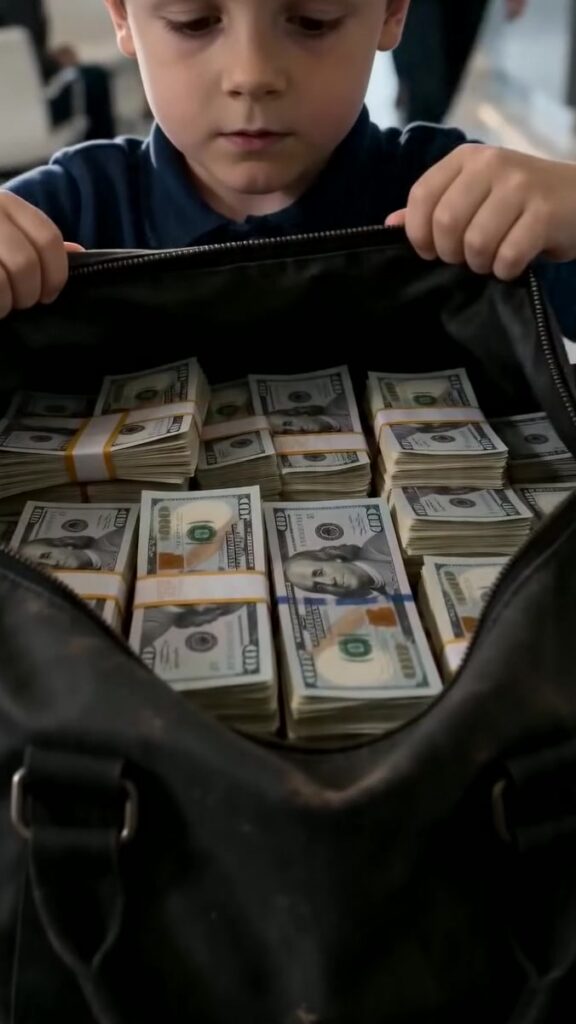
He stood on tiptoe so his chin cleared the counter’s edge, small hands planted on the stone, a frayed duffel bag between them. He couldn’t have been older than seven. His hair was neatly combed, as if someone had pressed him into order. His cheeks were round with childhood, but his eyes held no softness, no curiosity—only a steady, unblinking certainty that made Mara’s irritation falter and curdle into something less comfortable.
“Young man,” Mara said, pitching her voice to the tone she used when parents let their kids wander, “you can’t—” She stopped herself from saying play here. “Where’s your guardian?”
The boy’s gaze didn’t flick toward the lobby. It stayed on her, level as a ruler. “I want to open an account,” he said.
A ripple of laughter rose from the line. Not unkind, but uneasy, the way people laugh at a sudden wrong note to prove they’re not rattled. Someone whispered, “That’s cute,” and another voice said, “Maybe it’s for a school project.”
Mara forced a thin smile. “Accounts require identification. And a minimum deposit.” She tapped her keyboard, buying a moment for her nerves to settle back into their familiar channels. “How much did you bring?”
The boy’s right hand went to the zipper. He pulled it down in a slow, deliberate line, as if time itself were something he could portion out. The sound of teeth separating seemed too loud in the hush. When the bag opened, he folded the fabric back carefully—carefully, like someone revealing a wound.
Inside were stacks of bills, bound in tight bands. Not the sloppy handful of birthday cash, not the crumpled ten from a paper route. These were compressed bricks, arranged with a tidy precision that belonged to counting machines and locked rooms.
The laughter died so completely it felt sucked out. A man near the door made a small involuntary sound, half gasp, half prayer. Mara’s mouth went dry. Her hands hovered above the counter as if she’d reached too close to fire.
“That’s… that’s not funny,” she said, though no one was laughing anymore. “Where did you get this?”
“I counted it three times,” the boy replied, and the absence of pride was what made the words terrifying. He spoke the way adults spoke when they’d checked something painful and unavoidable. “Forty-eight thousand. There might be more. I stopped when my hands started hurting.”
Mara’s eyes flicked to the security camera over the lobby. Its black lens stared back, indifferent. She thought of protocol—call a supervisor, discreetly notify security, do not accuse. But her fingers didn’t move. Her body had forgotten its training, lost in the blunt fact of that money and the impossible person delivering it.
From the manager’s office, Derek Mills stepped out, drawn by the silence. Derek always wore his smile like armor; he wore it now, but the seams showed. He approached the counter with slow calm, careful not to startle whatever fragile balance held the room together. “Hello there,” he said, as if greeting a customer carrying a toddler, not a duffel of cash. “Can I help you?”
The boy didn’t look at Derek. He held his gaze on Mara, as if she were the only one who mattered. “I need it safe,” he said. “Not at home.”
Derek’s smile tightened. “We can certainly discuss safe deposit options, but—”
“No,” the boy interrupted, still quiet. His voice had the same evenness as before, but the word landed like a door being locked. “An account. In my name. I want it to exist on paper.”
Mara swallowed. “What is your name?”
The boy hesitated for the first time. It wasn’t fear; it was calculation, like someone deciding which truth to spend. “Eli,” he said at last. “Eli Vance.”
The name hit Mara with a strange familiarity she couldn’t place, a half-remembered headline, a story overheard on the evening news. Derek’s eyes, however, widened in recognition. The manager’s carefully maintained calm slipped, and in that tiny fracture Mara saw panic.
“Eli,” Derek said gently, “is your father with you?”
The boy’s jaw flexed. “He can’t come.”
In the quiet, the bank’s sounds crept back in—an air vent’s hum, the distant ding of the elevator in the building’s lobby, the tiny squeak of a shoe as someone shifted their weight to get a better look. Everyone watched, held between fascination and dread, as if the boy might suddenly transform into what their instincts were screaming he already was: a warning.
Mara’s mind raced through possibilities. Kidnapping ransom. A family hoard. A crime she didn’t want to imagine. But the boy’s posture was too controlled for a child in trouble and too tired for a child playing grown-up. His hands, she noticed, had faint red marks along the fingers, as if he’d been pulling bands off stacks of bills until the skin protested.
“Eli,” Mara said softly, lowering her voice the way one did around injured animals, “if someone told you to bring this here, you need to tell me. We can help you.”
For the first time, his eyes moved, glancing past her shoulder toward the lobby doors. The look was quick, sharp, and it chilled Mara more than any scream could have. Outside, cars passed in bright indifferent sunlight. A man in a blue jacket stood across the street pretending to study his phone. He didn’t move, but his stillness felt like a hand pressed against the glass.
“No one told me,” Eli said. “I decided.”
Derek leaned closer, voice barely above a breath. “Where did the money come from?”
The boy looked at him then, and Mara saw it: grief, not childish, but honed. “From the place under the sink,” he said. “From the wall. From the pantry. He hid it everywhere.”
“Who is ‘he’?” Mara asked, though she suspected she already knew.
Eli’s small shoulders lifted and fell, a miniature shrug that didn’t belong to him. “My dad.”
The name clicked into Mara’s memory like a key turning. Vance. The man whose face had been on the screen last night, blurred at the edges by the heat of the story—local contractor, suspected in a string of robberies, questioned and released, then vanished. The anchor’s voice had said: authorities urge caution, do not approach, call the hotline. Mara had switched channels, unsettled by the calmness of that warning.
Now the warning stood in front of her in a schoolboy’s body.
“Eli,” Derek said, voice shaking despite his effort, “I need you to step away from the counter for a moment. We’re going to—”
“If you call them,” Eli said, and the words were still quiet but suddenly older, “he’ll come back.”
Mara’s stomach dropped. “Come back from where?”
Eli’s gaze returned to the money. “He said if anyone took it, he’d know. He said money has a smell.” The boy’s fingers tightened on the bag’s edge. “He said I should never trust a bank, because banks keep records. But I want a record. I want proof that it’s mine now.”
The line of customers had stopped being a line; it was a crowd trapped by curiosity and fear, too engaged to flee, too polite to panic. The security guard near the entrance had a hand near his radio but wasn’t pressing it. Everyone seemed to wait for someone else to decide what this moment meant.
Mara looked at Eli—at the solemn mouth, the bruised knuckles, the too-steady stare. She saw a child trying to build a wall out of paperwork. She saw a boy who believed that ink and signatures might hold back a monster.
“Okay,” she heard herself say, surprising even Derek. “Okay. We can start the process.” She slid a form across the counter with a hand that trembled. “But I need some information, Eli. I need… something.”
Eli reached into his pocket and placed a folded piece of paper beside the stacks of cash. The paper was creased so many times it looked soft as cloth. Mara unfolded it carefully. A handwritten note, the letters jagged and urgent.
It wasn’t a list of instructions. It was an apology.
Mara’s throat tightened as she read the last line, the one that made her skin prickle with the certainty that someone was watching this lobby through more than glass: If he finds you, tell them it wasn’t your fault. Tell them to look where the marble meets the wall.
Mara’s eyes darted to the baseboards along the bank’s pristine floor. The marble tiles, the thin seam of grout, the spotless edges where stone met plaster. Her pulse hammered loud enough she thought the cameras might pick it up.
Across the street, the man in the blue jacket finally lifted his head. His gaze found the window and held it. And Eli, still too small to reach the counter properly, leaned forward as if he could push his life across the stone with the money and the note and the weight of everything he’d stolen from his own home.
“Please,” he said, not begging, but stating a final fact. “Make it real.”
Mara’s fingers closed around her pen. In the bank’s sudden, suffocating stillness, she understood that opening an account was the least dangerous thing that could happen today—and perhaps the only act of mercy left within reach.