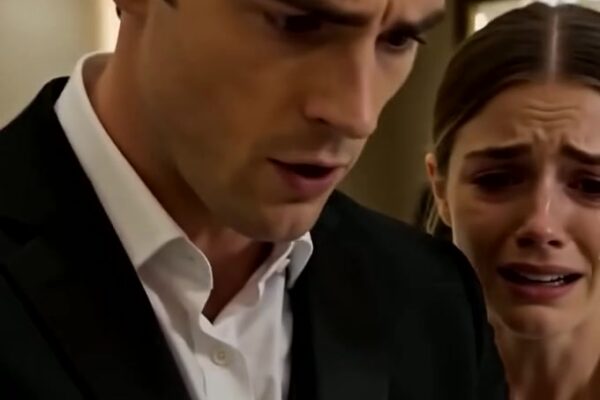
Rain fell without mercy, turning Marrow Street into a cold mirror that reflected neon signs like bruises. Water ran in thin rivers along the curb and gathered in the cracks of the pavement, as if the city itself were trying to wash something away. People hurried under umbrellas that shuddered in the wind, coats pulled tight, faces turned down, each person a moving island determined not to be touched.
On the sidewalk beside a closed bakery, a boy stood as still as a dropped doll. Barefoot. Shaking. His toes were purpled by cold, his heels blackened by soot and grit, and the rain made his skin shine like stone. In his hands he held a pair of small shoes—worn leather, the kind a child outgrows before it ever looks new—tied together with twine that had frayed into soft threads. He lifted them toward passersby as if offering a prayer. Most didn’t see him. Or they did and chose the easier lie: that he wasn’t there.
He had learned the rhythm of rejection. A glance, a flinch, a quicker step. A pocket tugged closed. A hand tightening on a handbag strap. He was not angry at them; anger demanded warmth, and he had none to spare. What he had was a thin, stubborn focus, a thought that repeated like a heartbeat: Lysa needs the medicine. Lysa needs the medicine.
He watched a woman with a bright scarf cross the street without meeting his eyes. A man laughed into a phone and splashed past him without noticing the water that soaked the boy’s cuffs. The boy’s fingers cramped around the twine until his knuckles blanched. The shoes swung slightly, tapping each other, a soft sound lost beneath the rain.
Then a man in a dark coat slowed. He was tall, but rain made everyone hunch, and the brim of his hat shadowed his face. He carried no umbrella. Water ran from his sleeves and down the back of his coat, but he didn’t rush. He looked as though he had forgotten where he was going.
The boy swallowed hard, gathering courage like coins. His throat hurt. “Sir,” he said, and the word came out small. “Would you buy these?”
The man stopped. For a moment he looked confused, as if the scene had been cut from another life and pasted into this one. Then something shifted in his expression—softened, yes, but also tightened, as if a door inside him had been forced open. His gaze dropped to the boy’s bare feet, then to the shoes, then to the boy’s face, which was too old around the eyes.
Rain clung to the boy’s eyelashes. He blinked it away and tasted salt; he couldn’t tell if it was rain or something else. “My sister,” he whispered, voice cracking on the word as if it hurt to say it aloud. “She’s sick. She needs medicine.”
Silence widened between them. Even the traffic noise seemed to recede. The man took a step closer and then, slowly, knelt in front of the boy until they were eye level. There was no performance in it, no loud pity. Only a strange carefulness, as if the wrong movement might break something already cracked.
“What’s your name?” the man asked.
The boy hesitated. Names were dangerous; names were a thread someone could follow. But the man’s voice did not sound like a trap. “Tomas,” he said. He tightened his grip on the shoes, prepared for the man to take them and walk away. Prepared for the oldest story.
The man reached into his pocket.
And behind them, a car door opened.
The sound was not loud, yet it landed like a weight. A single thud of metal on metal. The man froze mid-motion. Rain ran off the brim of his hat in a steady drip that looked suddenly like a countdown.
His face changed—not fear, not exactly. Recognition. A stare that went past the boy, past the street, to some memory that had teeth. He didn’t turn immediately. His hand stayed inside his pocket as if it had forgotten what it was reaching for.
“…It can’t be,” he breathed, so quietly Tomas almost didn’t hear.
Tomas followed the man’s gaze without meaning to. Parked at the curb was a black sedan, too clean for this part of town, its windows tinted dark as old bruises. The rear door hung open. A woman stepped out, her heels tapping the wet pavement with purpose. She carried an umbrella like a weapon—black, sharp, angled. Her hair was pinned up, dry beneath the shelter, her lips painted a disciplined red.
She did not look at Tomas at first. She looked at the kneeling man as if she had found something she’d lost and was displeased by where it had ended up.
“Elias,” she said, and his name sounded like a verdict. “They told me you were in the district. I assumed it was a mistake.”
Elias did not rise. He remained kneeling in the rain in front of a barefoot boy, as if standing would mean stepping into another version of himself. “Mirren,” he answered, and his voice tightened around the name. “You shouldn’t be here.”
Mirren’s gaze finally dropped to Tomas. It was quick and clinical, the way some people look at something unpleasant on the sidewalk and decide whether to step over it. “You’ve made yourself… noticeable,” she said to Elias. “Again.”
Tomas understood none of the words, only the sudden pressure of danger. He felt it like the drop in temperature before snow. His sister’s cough flashed in his mind—the sound of it, wet and hollow. He couldn’t afford to lose time to adult storms. He lifted the shoes higher, because that was the only bargaining chip he had. “Sir,” he said again, to Elias. “Please.”
Elias’s hand finally came out of his pocket. He didn’t pull money first. He pulled a small object, metal and dull, and for a moment Tomas thought it was a lighter. Then Elias’s thumb flicked it open—an old signet ring, its band split, the seal inside etched with an emblem like a broken crown.
Mirren’s breath caught. “No,” she said, as if the word could rewind time.
Elias looked at Tomas, and his eyes were not just soft now—they were full of a grief that looked practiced, used so often it had become part of him. “Tomas,” he said, slowly, “where is your sister?”
“Home,” Tomas whispered. “In the rooms above the butcher. She can’t get up.”
Elias closed the ring in his palm. His jaw worked once, as if he were swallowing something bitter. “How old is she?”
“Seven,” Tomas said. Lysa had been seven for months, though she hadn’t had a proper birthday. The calendar meant little when you were counting pills instead of days.
Mirren stepped closer, her umbrella tilting forward like a shield. “Elias, listen to me. This is not your concern. Do you understand what it costs when you involve yourself? You promised you would stop.”
Elias finally stood, but he did not look away from Tomas. The rain plastered his coat to his shoulders, darkening it until he seemed made of shadow. “I promised a lot of things,” he said. “Some of them were lies I told myself to keep breathing.”
He reached into his pocket again and this time pulled out bills—more than Tomas had ever seen in one place, folded crisp as if untouched by real need. He pressed them into Tomas’s cold hands. Tomas’s fingers tried to curl around the money, but they were stiff and clumsy.
“Take this,” Elias said, and then, against all the rules Tomas had learned about strangers, he placed his own gloved hand over Tomas’s for a second, warming it through leather. “And take me to her.”
Mirren’s umbrella trembled. “Elias,” she said, and her voice became something sharper. “You are making a scene.”
He turned his head slightly toward her, not fully, as if giving her the smallest fraction of attention was all he could spare. “No,” he said. “I’m recognizing one.”
Tomas stared up at them, at the words he couldn’t untangle, at the expensive car and the woman who looked like she belonged to a different weather. His chest tightened with suspicion. Kindness was often the bait on a hook. Yet the money in his hands was real, and real things mattered more than fear.
“Why?” Tomas asked before he could stop himself. “Why would you help?”
Elias’s gaze flicked to the shoes still dangling from Tomas’s wrist, those small worn shoes tied together with fraying string. His expression broke in a way rain could not hide. “Because,” he said, “I’ve seen those shoes before.”
Mirren’s face went pale, the red of her lips suddenly too bright. “You don’t know what you’re saying,” she murmured.
Elias did not answer her. He leaned closer to Tomas, his voice dropping, intimate beneath the roar of rain. “Your sister’s mother,” he said, carefully. “What was her name?”
Tomas’s heart hammered. He could not remember his mother’s face clearly anymore; memory was like paper left in water. But he remembered the name because Lysa whispered it sometimes when her fever climbed. “Adeline,” he said. “Mama was Adeline.”
The name struck Elias like a fist. He closed his eyes for a brief second, and when he opened them the softness was gone, replaced by something fierce and awake. He looked at Mirren fully now.
Mirren’s umbrella lowered, exposing her hair to the rain for the first time. Water dotted her lashes. For a heartbeat she looked almost human. “Elias,” she said, quieter, pleading threaded through control, “don’t.”
“You told me she vanished,” Elias said. “You told me there were no children.”
Mirren’s mouth tightened. “I told you what kept you alive.”
Elias looked back at Tomas, and the street around them seemed to tilt. The rain still fell. The city still moved. But something had changed shape in the air, as if a hidden mechanism had clicked into place.
He took the shoes gently from Tomas’s hands and held them up as if they were evidence. “These,” he said, voice low, “were the last thing I bought with my own money before they made me stop being a man and start being an instrument. I bought them for a child who never got to wear them.”
Tomas’s breath caught. “Lysa—” he began, but the words tangled.
Elias handed the shoes back. “Take me to your sister,” he repeated, and now it sounded like an oath. “And Mirren,” he added without looking away from Tomas, “if you try to stop me, I will make the whole city remember what you taught it to forget.”
Mirren stood very still, rain sliding down her cheeks like a mask cracking. Behind her, the sedan idled, patient as a predator. She did not speak again. Only watched as Tomas, barefoot and trembling, turned and began to lead Elias through the wet streets toward the rooms above the butcher—toward medicine, toward answers, toward whatever waited in that small dark apartment where a girl coughed and a past refused to stay buried.
The rain did not let up. It never did. But as Tomas walked, clutching bills that could change everything, he felt something unfamiliar bloom under his ribs—small and dangerous as a match struck in a storm. Hope, he realized, had its own kind of terror. It demanded you believe the world might still be able to turn toward you.
Behind them, Mirren closed the car door with a careful, final sound. And on Marrow Street, in the relentless rain, the story that had been ignored finally began to insist on being seen.