Outside Luminara, the sidewalk shimmered as if it had been lacquered. Manhattan did that to money—made it look like light. A line of cars purred at the curb, their chauffeurs stiff as mannequins, while laughter rose in soft waves from the restaurant’s doors. People arrived wrapped in cashmere and confidence, stepping over the city like it was a rug.
Mara Halden paused beneath the awning, letting the doorman hold the evening open for her. Her beige coat was tailored to the last millimeter; the pearl buttons caught and returned every gleam. She should have been thinking about the investor she was meeting inside, about the numbers she’d recite with practiced ease. Instead she was thinking about the thin slice of air between her shoulder blades—how it sometimes felt like a hand might land there and pull.
It did. Not heavy. Not flirtatious. A tug, desperate and small, at her sleeve.
She spun, irritation flaring before she even saw what she was aiming it at. “Don’t,” she said, the word sharp enough to cut. “Don’t touch me.”
The child in front of her looked as if he’d been assembled from winter leftovers. A coat too large swallowed his arms; the hem brushed his ankles. His hair was damp with sleet, and grime traced the lines under his eyes as if the city had drawn him in charcoal. He couldn’t have been more than five. His teeth chattered, not theatrically, but with the relentless rhythm of a body losing its fight against cold. Tears had dried and re-wet the tracks on his cheeks.
For a moment Mara expected him to retreat. Children always retreated from her anger. That was part of what she paid for—distance, control, the sense that her life was uninterruptible.
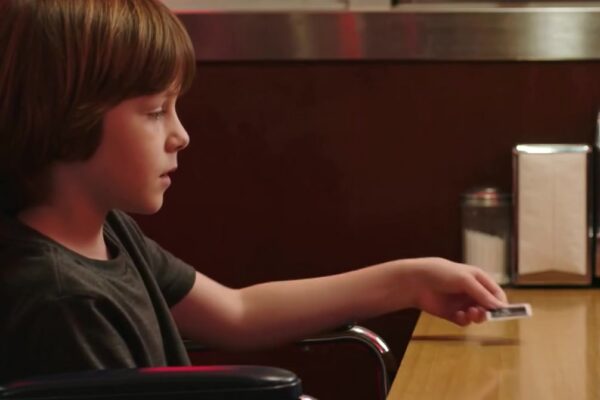
But the boy didn’t move away. He steadied himself the way an adult might, bracing his knees, and lifted his hand with deliberate care, as if his fingers were fragile mechanisms that might break. His palm opened.
A small pin lay there: a bright stroke of blue shaped like a swallow in mid-flight. Under the streetlamp it looked unreal, like a piece of sky somebody had fastened into metal. The shade was impossible—too vivid for this gray, gritty block.
Mara’s breath snagged. Her throat tightened as though the cold had reached inside her. She stared at the pin, her mind refusing to supply context, and then—mercilessly—supplying it all at once.
That blue. That bird. The way the wing tipped upward, the tail split into two slender blades. A design she’d once admired because it looked like hope.
She had watched it disappear into earth.
“Where did you get that?” Mara heard herself ask, but her voice belonged to someone else—someone smaller, someone cracked open by memory.
The boy swallowed. His lips were pale, and the skin around them looked stretched by the cold. “She… she told me,” he said, and the words trembled apart. “She sent me.”
Mara’s vision narrowed so hard the restaurant’s golden glow became a distant smear. She saw only the child’s hand and the pin. Her heart hammered with an old rhythm she hadn’t felt in years, not since sirens, not since wet soil on her shoes.
Across the street, a motorcycle eased to the curb, its engine growling low. The rider dismounted in one smooth motion, tall and broad, leather jacket worn at the elbows. When he pulled off his helmet, his face emerged—sharp jaw, a scar near his temple, eyes that had learned not to look surprised.
Until he saw the pin.
He froze as if the air had turned solid around him. The helmet slipped a fraction in his grip. “No,” he whispered, and it traveled just far enough to reach Mara. “That pin…”
Mara knew him. She hadn’t seen him in seven years, but she recognized the way his shoulders held tension, as if bracing for an impact that never came. Ethan Rourke. Once a paramedic. Once the man who had carried a small body out of an overturned car while Mara screamed in the rain. Once the witness she’d paid to vanish.
Mara’s breath came shallow now, each inhale stuck somewhere high in her chest. Her eyes were fixed on the boy, because the boy was fixed on her. His gaze wasn’t accusatory. It was searching. Like he was reading her face the way people read street signs when they’ve been lost too long.
“What’s your name?” she managed.
His chin quivered. “Ben,” he said. Then, softer, as if saying it hurt: “Ben Larkin.”
The name struck like a thrown stone. Larkin. Not Halden. Not a name Mara had ever signed, yet a name she’d heard in court documents and in whispered conversations in hallways lined with legal oak.
“Your mom,” Mara said, her mouth dry. The street spun around her in a slow, nauseating tilt. “Your mom’s name is—”
“Nora,” Ben said quickly, as if he’d been waiting to deliver it. “Nora Larkin.”
Mara’s knees softened. Nora. The girl with the laugh that made you think of breaking rules. The girl who’d worked the coat check at Luminara before it was Luminara, before it got purchased and polished and renamed into something wealthy. The girl who’d once held up that pin and said, I found it in a thrift shop and it looks like it’s still flying.
Nora had worn it the night of the accident.
Behind Mara, the doorman shifted, uneasy. A couple exiting the restaurant slowed, curious at the tableau—woman in designer wool, shivering child, biker with a scar and a haunted stare. Another city story about to become background noise.
“She told me to find you,” Ben continued. He looked down at his hand, then closed his fingers around the swallow as if protecting it from being stolen. “She said… you would know what it means. And she said if you try to say you don’t, I should tell you this.”
Mara’s voice was barely audible. “Tell me.”
Ben lifted his eyes. There was steel in them that didn’t belong to five years of life. “My mom said… you were there.”
The words landed with the finality of a verdict.
Mara saw it again: the slick road, the headlights smeared into rain, her own hands on the steering wheel, nails digging into leather. Nora in the passenger seat, laughing at something, holding the blue pin up like it could ward off disaster. The impact. The taste of blood. Ethan’s face bending close, shouting instructions. And later, the hospital corridor, Nora’s mother wailing, and Mara’s father’s lawyer pressing papers into hands, arranging silence the way a florist arranges lilies.
She had told herself she’d mourned. She had told herself she’d paid for a funeral she couldn’t attend. She had told herself that burying the pin with the wrong name on the stone had been mercy, not theft.
But the pin hadn’t stayed buried.
Ethan stepped closer, his boots quiet on the wet pavement. His eyes never left Ben’s fist. “How did you get it?” he asked, voice rough.
Ben’s shoulders rose and fell in a tiny shrug that looked too heavy for him. “It was in her box,” he said. “The one under the floorboard. She wrote letters. She said if anything happened, I should take the swallow and go to the lady with the pearls.” He glanced at Mara’s collar where a single strand peeked out. “That’s you.”
Mara’s hand drifted to her throat, fingers touching the pearls as if they might choke her. “Nora’s… alive?” The question was an absurd, aching hope that she hated herself for feeling.
Ben didn’t answer at first. His eyelashes glittered with melted sleet. “She’s not at home,” he said carefully. “She didn’t come back last night. And men came to our apartment today. They said she owed.”
“Owed,” Ethan repeated, and his face darkened. He looked at Mara with an expression that was half accusation, half grim understanding. “Your kind of debt,” he murmured. “The kind that keeps going when you think you’ve paid it once.”
Mara’s mind raced through possibilities like doors slamming in a hallway. Nora had survived. Nora had disappeared. Nora had built a life with a child. And now she had sent that child into the cold, carrying a piece of the past like a flare.
Ben’s grip loosened slightly, and he opened his hand again. The swallow lay there, blue as a warning. “She said you’d be scared,” he whispered. “But she also said you might be sorry.”
Mara’s eyes burned. She wanted to say she was sorry. She wanted to say she’d been a girl too, once, frightened and controlled and stupid enough to think a signature could erase a crime. She wanted to promise she could fix it with a phone call.
Then she saw the way Ben’s thin shoulders shook and realized this wasn’t a problem to solve. It was a reckoning arriving in the shape of a child.
She reached out slowly, palm up, not to take the pin but to offer something steadier. “Come with me,” she said. “Inside. You’re freezing.”
Ben hesitated, looking from her hand to Ethan, then back to Mara. Ethan nodded once, jaw clenched, as if deciding to step back into a fire he’d escaped.
Mara did not know yet whether Nora had sent Ben as a plea or a weapon. She did not know what waited at the end of this street—truth, punishment, or a body she’d be forced to finally claim. She only knew the swallow’s blue was the same blue as regret: impossible to ignore once you’d seen it.
And as Ben’s small fingers finally slipped into her palm, Mara felt the city’s polished glow dim. In its place rose something older, darker, and far more real—the sound of buried things clawing their way back to light.