The courtroom had already decided she was guilty. You could hear it in what no one said—the way conversation died the moment the bailiff announced her name, the way the gallery held its breath not in sympathy but in anticipation, as if they’d come to watch a sentence rather than a trial.
Elena Marlowe stood at the defense table like a figure cut from the wrong cloth. Her uniform was clean, her hair pinned back with care, her hands red at the knuckles from scrubbing other people’s stains. The silk and wool of the room—judges, attorneys, well-pressed coats—seemed to recoil from her plainness, as if poverty were an odor.
Two nights earlier, Mrs. Adelaide Hale had been found in her upstairs bedroom. The widow’s door was locked from the inside, the windows latched, the servants’ corridor quiet as a chapel. Yet she lay on her velvet coverlet with a bruised throat and an open jewelry box beside her, the emptiness inside telling a story the household was already eager to repeat.
A maid. A theft. A sudden rage. A simple conclusion.
At the front, Judge Halston peered down from his bench with the fatigue of someone who’d already arranged the world into boxes. The prosecutor spoke in tidy phrases, building a staircase out of assumptions: Elena had access, Elena had motive, Elena had opportunity. Each sentence landed like a shovel of soil.
Only one person in the room kept his eyes fixed on her as if he were looking for a missing piece of himself. Noah Hale sat in the second row, feet not touching the floor, his small hands folded so tightly his fingers whitened. His suit pinched at the collar. He looked less like a witness and more like a child dressed for a funeral he did not understand.
Beside him sat Richard Hale, the dead woman’s brother-in-law and the boy’s guardian since the crash that had taken Noah’s parents. Richard’s presence filled the bench even at rest. He had a voice like polished metal and a way of glancing at people that made them question their own memories. He had been hailed in town as a benefactor, a builder of libraries and sponsor of scholarships, the kind of man reporters described as “steadfast.”
“You were frightened,” Richard had told Noah the night the police arrived. “You saw nothing. You will say nothing. The adults will handle this.”
Noah had nodded until his neck ached, because nodding was safer than breathing too loudly in Richard’s world.
Now Elena’s attorney rose with a thin folder and thinner hope. He spoke about a lack of fingerprints, about the impossibility of a locked room, about the absence of any stolen jewelry in Elena’s rented room above the bakery. His voice tried to lift her, but the room had already pushed her down in their minds.
When Elena was asked to stand, her knees wavered. She drew a breath that hitched halfway in her chest and managed, in a voice that sounded scraped raw, “I didn’t do it.”
Not a speech. Not a plea. Just the bare fact, offered into a void that did not want it.
Noah’s stomach turned with a sudden, remembered nausea. The trial room blurred for a moment, replaced by the upstairs landing of the Hale house and the smell of furniture polish and winter roses.
He had not been asleep that night. He had slipped from bed to search for his mother’s locket, the one he kept in his nightstand like a secret prayer. He had heard voices—adult voices, sharp and low—and ducked behind the carved newel post at the staircase, his heart thundering in his ears.
Elena had come first, carrying a tray she must have forgotten in the kitchen. She had seen Noah crouched there and, without asking why, had set the tray down and pulled him back into the shadow with her. Her hand over his mouth had been gentle, her whisper barely air: “Stay quiet, little sir. Please.”
Then someone else moved down the corridor. A man—broad shouldered, smelling faintly of brandy and cologne. Moonlight flashed off his wrist when he reached for a door handle: a silver cufflink, engraved with a small H and a laurel leaf.
Noah remembered the sound after that. A muffled argument, a sudden choke of breath, a thud. Elena’s hand had tightened on his shoulder like she could anchor him to the floor and keep him from running into something terrible.
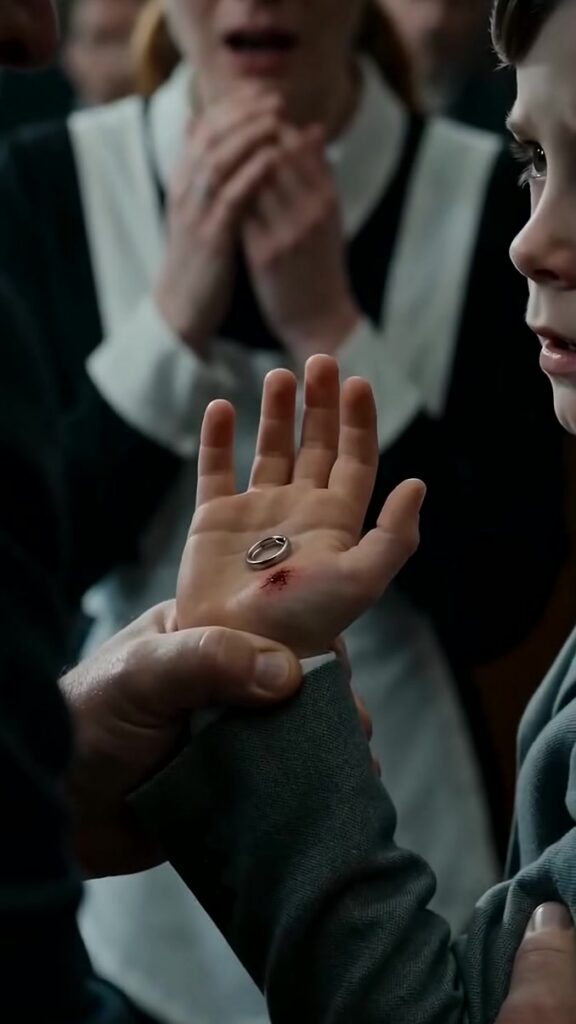
Later, after the shouting ceased and footsteps retreated, Noah had crept forward on shaking legs. Something glinted on the hallway carpet—a cufflink, torn loose, smeared at the edge with a dark stain. He had picked it up before anyone could see and tucked it into his pajama pocket, not knowing why except that it felt like evidence and evidence felt like the only thing in the house that did not belong to Richard.
In court, the judge began to speak of “preponderance” and “reasonable inference.” The prosecutor’s mouth curved as if tasting victory. Elena’s shoulders folded inward, a person already bracing for a door to close behind her.
That was the moment Noah felt something in him snap—not loudly, but cleanly, like a string cut under too much strain. He rose so fast his knees knocked the bench. The sound echoed through the courtroom, startling faces into turning.
Richard’s hand shot out, fingers closing around Noah’s sleeve. “Sit down,” he hissed, without moving his mouth much, like a ventriloquist speaking through someone else’s life.
Noah didn’t sit. His throat burned. His eyes stung. He looked straight at Elena—at the bruised fear on her face, at the steady dignity she had tried to keep—and the words burst out of him before he could drown them.
“It wasn’t her.”
A ripple moved through the gallery—half gasp, half murmur. Even the court reporter paused, pen hovering, as if unsure whether to write down a child’s rebellion.
Judge Halston leaned forward. “Young man,” he said, voice sharpening. “You will be sworn in if you intend to speak.”
Noah’s mouth went dry. Richard’s grip tightened until it hurt. But pain was suddenly useful. It reminded Noah he was still real, that he could still choose.
Elena lifted a trembling hand to her lips, eyes wide as a person seeing light after weeks underground.
“She… she protected me,” Noah said, and his voice cracked on the last word. “She told me to be quiet. I was on the stairs. I saw—”
“Noah,” Richard warned, louder now, a plea dressed as command. “You are confused.”
Confused. That was Richard’s favorite word. He used it to erase things—raised voices, slammed doors, bruises on wrists explained away as accidents. He used it like a cloth to wipe the truth clean.
Noah opened his fist. For a second his palm was empty, because his fingers shook too much for him to uncurl them properly. Then the metal fell into view: a silver cufflink, ornate and unmistakably expensive. The engraving caught the courtroom lights, bright as an accusation.
The gallery leaned forward as one body. Elena made a sound that wasn’t quite a sob and wasn’t quite a laugh, as if hope hurt too much to hold comfortably.
Richard’s face emptied of its careful color. “Where did you get that?” he asked, too quickly, too sharply, and the question betrayed him in a way his composure could not repair.
Noah swallowed. He could feel every eye on him, and in that heat of attention he finally understood what power was: not the ability to frighten someone into silence, but the ability to refuse to be frightened anymore.
He pointed—his arm a thin line across the room, his finger steady despite the trembling in his bones.
“It was him,” Noah said. “My grandfather.”
For a heartbeat the courtroom did not breathe. Then chaos surged. The prosecutor sputtered objections. Elena’s attorney shouted for the bailiff. People rose, chairs scraping, whispers multiplying like sparks.
Richard stood as well, too smoothly, as if he might still walk away simply by acting like he could. His eyes locked on Noah, cold warning flickering beneath the sheen. “You don’t know what you’re saying.”
Noah clenched the cufflink so hard its edge bit his skin. “I do,” he whispered, and it was the first time his words belonged entirely to him.
The bailiff moved in. The judge’s gavel struck once, then again, the sound cracking over the uproar like thunder trying to reclaim the sky. And somewhere in the noise, as Richard’s control finally began to fracture, Elena sank into her chair and cried—not in defeat, but in the stunned, aching relief of someone who has been dragged back from the edge at the last possible moment.
Outside, the day waited, indifferent and bright. Inside, the truth—small, shaking, and finally spoken—had started to change the shape of the world.