The bakery smelled like butter, cinnamon, and warm bread—an aroma so sure of itself it felt like a promise. People lingered there longer than they intended, letting the soft piano playlist and the hush of money make them forget the weather outside. Coats were draped over chairs like flags of comfort. Credit cards tapped. Pastries were photographed, admired, and abandoned with neat fork marks like polite wounds.
Glass cases glowed with laminated sweetness: glossy fruit tarts, croissants layered like folded silk, loaves scored with confident slashes. Behind the counter, a young woman in a linen apron recited specials with a practiced smile that never quite reached her eyes. Her name tag said MIRA. Her hands moved quickly, efficiently, wrapping warmth in parchment for strangers.
Then the bell above the door rang, and the cold walked in wearing a child’s body.
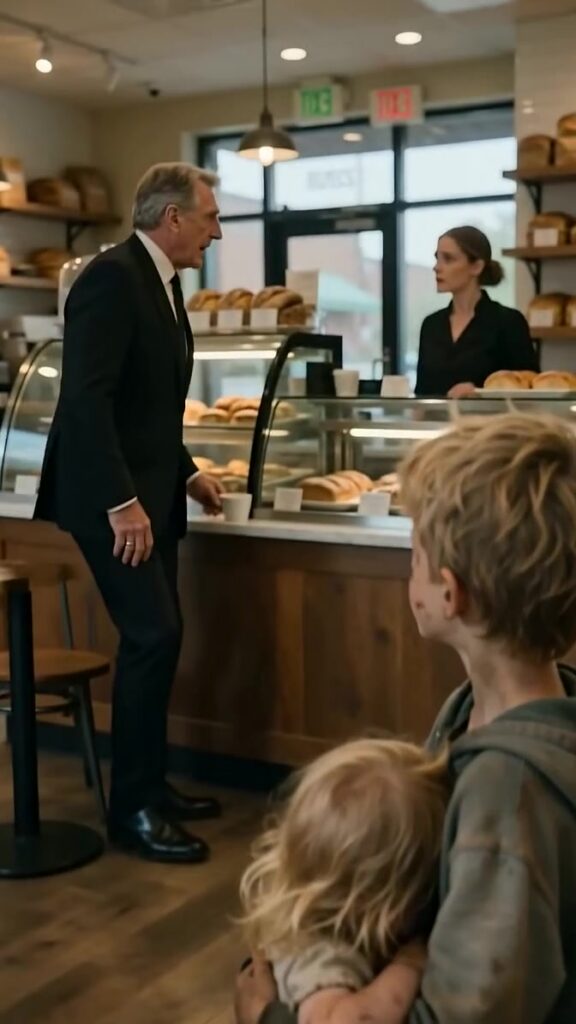
He was thin enough that his oversized hoodie looked like it might swallow him. The sleeves hung past his wrists, and the hem brushed his knees. He carried a toddler pressed to his chest, her cheek smeared with tears, her beige dress darkened at the bottom from street grit and old snow. The girl’s fists clutched the fabric at his shoulder as if it were the only stable thing left in the world.
“I’m hungry,” she whimpered, the words muffled into his hoodie.
He rocked her without stopping, an automatic motion he’d learned too young. His eyes stayed on the pastry case as if he could feed her by staring hard enough. People noticed and then looked away, the way you look away from a siren when you’re not the one being chased.
The boy approached the counter. He stood on the balls of his feet to see over the glass. Up close, you could see the purple shadows under his eyes and the tiny cracks in his lips from wind.
“Excuse me,” he said. His voice was small, but it didn’t shake. “Do you have yesterday’s bread? The one you… sell cheaper?”
Mira hesitated. Something soft appeared in her face for half a heartbeat—something human—before it was replaced by the tidy mask of policy. Her gaze flicked toward the security camera in the corner, then toward the line forming behind him.
“We don’t have discounted leftovers,” she said, too carefully. “We don’t sell day-old items.”
The words weren’t cruel. They were worse than cruelty: they were indifferent. They dropped between them like a locked door.
The boy didn’t argue. He didn’t plead. He only lowered his eyes, as if he’d been expecting the world to be exactly this shape. He pulled the toddler tighter to his chest. Her crying rose, a thin sound that cut through the café music like a tear in fabric.
At a table by the window sat an older man with a silver watch and a black suit that fit like authority. He held his cup with both hands but had forgotten to drink. His hair was combed back in a way that made him look disciplined, untouchable. Yet the boy’s question had struck him with a force that didn’t match its volume.
He set his coffee down. The cup clicked against the saucer—sharp in the sudden quiet. When he stood, his chair scraped the floor loud enough to turn heads.
He walked to the counter with the calm of someone used to being obeyed. Up close, the scent of his cologne mixed with the bakery’s butter and cinnamon until it felt almost obscene.
“Pack it all,” he told Mira.
She blinked. “Sir?”
He didn’t soften it. “Everything. Every loaf. Every pastry. Whatever you have ready.”
Mira’s mouth opened and closed. Then she moved, hands flying for boxes and bags, her professionalism suddenly frantic, as if speed could keep her from feeling.
The man turned toward the children. His voice lowered, gentler now, almost awkward in its attempt at warmth. “Come with me,” he said. “You can eat. Somewhere warm.”
The boy took an instant half-step back. His shoulders tightened around the toddler. Suspicion flashed across his face—not gratitude, not relief. He’d learned that offers could be hooks.
“Why?” he asked.
The man inhaled to answer—and stopped.
The toddler shifted, turning her head through tears. A small crescent-shaped mark showed near her temple, pale against flushed skin. The man’s expression broke in a way no suit could hide. Shock went through him first, then something older and uglier: recognition with teeth.
He lifted his hand, trembling, and halted it inches from her face, like touching her would make the moment real.
The boy noticed the hesitation and misread it as danger. His voice sharpened. “What are you doing?”
The man swallowed. It looked painful. “What is her name?”
The boy’s eyes darted to the door—measuring distance, calculating escape. Then to Mira, who had stopped packing long enough to stare. The room had become too silent, as if everyone was holding their breath and waiting to see what kind of person the man in the suit would be.
Finally the boy answered, barely above a whisper. “Lily.”
The man’s face drained of color. The name landed with a specificity that made his posture falter. He gripped the edge of the counter as if the marble could keep him upright.
“And… your mother?” he asked, voice rough. “What was her name?”
The boy went rigid. That question wasn’t curiosity; it was a bruise being pressed.
He looked down at Lily, who had quieted into hiccuping sobs, then back up at the man as if weighing the cost of honesty.
“She’s not here anymore,” he said.
The man’s throat worked. “Not here… where is she?”
The boy’s jaw trembled, the first crack in his careful composure. “She got sick. Winter. We couldn’t—” He stopped, because the rest of the sentence was too heavy for a child to carry in public.
The man closed his eyes. For a second, the expensive café vanished behind his eyelids and something else took its place: a younger woman with dark hair, standing in a doorway, begging him to listen. The memory hit like a wave. He opened his eyes and looked at the boy again. This time, he didn’t see dirt or hunger first. He saw cheekbones he recognized. A stubborn set to the mouth that matched a ghost.
“Please,” he said, and the word sounded like it had never been used in his life before. “Tell me her name.”
The boy held his stare for a long time. In that pause, the entire bakery seemed to lean forward.
Then, quietly, he said it. “Elena.”
The man’s knees weakened. He caught himself on the counter again, and his knuckles whitened. Elena. His daughter. The one he’d cast out with clean words and cold certainty when she chose a life he didn’t approve of. The one who had shouted through tears that money couldn’t hug you back.
Mira’s hands stopped. A box slipped slightly on the counter, forgotten. Someone near the window covered their mouth. The piano song drifted on, oblivious.
The boy shifted Lily on his hip and did something that made his age suddenly undeniable: he reached inside his hoodie like a child reaching for a talisman.
He pulled out an envelope, creased and soft at the corners, protected by body heat and desperation. He held it out but kept his fingers tight around it, like letting go might be irreversible.
“Mom said,” he murmured, eyes never leaving the man’s face, “if we got too hungry… and if a man looked at Lily like he already knew her… I should give him this.”
The man stared at the envelope as if it were a verdict. On the front, faded but legible, four words were written in familiar handwriting: For my father.
His hand shook as he took it. The paper seemed impossibly light for how much it carried.
He unfolded the letter with care that bordered on reverence. His eyes found the first line, and his face collapsed—pride, composure, all of it, peeling away until only a raw, frightened father remained.
Because the letter began: “Dad, if you’re reading this, my children reached the edge of hunger before you reached the end of your stubbornness.”
His breath broke. It wasn’t a sob yet, but it was the sound of something inside him finally giving way. He looked at the boy—at his grandson, though the word felt both miraculous and damning—and then at Lily, whose birthmark glimmered like a small crescent moon in the bakery’s warm light.
“I’m here,” he whispered, not to the room, but to the past. “I’m here now.”
The boy didn’t soften. Not yet. He only tightened his hold on Lily, as if love alone could still be stolen. But he didn’t run, either.
Outside, winter pressed its cold face to the glass. Inside, the scent of butter and cinnamon lingered—no longer a promise, but a question: what do you do when warmth arrives too late, and still asks to be let in?