The sign outside buzzed like a trapped insect, its blue letters stuttering in the rain. Inside, the dive bar held its breath the way old places do—wood darkened by decades of spilled liquor, air thick with cigarette ghosts, a neon beer logo humming like a warning. The men scattered along the booths and stools looked up only when they had to, then returned to their glasses as if the world beyond the door wasn’t their concern.
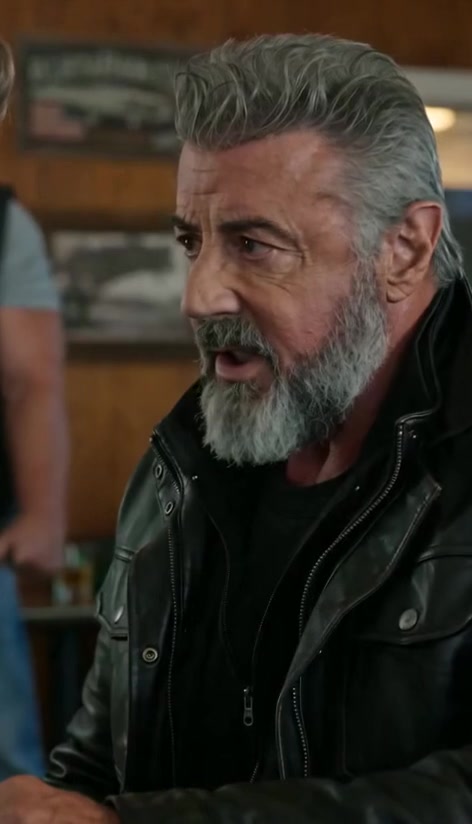
Rafe Mercer sat at the table closest to the window. He was the kind of older man who seemed carved from what he wore: heavy black leather, scuffed boots, a face weathered into angles that didn’t soften even when he blinked. One hand rested on his knee. The other lay open on the table near a half-finished coffee that had long since cooled. He stared at the empty chair across from him as if waiting for someone who was always late.
Behind the bar, Lenny polished the same glass with the same rag he’d used since Rafe still had black in his hair. A few regulars played cards without talking. Another pair watched the door without pretending. In this place, silence wasn’t awkward. Silence was policy.
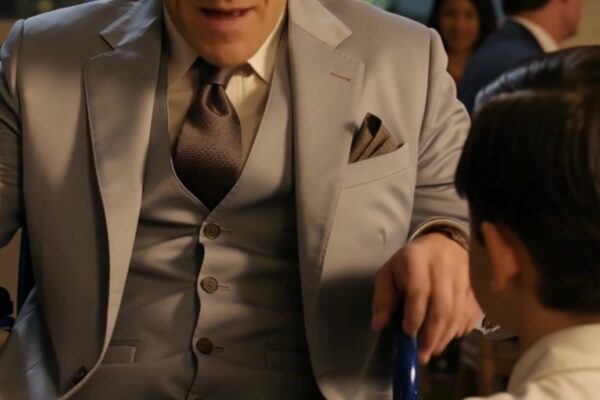
The door swung in hard enough to slap the bell above it into a frantic jangle. A younger man stepped in, water on his shoulders, white button-down tucked too neatly into dark slacks. He wasn’t dressed for the weather or the neighborhood. His jaw looked clenched even at rest, the kind of face built for saying no. His eyes raked the room and landed on Rafe as if they’d been aiming there all along.
He crossed the floor in a straight line, pulled the chair opposite Rafe, and sat without asking. The air around him felt sharper, like somebody had opened a freezer.
“A little girl come in here?” he asked. His voice was calm in the way a blade is calm—clean, controlled, and meant to cut.
Rafe didn’t shift. Didn’t glance under the table, though something small and living pressed against his boots. He kept his gaze on the man’s face, reading him the way he’d learned to read trouble: by the muscles around the eyes, by how the hands wanted to move.
“Kids don’t run into places like this for fun,” Rafe said. He kept his tone flat, almost bored. The lie was in the stillness, not the words.
The man’s nostrils flared, almost imperceptibly. “She’s mine.” He leaned forward until the edge of the table bit into his ribs. “She belongs with me.”
Under the table, the girl curled tighter, bright red hoodie bunched around her shoulders like a lifeboat. Rafe could feel her breathing through the leather of his boot, quick and uneven, trying not to be heard. He didn’t look down. In this room, looking down was the first step toward showing your hand.
“Did you hear me?” the man asked. Lower now. Closer. He spoke like someone used to obeyed rooms.
Rafe’s fingers made a small movement at his knee—nothing obvious, just enough to angle his leg so it shielded the space beneath the table. A tiny patch of safety, measured in inches.
The girl made a sound then, a whisper that barely cleared her throat. “Please,” she breathed, the word cracking as if it had to push through fear to get out. “Don’t let him take me.”
It was the kind of plea that didn’t belong in any language. It belonged in bones. Rafe felt something in his chest give way, a thin thread that had been holding him stiff and distant for years.
He watched the younger man’s face change—surprise first, then annoyance, then a hardening that made his eyes look colder. The man’s mouth curled, not quite a smile.
Rafe’s voice dropped into the quiet like a stone. “Then she stays.”
The bar’s hush deepened. Even the neon seemed to dull. The card game stopped mid-hand. Lenny’s rag froze against the glass. Men who had been hunched over their drinks straightened one by one, the slow way wolves rise, no sudden movements, just a collective decision.
The man in the white shirt pushed his chair back. Wood legs scraped the floor in a scream of protest. He stood, and the height of him didn’t matter; what mattered was the certainty he carried, the expectation that the world would step aside.
“Move,” he said.
Rafe didn’t move.
“You don’t know what you’re getting into,” the man added, and now there was a rasp beneath the calm, something ugly. He glanced around at the watching men as if counting bodies. “You want a problem over some runaway?”
Rafe’s gaze didn’t waver. “I don’t want anything,” he said. “But I don’t ignore a kid begging.”
A chair scraped in the corner. Another. Boots shifted. Leather creaked. Still no one spoke. That was the thing about this bar—everyone understood the difference between noise and commitment. Noise was cheap. Commitment got you hurt.
The younger man’s eyes flicked down toward the space beneath the table as if he could burn through wood with anger. “Come out,” he ordered, voice tight.
The girl didn’t move. She pressed her forehead to Rafe’s shin as if trying to become part of him, as if he were a wall and not a stranger.
Then her trembling hand slid between Rafe’s boots and the table leg. Something cold touched his palm. She placed it there like an offering, like a key.
Rafe’s fingers closed by instinct, then opened. A silver bracelet lay across his skin, small and worn. It wasn’t fancy—just a thin band with a simple clasp, scuffed by time. The metal carried the faint warmth of her hand and something else: memory.
Rafe’s breath caught. He had seen that bracelet once before. Not in a jewelry box, not in a store window, but glinting on a wrist that used to wave at him from the end of a driveway. A girl with scraped knees and too much laughter, shouting, “Watch this, Dad!” before she’d hop her bike off the curb like she was flying.
His fingers started to shake. He curled them to hide it, but the tremor ran up his wrist like an electric current.
The man in white noticed. His eyes narrowed. “Where did you get that?” he snapped, and for the first time he sounded worried.
Rafe looked down then. Really looked. The girl’s face was pale beneath the hood, cheeks streaked with old tears and new rain. Her eyes were enormous, not just with fear but with a desperate kind of hope, as if she’d been carrying a story too heavy for her small body.
“My mom said…” the girl whispered. She swallowed, throat bobbing. Her voice came out thin, but it didn’t break. “My mom said you’re my grandpa.”
For a second, the bar seemed to tilt. The neon hum stretched into a long, distant note. Rafe’s mind filled with a name he hadn’t spoken in years, a name he’d buried under anger and pride: Mara.
Mara, who’d slammed his door and walked away when she was seventeen. Mara, who’d sworn she’d never come back to a man who chose silence over apology. Mara, who’d sent one postcard from nowhere with no return address and no forgiveness—just a line that read, I’m alive.
Rafe’s throat tightened until it hurt. He held the bracelet up between two fingers. Its dull shine looked like a ghost of the past.
“What’s your name?” he asked the girl, and the gentleness in his voice startled even him.
She hesitated, flicking a glance toward the man standing over them. “Elowen,” she said, as if the name itself might get her punished.
The man in white took a step closer. “This is ridiculous,” he hissed. “She’s confused.” He reached out, quick, fingers splayed for the edge of the table as if he could grab her through it.
Rafe’s hand shot out and landed on the table with a sharp, final thud. Not a punch. Not violence. A boundary. His eyes rose, and whatever lived behind them now wasn’t weary. It was awake.
“You touch her,” Rafe said, “and you won’t leave this room on your feet.”
The men around them didn’t cheer. They didn’t threaten. They simply shifted into positions that made the doorway feel far away. Lenny’s hand disappeared beneath the bar, not for drama but for certainty.
The younger man’s lips peeled back in a smile that didn’t reach his eyes. “You think you can keep her?” he asked softly. “You think you can undo what’s already done?”
Rafe leaned back, slow, never taking his eyes off him. Beneath the table, he felt Elowen’s fingers clutch the hem of his jacket like it was the only solid thing left in her world.
“I don’t know what you did,” Rafe said. “I don’t know what you’re trying to call yours.” His gaze flicked to the bracelet, then back to the man’s face. “But I know what she’s saying. And I know who this belonged to.”
The man’s smile faltered. For the first time, something like calculation crossed his features—realizing this wasn’t a random old drunk to intimidate. This was history. And history, when it comes back, comes back with teeth.
Rafe slid his chair back, just enough to let his hand drop beneath the table. He didn’t touch Elowen’s face or pull her out. He only offered his palm where she could find it. Her small fingers latched onto him immediately, fierce, as if she’d been waiting her whole life for something to hold.
“Stay behind me,” Rafe murmured, and it wasn’t an order so much as a promise he intended to keep.
When he stood, the bar felt smaller. The old wood, the neon buzz, the quiet men—they all seemed to gather behind him like a tide.
Rafe faced the younger man. “You came to the wrong place,” he said. “And you picked the wrong kid.”
Outside, the rain battered the windows. Inside, the silence turned solid. And in that hard, watchful quiet, Rafe Mercer realized the past hadn’t come back to haunt him. It had come back to be protected.
Elowen’s grip tightened on his hand. The bracelet glinted once, like a signal. Somewhere out there, Mara’s voice lived in that metal, in that child, in the word grandpa that cracked his heart open.
Rafe didn’t look away from the man in white. “Tell me,” he said, each word measured. “Who are you to her?”
The younger man’s eyes darkened, and the answer he carried felt like the first gunshot of a war that had been walking toward this bar for years.