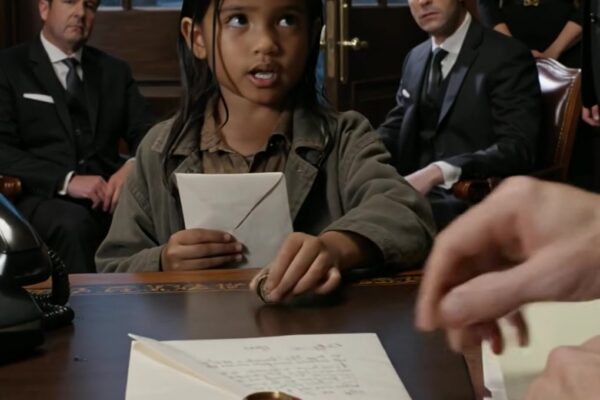
The boy stood at the back of the auditorium as if the shadows had been stitched to his shoulders. The stage lights poured over the polished floor, over rows of folding chairs, over parents in pressed shirts and glossy hair, over a banner that read WILLOWRIDGE ACADEMY: FOUNDERS’ NIGHT. It was the kind of evening that smelled of perfume and varnished wood, where laughter landed softly because everyone had practiced it in front of mirrors.
He did not laugh. He watched, fingers knotted around a cream-colored envelope that looked too clean for his hands. When the principal called for “a brief recognition of our scholarship recipients,” the room tilted slightly, as if the air itself leaned away from him.
Micah Hale—someone had said his name earlier with a pause in the middle, the way people pause around things they don’t want to touch. A scholarship kid. A charity case. A boy from the apartments by the highway where the streetlights flickered like tired eyes.
He tried to tell himself to breathe, but the breath kept catching like a thorn. The envelope trembled. He felt it in his wrists, in the bone-deep hum of nerves, in the sudden awareness of how every seat seemed to hold someone who had already decided he was an error in the room.
When he stepped into the aisle, a whisper surfaced—sharp, careless. “He doesn’t belong here.”
The whisper wasn’t alone. It multiplied under the soft coughs and the rustle of programs. A few faces turned away quickly, as if looking at him too long might stain them. Others stared with curiosity that wasn’t quite human kindness. The kind of interest reserved for a stray animal wandering into a banquet hall.
Micah walked anyway. He moved like someone crossing thin ice, measuring each step, trying not to crack the polite surface of the night. He passed the first row where the donors sat—women with bracelets that chimed, men with watches that caught the light. Somewhere in that row, Mrs. Langford, head of the board, held her chin high with the calm of someone who believed rules were the same thing as morality.
On the stage, Principal Dorsey smiled the smile he used for photographs. He extended a hand as if offering a prize. Micah climbed the steps, the microphone towering at his throat level like a judge.
“Micah Hale,” Dorsey said, voice warmed with public friendliness. “We’re pleased to have you with us this year. Willowridge is—” He hesitated, eyes flicking down toward the envelope. “—is a community. And communities thrive when everyone earns their place.”
It was meant to sound inspiring. It landed like a warning.
A tightness spread across Micah’s ribs. He heard, faintly, a snicker from somewhere near the center aisle. He imagined their thoughts: He should be grateful. He should keep his head down. He should not make trouble. He should not remind them that the world outside their gates existed.
But the envelope in his hands was not a thank-you note. It was not a trophy. It was a door, and he had come to open it.
Micah leaned toward the microphone. The sound of his breath hit the speakers—too loud, too intimate. He cleared his throat, and the room’s chatter died the way a candle dies in a sudden draft.
“I know you think I don’t belong,” he said.
A ripple moved through the audience. Principal Dorsey’s smile tightened, quick as a snapped thread. Someone coughed too loudly to cover their discomfort.
Micah looked out at them—at the polished faces, the pressed fabric, the certainty. His gaze found Mrs. Langford. Her eyes were pale and steady, the eyes of a woman who had never had to wonder if dinner would exist.
He lifted the envelope so they could see it. His hands were still shaking, but his voice steadied, as if it had finally found something to hold onto.
“This was left in my mother’s things,” he said. “She died last spring. She kept it sealed. She wrote on the back that I should open it only if I needed the truth.”
People shifted in their chairs. The story of a dead mother in a room like this was an unwelcome stain—something tragic that should remain off-stage, off the polished floor.
Micah broke the seal with a thumb that felt too large, too clumsy, and pulled out a folded letter. Paper whispered. It was a small sound, but it cut through the hall.
“Dear Micah,” he read, the words blurring for a moment as if the ink were wet. He blinked hard. “If you’re reading this, then the world has asked you to prove you deserve what was always yours.”
He paused, swallowing. He felt Principal Dorsey’s eyes on him, tense with the instinct to regain control of the program.
Micah continued. “Your name is Micah Hale because it was mine before it was yours. You were born under another roof, but not another worth. Your father—” He forced the next words out, each one a stone he had to lift. “—your father is Everett Langford.”
The silence that followed was not polite. It was violent in its stillness. It pressed down on the room, squeezing out every breath. A glass clinked somewhere and sounded like a bell in a cathedral.
Micah’s eyes moved again to Mrs. Langford. Her mouth had gone slack, as if her face had forgotten how to perform. In the front row, a man with silver hair—Everett Langford—stiffened as though the stage light had turned into heat.
Micah read on, voice hoarse now, but unbroken. “He doesn’t know about you. He didn’t know about me. When I was young, I made choices I can never undo. I thought leaving was mercy. It was cowardice. I met him before his marriage, before the name became a fortress. I did not tell him when I realized I was pregnant. I thought I could carry it alone.”
Micah’s hands steadied. The shaking had traveled somewhere else—into the audience. He could see it: the small tremors of hands clutching programs too tightly, the darting glances, the sudden recalculation of who stood where on the invisible ladder of the room.
“There is proof,” the letter continued. “In the safe deposit box under my name. Key taped inside this envelope. Documents. Dates. A photograph he never received.”
Micah reached into the envelope and held up a small brass key taped to the inner flap. It gleamed under the stage lights like a dare.
Everett Langford rose half out of his seat, as if his body couldn’t decide between denial and gravity. His wife’s fingers shot out and gripped his sleeve with a strength that looked like panic disguised as propriety. Their polished lives suddenly seemed made of thin glass.
Principal Dorsey stepped forward. “Micah,” he began, voice strained. “This is highly inappropriate—”
Micah turned his head slightly, meeting the principal’s eyes. “You said Willowridge is a community,” he replied. “Communities thrive when everyone earns their place.” He lifted the letter again. “I’ve been earning it my whole life. And I’m done pretending I’m asking permission to exist here.”
Someone in the audience let out a sharp breath, the kind that happens when a truth lands and breaks something. It wasn’t applause. It wasn’t outrage. It was simply the sound of a room realizing the rules had never been as solid as they thought.
Micah looked down at the final lines of the letter. “You have the right to choose what you do with this,” his mother had written. “But remember: you are not a guest in any room where your blood has already paid the entry fee.”
He folded the paper carefully. The neatness of the gesture surprised him, as if some part of him had practiced dignity in secret for years.
He faced the audience one last time. He did not plead. He did not apologize. He simply held the envelope at his side like a quiet weapon.
For a moment, no one moved. The donors, the parents, the board members—all frozen in the bright light with their judgments caught in their throats. The whispers that had once followed him now had nowhere to go.
Then Everett Langford took a step forward, onto the aisle, his face pale in a way that made him look suddenly older. His mouth opened, but whatever he might have said—denial, anger, grief—did not come. Perhaps because the envelope had already spoken. Perhaps because the boy on the stage was no longer asking for a place.
Micah turned away from the microphone. His heart hammered like it was trying to escape, but his spine held. He walked off the stage with the steady pace of someone who had carried a secret up a mountain and finally set it down in full view.
Behind him, the night remained silent—not because they had nothing to say, but because the only thing left was the truth. And the truth, when revealed, has a way of taking every voice in the room and making it wait.