The boy waited at the edge of the gymnasium floor as if the varnished wood might swallow him whole. The spring concert had ended ten minutes ago, yet the crowd still lingered, hungry for the last sweetness of applause, the last selfie under the banner that read WELDON ACADEMY: A TRADITION OF EXCELLENCE. Parents in pressed suits clustered in bright knots. Teachers drifted like careful ghosts, collecting programs and loose music stands. The stage lights had been dimmed to a tolerable glow, but the boy’s palms still shone with sweat.
He was small for thirteen—thin in the shoulders, too-long sleeves, hair cut by someone who knew only function. He held an envelope in both hands, pinched so tightly the paper bowed. It wasn’t an elegant envelope. It had been reused, the original return address blacked out with marker. The flap was sealed with a strip of clear tape as if he feared it might spill its contents if he blinked.
“Eli,” whispered the woman beside him. She wasn’t his mother, though her hand hovered at his back as if it had learned the shape of his spine. Mrs. Calder, the guidance counselor, had escorted him here like a fragile message. “If you’re not ready, we can—”
He shook his head. His throat felt packed with sand. “I have to,” he said, and the words sounded too loud in his own ears.
Across the gym, near the first row of folding chairs, Headmaster Rourke stood with his arms folded, talking to two men in tailored coats. One wore a silver pin shaped like the school crest: a stylized torch and laurel. The other held a leather portfolio and smiled with the thin patience of someone who had somewhere better to be. Eli recognized them from the office: trustees. Gatekeepers. People who decided who belonged inside these walls and who should remain outside, looking in through the glass.
He had been told he didn’t belong more times than he could count, and each time it had been delivered in a different wrapping. He didn’t belong because he hadn’t attended the feeder schools. Because he didn’t know the songs everyone sang in assembly. Because his lunch came in a paper bag while others carried bento boxes with names etched into metal. Because the rules, though written in a handbook, seemed to exist in another language when he read them—one that assumed you already knew how to be here.
Tonight, the dismissal had been sharper.
He’d been summoned to the headmaster’s office before the concert, made to sit under framed photographs of past graduating classes where every face looked like it had been carved from the same confident stone. Rourke had slid a letter across the desk without looking at him for longer than a heartbeat.
“We are rescinding the scholarship,” he’d said. “There was… an error in the eligibility review. It’s unfortunate, but the academy cannot be responsible for misunderstandings.”
Eli had stared at the letter as if it were a riddle. “But I already—”
“You’re a bright child,” Rourke had cut in, voice smooth as polished wood. “You’ll do well elsewhere. Weldon is not the right fit.”
Not the right fit. The phrase had followed Eli like a shadow all day, whispering in the halls, clinging to him during the concert as he watched classmates perform under warm lights while he sat near the back, hands knotted around his own knees.
Now, at the edge of the gym, he watched Headmaster Rourke laugh at something the trustee with the crest pin said. The laugh wasn’t cruel, exactly—it was simply effortless, the laugh of a man certain the world would move aside for him.
Eli stepped forward.
The first few strides felt like wading into a current. His feet wanted to stop. His lungs tried to remember how to inhale. But he kept moving, the envelope held out in front of him as if it were a passport. Mrs. Calder followed two steps behind, her face tense.
Someone noticed him and frowned. A parent turned, then another. The low buzz of conversation frayed. Eli felt eyes snag on his thrifted blazer, his too-tight shoes, his hands that wouldn’t stop shaking.
When he reached Rourke, he stopped so abruptly his shoulder bumped a chair. The trustee with the portfolio looked him over, irritation flickering across his features like static.
“Can we help you?” Headmaster Rourke asked, and there it was again—the gentle blade in his tone, the careful politeness that kept violence clean.
Eli swallowed. The envelope trembled between his fingers. “I… I need you to read this,” he said.
Rourke’s eyes narrowed. “This is not the time.”
“It is,” Eli insisted, and surprised himself with the firmness of it. His voice wavered but did not break. “You said I don’t belong here. That there was an error.”
Rourke’s mouth tightened. “Eli, let’s not make a scene.”
The trustee with the crest pin leaned in, voice low. “Is this the scholarship boy?”
Eli heard it. Scholarship boy. Like a category of inconvenience. His cheeks burned. He extended the envelope farther, arms aching with the effort of holding them steady. “Please,” he said, softer now. “Just read it. Out loud.”
For a moment, Rourke did not move. He seemed to weigh the envelope as if it might contain something messy. Then, perhaps sensing the gathered attention, he took it with two fingers, like something sticky. He glanced around at the parents, the trustees, the teachers who had drifted closer. Mrs. Calder’s hand came to rest lightly on Eli’s shoulder, a silent anchor.
Rourke broke the tape. The sound was small, but in the quiet gym it landed like a snap.
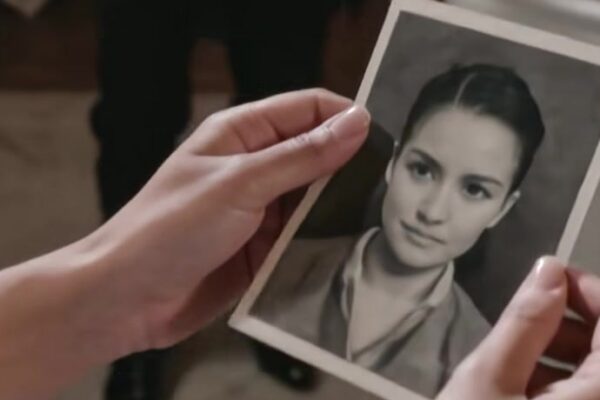
He pulled out a folded letter and an old photograph, sepia-toned at the edges. The photograph slipped slightly from his grip, and Eli caught a glimpse: a young man in a Weldon blazer, arm slung around another boy, both grinning into the sun. Behind them, the same academy crest on a brick wall. It was history made casual.
Rourke’s gaze flicked to the photo, then back to the letter. He unfolded it with a stiffness that looked, suddenly, like fear.
“Where did you get this?” he asked, and the question wasn’t meant for the room. It was meant for Eli alone.
“My mother kept it,” Eli said. His throat tightened at the word mother. He had only a handful of memories—hands that smelled like laundry soap, a laugh that tried to hide exhaustion, a lullaby hummed when there was no money for heat. “She told me to give it to you if anyone tried to send me away.”
Rourke stared at him as if Eli had grown another face. The trustee with the portfolio leaned closer, curious now. “Headmaster?” he prompted. “What is it?”
Rourke’s fingers trembled as he lowered his eyes to the page. Then, with visible effort, he cleared his throat and began to read.
“‘To the Headmaster of Weldon Academy,’” he said, voice flat. “‘My name is Margaret Hale. I am writing to place on record a matter that may become inconvenient for certain men, and therefore necessary for a child.’”
A shiver ran through the listening circle. Eli watched Rourke’s face change with each line, the way a confident mask can slip when the straps are cut.
Rourke continued, slower now. “‘In 2012, during the winter donor gala, I was employed in the kitchen. I witnessed Trustee Daniel Harrow and then–Development Director Rourke remove a sealed donation packet from the vault office. I witnessed them replace it with an empty envelope. I witnessed them laugh. I did not understand the scale of what I had seen until later, when I learned the packet contained restricted funds intended for scholarship applicants.’”
A sound went through the crowd—not quite a gasp, not quite a murmur, like the first crack in ice. The trustee with the crest pin stiffened. The man with the portfolio blinked, once, sharply.
Rourke’s voice faltered. He tried again. “‘When I confronted Mr. Rourke weeks later, he offered money for my silence. When I refused, I was dismissed. Shortly after, I discovered I was pregnant. I did not seek revenge. I sought survival. But I promised myself that if my child ever earned his place at Weldon through merit, no one would have the right to steal it from him twice.’”
Silence dropped heavy as a curtain. Someone’s phone, held halfway up, lowered slowly as if the air had turned thick.
Rourke reached the end and stopped. His eyes moved across the final paragraph without sound, lips barely parting.
“Read it,” Mrs. Calder said quietly.
The headmaster looked up, and for the first time Eli saw something raw in him—a man caught at the edge of an open pit. Rourke’s gaze darted toward the trustees, then toward the exit, then back to the boy who stood like a match held to a fuse.
Rourke’s mouth worked. Finally, he read the last lines, each word scraped out like grit. “‘Attached is a photograph taken at the gala after midnight. It includes Mr. Harrow and Mr. Rourke carrying the packet. I kept a duplicate of this letter with my attorney. Should anything happen to me, it will be delivered to the State Board of Education, along with the names of two other staff members willing to testify.’”
Rourke lowered the paper. His hands, which had never seemed capable of shaking, now trembled openly.
The trustee with the crest pin—Harrow, Eli realized with a cold clarity—stepped forward, face flushed. “This is absurd,” he snapped. “A disgruntled employee—”
“It has a photograph,” someone said from the crowd, a parent’s voice, disbelieving. “It’s right there.”
“And an attorney,” another murmured.
Mrs. Calder’s fingers tightened on Eli’s shoulder. “Eli,” she whispered, “are you sure—”
“I’m sure,” he said, though his heart hammered so hard it felt like it might burst. He had carried this letter like a weight, like a blade, for weeks. His foster mother had found it tucked inside an old cookbook when they cleaned out a storage unit paid for by a stranger. The cookbook had smelled like cinnamon and grief. Inside, the envelope had waited with his name written on it in careful handwriting: For Eli. If they try to take it.
Now the room belonged to the truth, and the truth had teeth.
Headmaster Rourke opened his mouth, but nothing came out. He looked around as if searching for an ally, and found only faces that had shifted—parents who had once smiled at him now watching with the hunger of scandal, teachers holding themselves very still as if afraid movement might implicate them.
The man with the portfolio, one of the current trustees, cleared his throat. “Daniel,” he said to Harrow, voice suddenly formal, “we need to step aside. Now.” Then, to Rourke, “And you as well.”
Harrow’s jaw clenched. “This is a child’s tantrum.”
“This is a documented allegation of embezzlement,” the portfolio trustee replied. “In front of witnesses.”
Rourke’s eyes locked onto Eli’s for an instant. There was anger there, yes—hot and humiliating—but beneath it something else, too. Recognition. The moment he understood that Eli wasn’t simply a boy asking to stay; he was a door opening to everything Rourke had buried.
“You don’t understand what you’re doing,” Rourke whispered, so low only Eli could hear.
Eli’s hands still shook, but his voice steadied. “I understand,” he said. “I’m not leaving because you say I don’t belong. I belong because I earned it.”
The words hung in the air like a bell struck once and left to ring. For a second, the gym felt like it had stopped breathing.
Then Mrs. Calder stepped forward beside him, chin lifted. “Eli is a Weldon student,” she said clearly. “And this matter will be reported. Tonight.”
Somewhere in the crowd, someone began to clap—one hesitant clap that quickly stopped, as if the person had realized applause could not mend this. But it was enough to break the paralysis. Voices rose in urgent, overlapping fragments. Phones appeared. A teacher hurried toward the office. Parents pulled their children closer.
Eli stood in the center of it, small and shaking and impossibly tall all at once. The envelope, now empty, hung loosely in his hands. He felt as if he’d stepped onto a bridge that might collapse behind him, but he also felt something he had never felt inside these walls: stillness. The quiet certainty of a place claimed, not granted.
At the far end of the gym, the banner declaring tradition fluttered slightly in the draft from an opening door. Tradition, Eli thought, could mean many things. Sometimes it meant keeping the same people in power. Sometimes it meant a boy refusing to be erased.
Mrs. Calder leaned in. “Are you okay?”
Eli stared at the headmaster as Rourke was guided away by the trustees, his face pale under the harsh gym lights. Eli’s heart still pounded, but the fear had shifted shape. It was no longer the fear of being thrown out. It was the fear of what truth demanded next.
“I don’t know,” Eli admitted. Then he lifted his chin, the way he’d seen other students do without thinking. “But I’m here.”
And for the first time since he’d walked through Weldon’s doors, the room had nothing left to say against him.