The first thing they saw—wasn’t the boy.
It was the grease.
It shone in the clean white light like a bruise on something sacred, black smears on knuckles that should’ve been wearing nitrile gloves. The technicians had trained themselves to notice imperfections the way priests notice sin. A thumbprint on stainless steel. A socket set not returned to its shadowed outline. A single drop of oil on epoxy floor so polished it could reflect the ceiling’s grid of LEDs like a second sky.
So when the elevator doors slid open at the far end of the facility and a kid stepped into the bay with his sleeves rolled, hands stained, shirt collar frayed, everyone saw him as a problem before they saw him as a person.
Because the garage—if you could call it that—was perfection.
Glass walls, dark as smoked water, kept the outside world away. Steel beams cut clean lines through space. The machines were million-dollar beasts: alignment lasers, dyno rollers, diagnostic rigs with screens that glowed with graphs like heart monitors. Every tool lived in a drawer fitted with foam, every rag folded, every air hose coiled. There were no posters, no calendars, no jokes. Only order.
Except one car.
It sat under a clear protective shroud at the center bay like a body beneath plastic. Black paint that swallowed light, carbon fiber seams as sharp as paper cuts, the kind of supercar you didn’t drive so much as you endured. It belonged to Hale—Mr. Julian Hale—whose name turned people careful when they spoke it. The kind of man who bought companies the way others bought coffee.
The car was dead.
Not in the simple ways cars die. Not a belt. Not fuel. Not a battery. Dead in a way that embarrassed everyone who had looked at it. It had come in after an exclusive track day, delivered in a climate-controlled truck, and then it refused to wake. No crank. No ignition. No error messages that made sense. Diagnostics came back clean as if the car were lying.
They had tried everything.
The in-house engineers had run software reloads and hardware tests. Two teams from the manufacturer flew in with briefcases and arrogance, then left with their faces tight. A consultant who normally spoke at conferences had spent a night in the bay and emerged at dawn with a stare like he’d seen a ghost in the engine bay. Rumors braided themselves into myths: a sabotaged ECU, a locked security handshake, a curse from a rival team.
By the time the kid arrived, the car had become more than a machine. It was a threat. A stain on Hale’s flawless life, and by extension, on everyone employed to keep that life shining.
Marcus Redd, the shop manager, was in the glass office above the floor when it happened. He was reading a report with the intensity of a man counting bullets. Below, twelve people moved quietly through tasks that didn’t matter, avoiding the center bay like animals avoiding a trap.
Then, without announcement, the kid walked straight toward the shrouded car.
“Who is that?” someone whispered, the words barely escaping over the hum of climate control.
“No idea,” another answered. “He’s not on today’s roster.”
“He’s on Hale’s car.”
That last sentence cut through the air like the crack of a wrench on concrete. Panic didn’t rise gradually. It arrived whole, complete, the way a fire does when it finds oxygen.
Marcus saw movement in the center bay through his office glass—an unapproved shape by the car—and his chair scraped back hard enough to make his assistant flinch. He was already out the door, keys and authority rattling at his belt, his shoes striking the metal steps two at a time.
“STOP!” he shouted as he hit the floor.
The entire facility seemed to inhale and hold it.
Silence.
Every technician froze where they stood, hands half-raised, eyes wide. Even the loudest machine—an air compressor cycling—felt suddenly too loud, too present, as if it might be blamed for whatever was about to happen.
But the boy didn’t stop.
He didn’t even look up.
He had pulled the shroud back with a care that made the plastic whisper. Now he leaned over the open rear access panel, his hands moving with practiced certainty. No hesitation. No fumbled searching for bolts. He knew where every clip was, how much pressure each connector would tolerate. He worked like someone finishing a sentence he’d already started.
Marcus pushed through the ring of stunned technicians. “Hey—kid!” His voice lowered as he came close, the anger boiling under control because anger was safer than fear. “You can’t touch that.”
The boy’s hands continued. He reached deeper, and for a moment his wrist disappeared into the maze of carbon and wiring. He tugged something loose—small, black, rectangular—and set it on the floor mat beside the car like a surgeon setting aside a tumor.
Then he wiped his fingers on a rag he’d brought in his pocket. The rag was already stained darker than old blood.
Only then did he step back.
Only then did he look up.
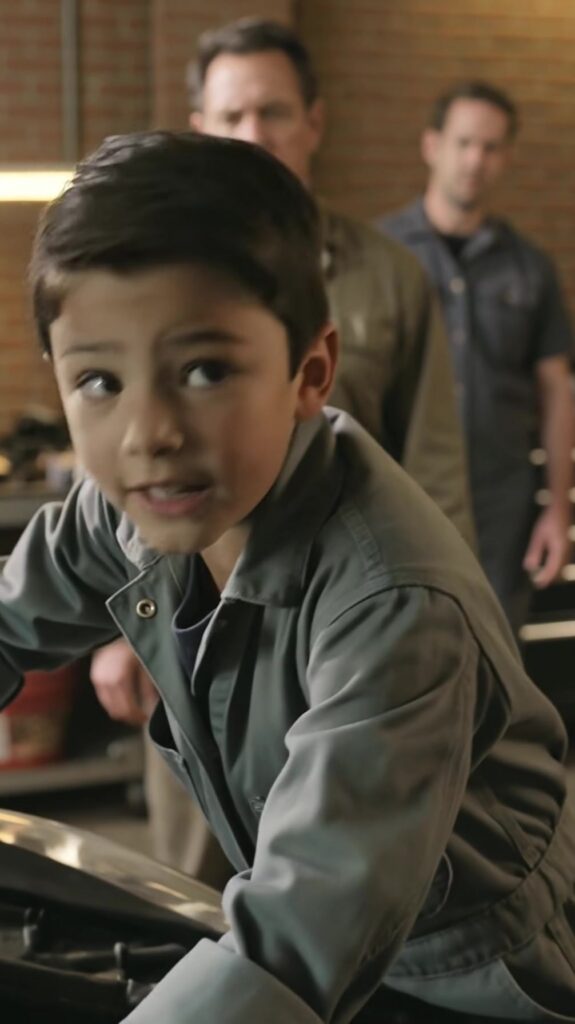
His face was young enough to make the grease on his hands feel like a costume, but his eyes were steady, untroubled. There was a faint curve at the corner of his mouth, not smug, not taunting—more like satisfaction.
Like he wasn’t fixing the car.
Like he was finishing something that was already his.
Marcus was close enough now to see that the boy’s clothing, though dirty, was not careless. The fraying at the collar was from use, not neglect. His boots were scuffed but sturdy. He had the posture of someone who’d learned to work around expensive things without being invited to own them.
“Who are you?” Marcus demanded.
“Eli,” the boy said. The name came out simple, unadorned. “I was told to come.”
“By who?”
Eli’s gaze flicked to the glass office upstairs, then past it toward the darker hallway that led to the private wing—Hale’s wing. “By the person who wants the car to start,” he said. “The same person you’re scared of.”
A laugh threatened from someone in the back, strangled into silence. Marcus’s jaw tightened. “You’re trespassing,” he said. “You’ve compromised—”
Before Marcus could finish, the facility’s front doors buzzed. The sound echoed through the clean space like a warning bell. Two security guards appeared at the entry, then halted when they saw Marcus in the center bay, and behind him, the boy beside Hale’s car.
“Don’t move,” Marcus called to the guards without taking his eyes off Eli. “Get him—”
“Wait,” Eli said, and it wasn’t a plea. It was an instruction.
He bent, picked up the small black module he’d removed, and held it between thumb and forefinger. It was the size of a deck of cards, sealed tight, with no manufacturer stamp. Homemade, or worse—custom.
“This doesn’t belong,” he said. “It’s not a failure. It’s a lock.”
Marcus’s stomach dropped. It was one thing for a car to be broken. It was another for it to be deliberately silenced.
“Where did you get that?” Marcus asked, voice suddenly hoarse.
“From the harness,” Eli replied. “It’s intercepting the handshake between systems. You can’t see it on your diagnostics because it’s pretending to be the car.”
The words were too precise to be guesswork, too calm to be bravado. The room tilted subtly. Every technician leaned in without meaning to.
Marcus took a half-step closer, anger leaking away like air from a punctured tire. “How do you know that?”
Eli looked at the black supercar—at the paint, the curves, the brutal elegance. Then he looked back at Marcus.
“Because I built it,” he said.
The sentence landed like a dropped engine block.
Marcus’s mouth opened and shut. “That’s impossible.”
“No,” Eli said. “What’s impossible is that it stayed locked this long.”
He placed the module on the workbench with reverence, then reached into the open access panel again. This time he didn’t rummage; he adjusted, re-seated, and clipped. His fingers moved in short, decisive motions, as if correcting someone else’s mistake.
“Don’t,” Marcus whispered, but the word had lost its force.
Eli slid into the driver’s seat without asking permission. The leather creaked once under his weight. He didn’t marvel at the cockpit. He didn’t look around like a kid in a dream. His hands found the start switch as if he’d done it a thousand times.
For a heartbeat, nothing happened.
Then the car exhaled—low, electrical, a quick sequence of clicks and relays waking from a long sleep. The instrument cluster flared to life, sweeping needles like a conductor raising a baton. A soft chime sounded, delicate as a warning.
And then the engine caught.
Not with a roar at first, but with a deep, controlled thrum that turned the air viscous. The vibration traveled up through the floor into everyone’s bones. The black supercar sat still, yet the entire room shifted around it, gravity rearranged by the fact of it being alive.
Someone swore under their breath. Someone else made a strangled sound that might’ve been laughter or relief.
Marcus stood rooted, watching the boy in the driver’s seat, the grease on his hands now smudged against steering wheel leather that cost more than Marcus’s first car. The facility’s perfection had been breached—and restored—in the same motion.
Eli turned the engine off after a few seconds, as if anything longer would be unnecessary cruelty. He stepped out, closing the door with a gentle push.
Upstairs, in the glass office, Marcus’s assistant held a phone to her ear, her face pale. She mouthed two words through the pane: “He’s coming.”
Marcus didn’t need to ask who.
In the private hallway, footsteps approached—measured, unhurried. The kind of footsteps that expected the world to clear.
Eli wiped his hands again on his rag and looked toward the hallway with that same faint smile.
Like the real problem hadn’t been the car at all.
Like the car had only been the first door.
And now someone was finally on the other side of it.