The gala was supposed to be elegant, controlled, and perfect—an evening designed to look effortless from a distance and feel unbreakable up close. Gold light spilled from chandeliers like honey, warming the marble floors and flattering every lie. Waiters moved like practiced shadows with trays of champagne. Laughter rose at measured intervals, as if timed. Women in dresses that cost as much as cars leaned close to friends they didn’t trust. Men in sharp suits spoke in smooth sentences about generosity and legacy while their eyes calculated interest.
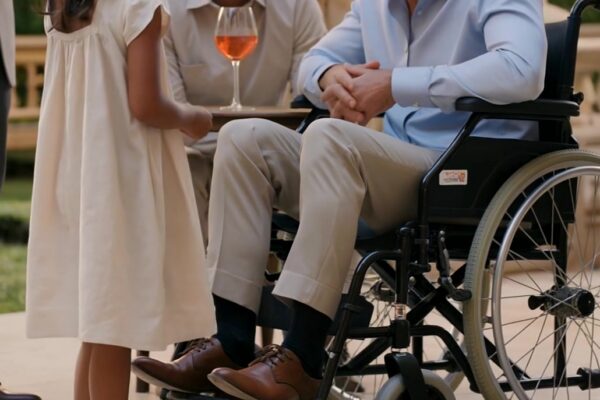
At the center of the room, in the one spot everyone could see without appearing to stare, sat Evelyn Hart. Her wheelchair was a custom piece of engineering, sleek as a sports car, but nothing could disguise what it meant. She wore emerald satin that gathered at her knees like pooled water, and diamonds at her throat that glimmered with the cold patience of stones that had waited for centuries. People came to her like pilgrims to a relic—soft voices, lowered heads, careful admiration.
Two years ago, the accident had taken her mobility and left gaps in her memory like pages torn from a book. She remembered names and etiquette, the architecture of her life, but some days her own history felt like a mansion with locked rooms. The hardest part wasn’t the pain or the chair. It was the way everyone insisted she was “back,” as though saying it often enough could make it true.
No one insisted more than Adrian Cole.
He stood behind her right shoulder as if he’d been built for that position, navy suit fitted to his frame, hair perfect, expression calm. If Evelyn turned her head, she would find him. If she reached for her glass, it was already in her hand. He called himself her protector. The board called him devoted. The press called him a miracle of loyalty. And Evelyn, in the quiet hours, had begun to suspect that devotion could be shaped into a cage.
When the auction began—silent bids on art, vacations, and access—Adrian leaned down and murmured, “You’re doing wonderfully. Just keep smiling when people approach.” The words were gentle. The instruction underneath them wasn’t.
Evelyn’s smile held for photographs. It held for donors. It held while a senator’s wife praised her courage and touched her forearm as though it were a talisman. But as the room swelled with music and money, a pressure built behind Evelyn’s ribs, an irrational sense that something important was approaching, something she had forgotten on purpose.
That was when she saw the boy.
He didn’t match the room. He wore a green hoodie instead of black tie, and his shoes were scuffed in a way that made Evelyn’s security team look down at his feet first, as though poverty itself were a weapon. He couldn’t have been more than sixteen or seventeen. His face was too pale, his mouth too set. He moved with determination that did not belong to someone who had slipped past two guards.
He walked straight toward Evelyn.
Adrian reacted instantly, stepping between them. “Stop.” He didn’t raise his voice, but it cut through the music anyway, sharp as a snapped string. “Step back from her.”
The boy halted, shoulders tight. Fear flickered in him, but he didn’t retreat. His gaze stayed fixed on Evelyn, not Adrian, as if Adrian were merely a door.
“I’m not here to hurt her,” the boy said. His voice trembled around the edges of steadiness. “I just— I need her to look at me.”
Adrian’s jaw tightened with practiced restraint. “This is a private event. You’ve made a mistake.”
Evelyn should have looked away, should have let security carry the boy out and let the night seal itself shut again. Instead, something in his eyes snagged her attention like a hook in silk. Recognition without context. A bruise of familiarity.
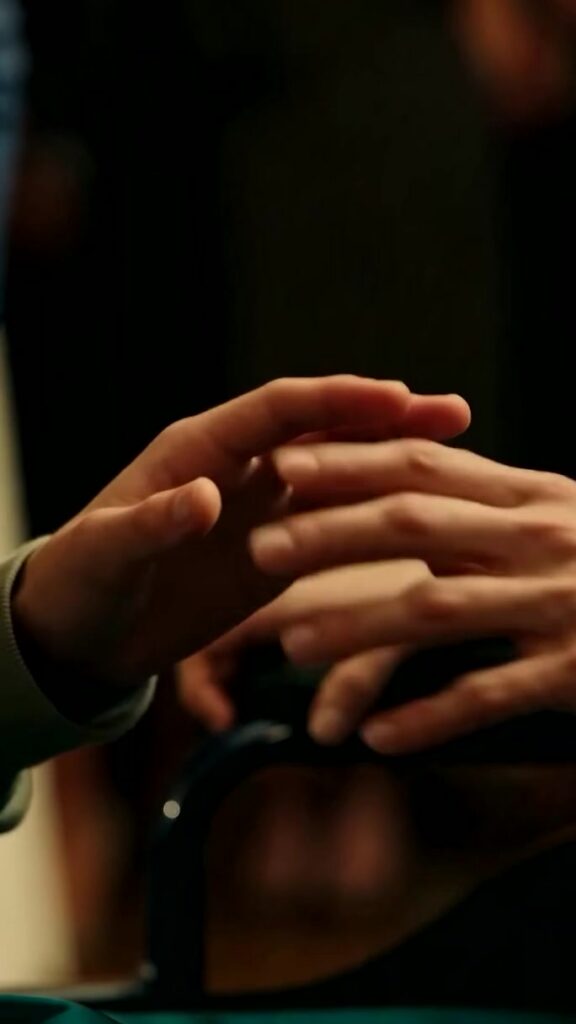
The boy swallowed hard and lifted his hand, palm up, toward Evelyn. “Please,” he said, quieter now. “That’s all I’m asking. Just… your hand.”
The circle of guests nearest them fell silent, the kind of silence made by people who could smell scandal before it happened. Someone’s glass clicked against a plate. A camera flash fired too early, like a starting pistol.
Adrian leaned closer to Evelyn, voice low, urgent. “Evelyn, don’t. We don’t know him.”
But Evelyn was already leaning forward, drawn by an invisible thread. Her fingers hovered above the boy’s trembling palm. Adrian’s hand closed lightly over her wrist—not a grip, not exactly, but a reminder of ownership. Evelyn felt the pressure and, for the first time all night, resented it.
She slid her hand free and placed it in the boy’s.
The moment their skin met, her breath jammed in her throat. Her world jolted sideways.
White light. Hospital antiseptic. A scream cut short into a sob. The sensation of straps at her wrists, restraining her—not for safety, but for convenience. A newborn’s cry, high and furious. Evelyn’s own voice, hoarse with pleading: “Let me hold him. Just once.” Another voice—male, composed, close enough to be intimate—saying, “You won’t thank me today, but you will later.”
Then the terrible, muffled silence of a door closing.
Evelyn gasped and jerked as if burned. Her fingers tightened on the boy’s hand, not wanting to lose the only anchor in the storm. She felt herself shaking, small tremors racing through her arms. Across from her, the boy’s eyes shone with tears that made him look younger than he was.
Adrian’s face drained of color with an abruptness Evelyn had never seen. He looked, in one unguarded instant, less like a protector and more like a man watching a lock fail.
“What did you do?” Adrian hissed, and for the first time, his voice was not gentle.
“Nothing,” the boy whispered. “She’s remembering.”
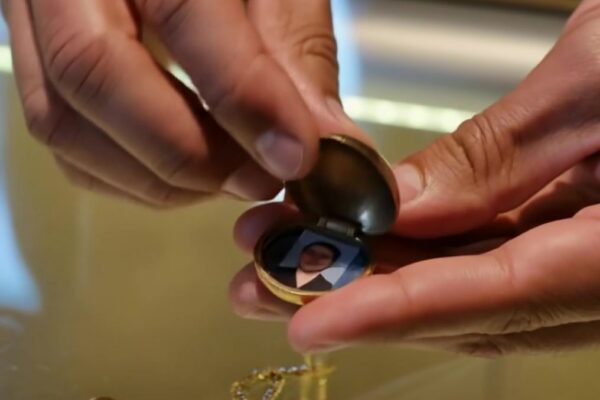
Evelyn’s gaze dropped to her own wrist. Beneath the emerald sleeve, pressed against her pulse, was a broken silver bracelet she’d worn for years. It had been given to her—she couldn’t remember by whom. She only remembered that she’d tried to throw it away once and ended up crying on the bathroom floor, clutching it like a lifeline. So she’d kept it, half a circle of tarnished metal with a small engraved star.
The boy reached into his hoodie pocket and pulled out the other half.
The matching engraved star caught the light. The break in the metal aligned perfectly with hers, like a wound that had waited to close.
A sound escaped Evelyn, not quite a sob, not quite a laugh—something rawer. “I know this,” she breathed. “I— I’m supposed to know this.”
Adrian stepped forward, arm out. “Hand it over.” The words were clipped, panicked. “Now.”
“No,” the boy said, and the single syllable was the bravest thing in the room. He held the bracelet half like evidence. “You can’t take it from her again.”
Again. The word landed in Evelyn’s mind like a gavel.
Pieces shifted, snapping into place. Not full memory—nothing that neat—but enough. Enough to see Adrian in that hospital brightness. Enough to feel the weight of a baby against her chest that she had never been allowed to know. Enough to understand why she had woken some nights with her arms empty and aching as if they’d been holding something real.
Evelyn lifted her eyes to Adrian’s face. “Who,” she asked softly, “are you to me?”
Adrian’s expression tightened, then smoothed, as though he could still edit the story if he spoke fast enough. “I’m the person who kept you alive,” he said. “I’m the person who kept you safe. You were spiraling. You didn’t know what you wanted. You were—”
“Pregnant,” Evelyn whispered, the word tasting like blood and truth. Another flash: her own hands over her stomach, a private smile in a mirror. “I was pregnant.”
The boy’s tears spilled over. “My foster mom told me the truth when she got sick,” he said, voice breaking. “She said you didn’t give me away. She said somebody signed papers while you were sedated. She said to find you when I could. She said if you ever touched my hand, you’d remember why you screamed.”
The room had become a frozen tableau—donors, politicians, socialites—faces turned toward them like witnesses at a trial. Security hovered uncertainly at the perimeter, waiting for Adrian’s signal. Even the string quartet had faltered into silence.
Evelyn stared at the boy’s face, tracing familiar angles she’d never seen before and somehow had always carried. His eyes were the exact shade of hers when she cried.
“What’s your name?” she asked, voice shaking.
He swallowed, fighting to stand upright beneath the weight of the moment. “Noah,” he said. “Noah Hart. At least… that’s what she told me I was supposed to be.”
Adrian’s hand twitched, as if he might reach for Evelyn’s chair handles and wheel her away, relocate the narrative to somewhere he could control it. Evelyn saw it. She saw the calculation. She saw, too, the truth that had been hiding behind every tender gesture: Adrian hadn’t just protected her. He had managed her. Curated her. Pruned her life until only the parts that suited him remained.
Evelyn drew a slow breath and did something she had not done since before the accident: she chose. She curled her fingers around Noah’s hand and held tight.
“Call my attorney,” she said to the nearest staff member, her voice suddenly clear enough to cut through chandeliers and reputations. “Now. And call the police.” Her gaze never left Adrian’s. “Tell them my son is here. Tell them the man who’s been standing beside me has questions to answer.”
Adrian’s smile tried to form, failed, and fell away. In its place, something bare and ugly appeared—fear, yes, but also anger, as if Evelyn had broken a contract by remembering she was a person.
“Evelyn,” he said, softer, warning. “You don’t understand what you’re doing.”
“I understand enough,” she replied. Her hand trembled, but it did not let go of Noah’s. “The rest will come.”
Noah lifted the broken bracelet half, and Evelyn slid her own into view. Under the golden lights meant to make everything look perfect, the two pieces met at the jagged break and became one circle again—still scarred, still tarnished, but whole.
The gala had been planned to celebrate control. Instead, in the center of all that polished wealth, a mother remembered her child, and a carefully constructed life began to collapse exactly as it deserved.