The ballroom had been rebuilt three times in forty years, yet it still managed to look like it had never forgiven the first fire.
Gold leaf clung to every curve of the ceiling, so bright it made the guests seem dimmer by comparison. Music drifted from a quartet tucked behind a screen of orchids—soft enough to imply refinement, sharp enough to slice through hesitation. The city’s power gathered here the way heat collects under a lid: invisible, smothering, inevitable.
They moved in practiced orbits around the center. They kept their laughter measured. They drank as though tasting could be a performance. They avoided looking directly at the staff unless something was missing from their hands.
In the space between tables, a maid wove like a shadow trying not to belong to any candle’s reach.
Her uniform was plain—gray and obedient—and her hair had been pinned back with the kind of care that suggested rules, not vanity. She carried a cloth and a tray with nothing on it, as if she had been assigned to hold emptiness and apologize for taking up air. Her eyes stayed lowered. Her shoulders held an old habit of bracing, the way people do when they’ve learned that attention is not a gift.
It should have worked. It usually did.
But a man in a tuxedo—black so deep it swallowed the light—watched her as though she were the only thing that wasn’t rehearsed. His name was Gideon Ashford. Everyone here knew it. They knew the philanthropic speeches, the camera-ready smiles, the foundation plaques. They knew how his family had owned the building before the city had names for its neighborhoods.
They didn’t know what it cost him to keep the ballroom unchanged.
Gideon lifted his glass slowly, and the gesture made nearby guests pause mid-sentence. A toast, they assumed. A signal of favor. His wrist rotated with calm precision, so practiced it looked like elegance.
It wasn’t.
He took a step toward the maid, close enough that the men beside him leaned in, hungry for the shape of humiliation. The woman on his arm—draped in diamonds that bit into her skin—smiled as if she expected a joke.
Gideon tipped his glass.
What should have been an arc of champagne, pale and ordinary, never reached her.
It paused between them, a suspended ribbon of liquid hovering at throat-height, trembling as if held by an unseen hand. Then it twisted, not falling but turning inward, coiling with a deliberate intelligence. Light flared from its core—first a spark, then a bloom—until the champagne became something else entirely: a flock of bright fragments, drifting toward the maid like moths drawn to a long-locked flame.
The quartet faltered. A violin string squealed. Someone laughed once, too loudly, and then stopped when nobody joined them.
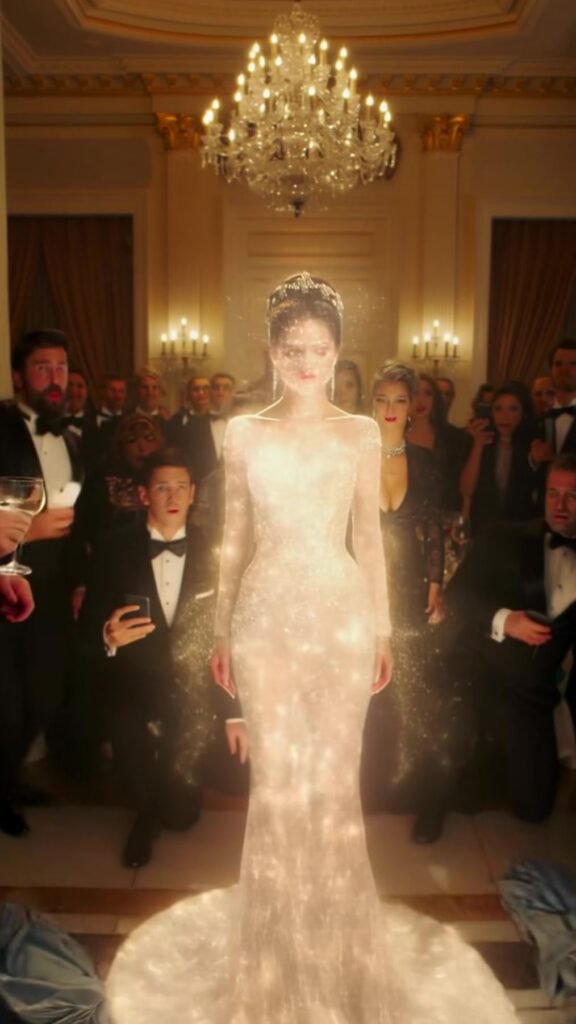
The fragments touched the maid’s uniform and spread, not wetting, not staining—awakening. Threads loosened as if unknotted from inside. The gray fabric did not tear; it let go. It broke into dust that glowed and rose, swirling around her in a slow, solemn spiral.
Under it, a gown took shape—impossible in its detail. It formed from nothing and memory at once, layers of dark silk like midnight water and seams that caught light without reflecting it. Tiny stones—no, not stones, something older—embedded themselves along the bodice, each one pulsing faintly as if answering a distant call.
People stared with the kind of awe they pretended not to possess.
“Is this… a trick?” someone whispered, and their voice sounded like profanity in a chapel.
The maid—no longer dressed like a servant—straightened slowly. It wasn’t a posture of pride; it was a return to alignment, like something within her had finally found its proper orientation to the world.
Gideon’s companion loosened her grip on his arm. Her fingers slid away as though his sleeve had turned to ice.
“What is this?” she breathed, the words barely shaping themselves around fear.
A wave moved through the guests—subtle at first, like the collective sway of a field under wind. Knees buckled. Hands reached for tables that offered no stability. One person sank to the marble as if compelled, then another, then a dozen more, until the kneeling became a pattern, a reflex older than etiquette.
They weren’t choosing reverence. Their bodies remembered it.
Phones lifted, trembling in manic disbelief, screens reflecting the glow around the woman’s skirt. A spotlight from the ceiling—meant for speeches and awards—turned as if guided, finding her precisely. It held her like a question it had been waiting decades to ask.
She lifted her head.
Her face was calm. Not blank—controlled. The kind of calm that comes after surviving what should have ended you. Her eyes, dark and lucid, moved across the room as if counting missing pieces.
When her gaze landed on Gideon, something in his expression broke. It wasn’t guilt alone. It was recognition. The kind that makes a person feel suddenly young and cornered.
He stepped back once. The movement was small, but the confidence that had filled his spine drained out with it.
“No,” he said under his breath, the word scraped raw. “That’s impossible.”
She smiled, and it held no humor.
She spoke softly, and yet the sound carried as if the walls themselves leaned in.
“You kept this place exactly the same.”
It wasn’t a compliment. It was an accusation sharpened by time.
The chandelier above them flickered, crystals clinking like teeth. The quartet’s music died mid-note, leaving a silence so heavy it pressed against throats. Even the air smelled different—like rain that hasn’t fallen yet.
Gideon’s companion turned on him, her eyes wide with outrage that could not compete with terror. “Do you know her?”
Gideon swallowed. His lips parted, and for a moment it looked as if a name might escape—the kind of name that would change the architecture of the world.
The woman in the impossible gown took one step forward.
Her heel met the marble, and the floor cracked with a sharp report that echoed through the ballroom like a gavel’s strike. Hairline fractures raced outward, branching beneath the guests’ shoes. People screamed, not from the damage but from what the sound meant: the building was no longer a stage. It was a witness.
She continued forward, the hem of her gown floating just above the floor as though gravity had agreed to compromise. The light around her did not brighten the room; it revealed it, stripping away the gloss until the gold looked like old coin and the flowers looked like something placed over a smell.
Gideon stared as if he were seeing an old portrait breathe.
“We buried you,” he whispered. “We erased you.”
“You tried,” she replied. “You traded truth for tradition and called it inheritance.”
His throat worked. “Your name—”
“You don’t get to say it like a prayer,” she said, and the warmth of her voice made the words colder. “You used it like a lock.”
Behind them, a server dropped a tray. Glass shattered—sharp, bright, useless. One shard slid across the cracked marble and stopped at the edge of her shadow, as if afraid to cross.
She looked around the kneeling guests. Her gaze touched them briefly, not with cruelty but with assessment. “Stand up,” she said, not loudly.
Several people tried and failed, their legs trembling, their bodies refusing to obey. Their fear wasn’t of her power. It was of what their obedience revealed.
Gideon lifted his empty hand, as if he could reverse the gesture that had started this. “What do you want?” His voice broke on the last word.
She paused inches from him. Up close, her eyes were not dark; they were deep, with a glint of something like starlight trapped under ice.
“I want what was taken,” she said. “Not the dress. Not the room. Not the performance you call history.”
The chandeliers shuddered again, lights sputtering. Somewhere within the walls, a low rumble answered, like a long-silenced organ drawing breath.
She lifted her hand and, with two fingers, touched the air where the champagne had hovered.
A thread of light snapped into being between her fingertips and Gideon’s chest, stretching taut as wire. He flinched, not from pain, but from the sudden sense that something inside him had been hooked.
She leaned in, close enough that only he could hear her next words—yet everyone felt them, as if they were spoken in their own bones.
“You built this ballroom to celebrate yourself,” she murmured. “Tonight it remembers me.”
Gideon’s eyes filled, not with tears, but with the bright panic of a man realizing the story he controlled had just changed authors.
She straightened, and the spotlight held steady, obedient. Around her, the glowing fragments of the spilled drink drifted upward, collecting near the ceiling like waiting fireflies.
“The glass never touched me,” she said to the room, her voice now clear as a verdict. “But you did.”
Then she smiled again—small, sharp, inevitable.
“And now,” she added, “I’m touching back.”