The grocery store was bright in the unforgiving way only supermarkets are—white light flattened everything, drained shadows from faces, erased the small mercies people usually tuck themselves into. Even grief looked like something you could price per pound under those fluorescent tubes.
It was a Tuesday that pretended to be ordinary. The automatic doors kept inhaling and exhaling strangers. A child cried near the cereal aisle; a speaker overhead promised discounts in a voice too cheerful to be human. Somewhere behind the bakery, an employee was spraying fresh-water mist over vegetables so they’d look alive.
Officer Daniel Mercer stood in line at register three with a microwave burrito and a bottle of water, his uniform still smelling faintly of rain. He’d been on foot patrol for six hours. The city had been restless lately, not with riots or headlines, but with a low grinding pressure that made every call feel like a fuse.
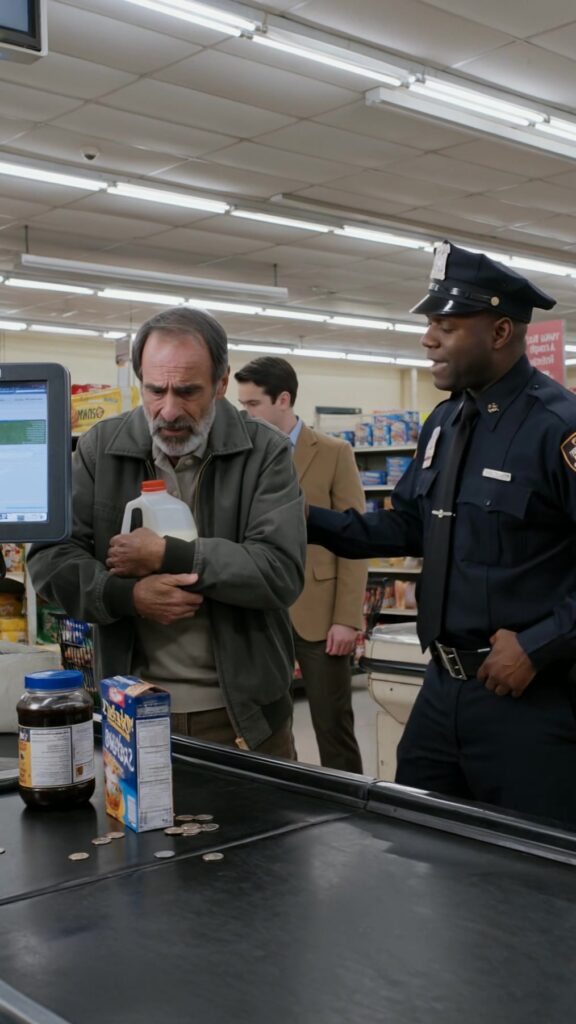
In front of him, an elderly man held a plastic jug of milk to his chest as if it were a fragile animal. His back was bowed not just by age but by something heavier, something that pushed from the inside. A single box of macaroni, a jar of instant coffee, and a bruised banana sat on the conveyor. Beside them lay a small scatter of coins—nickels and dimes and pennies, as if the man had emptied a drawer and hoped the drawer would forgive him.
The old man’s hands trembled as he counted. Then he counted again, moving each coin with careful respect. He wore a fraying coat whose buttons didn’t match, and his shoes were clean in that particular way that said they had been cleaned too often, repeatedly forgiven for their age.
The cashier, a young woman with a tired ponytail, waited without looking impatient, her fingers poised above the keys. Daniel watched her eyes flick toward the coins and back to the man’s face. She didn’t speak. The silence around them was thick enough to snag on.
Behind Daniel stood a man with a tan blazer and expensive watch, the kind of man who never had to check a price tag because he had outsourced that worry to his confidence. Next to him, his son—maybe eight—held a candy bar with both hands like a prize. The boy’s sneakers were bright, freshly new, their laces tied in symmetrical bows.
The father sighed loudly. The sound was designed to be heard. “Seriously?” he muttered, the word stretching like gum. His annoyance didn’t land on the delay so much as on the existence of the delay. On the proof that life did not move at the speed he preferred.
Then he said it, in a voice that needed an audience to feel complete.
“What a loser.”
The boy looked up, not shocked—children learn their ethics the way they learn language, by repetition. “Dad,” he asked, curious and unguarded, “why is he poor?”
The elderly man’s face changed at that question, though he didn’t turn around. Something tightened at the corners of his mouth, as if he’d swallowed a stone. His grip on the milk grew firmer, knuckles whitening. It wasn’t anger. It was the instinct to protect what dignity he had left from being snatched away in public.
Daniel felt heat rise in his chest, a familiar anger that was part righteous, part weary. He’d heard every kind of cruelty on patrol—shouted, whispered, typed in anonymous threads. But there was something about a child being handed contempt like an inheritance that made Daniel’s jaw clench.
The old man pushed a few coins forward. They made a small metallic clatter. “This… this should be enough,” he said, and the lie was gentle. He was trying to spare the cashier the work of saying no.
The cashier glanced at the register, then at the coins. Her lips parted, but no sound came out. Behind them, the line had begun to swell with held breaths.
Daniel stepped closer. He didn’t do it dramatically. He simply moved like a door closing quietly against a draft. He laid one steady hand on the old man’s forearm. Not forceful. Not a warning. Just contact—human, grounding.
“I’ve got it,” Daniel said.
The elderly man flinched as if touched by shame instead of fingers. His head shook quickly, a desperate refusal. “No,” he whispered. “No… I can manage.” His voice cracked on the last word.
Daniel kept his tone calm, the way he spoke to victims before ambulances arrived, the way he spoke to children when their parents were in handcuffs and the world had turned inside out. “It’s okay,” he said. “Let me.”
The man stared at the coins like they’d betrayed him. For a moment, Daniel thought he might leave—abandon the milk, the macaroni, the coffee, all of it—just to escape being seen like this.
“Thank you,” the elderly man finally breathed, and the words were so thin they could have snapped.
The father in the tan blazer gave a short laugh, dismissive, a sound that tried to wash the moment clean of compassion. Daniel didn’t look at him at first. He focused on the old man, on the gray beard that didn’t quite hide the hollows of his cheeks. On the scar near his temple, pale and jagged, partially obscured by stubble.
Daniel’s hand froze against the man’s arm.
He knew that scar.
Memory, sharp as a whistle blast, cut through him: a gym that smelled like varnish and sweat; a basketball thudding against polished floor; a man with a voice like gravel and eyes that missed nothing. A man who never let Daniel quit when his father disappeared and his mother worked doubles and the world said he’d be another statistic that ended early.
Coach Sweeney.
Coach who paid for Daniel’s first pair of decent shoes with cash from his own wallet and made him promise to “run like your future is chasing you.” Coach who’d pulled Daniel aside after a fight and said, “I don’t care what they call you. I care what you answer to.” Coach who’d shown up to the courthouse when Daniel needed an adult witness just so the judge would look at him like a person.
Daniel heard himself speak before he decided to. The word came out on a breath, small and stunned. “Coach?”
The elderly man blinked slowly, as if the fluorescent lights had finally become too bright to bear. His gaze lifted from the coins to Daniel’s chest, to the badge, to the name stitched above the pocket. His eyes, tired and filmed with years, sharpened with recognition that hurt to hold.
“Danny?” he said, and the name was a bridge thrown across decades. His voice wavered, then steadied. “Daniel Mercer?”
Daniel swallowed. His throat felt suddenly narrow. “Yeah,” he managed. “It’s me.”
The cashier, sensing a private history unfolding, stood very still. The father in the blazer shifted his weight, discomfort creeping in now that the story in front of him had complicated itself. The boy watched with round eyes, as if witnessing something he hadn’t been taught a word for.
Coach Sweeney’s fingers tightened around the milk again, but this time it wasn’t fear. It was the reflex of not letting go of what mattered. “I didn’t—” the coach began, then stopped. Pride and exhaustion wrestled in his expression. “I didn’t think anyone would remember me,” he finished, quieter.
Daniel felt an ache spread through him, old and new at once. “I remember,” he said. He reached into his wallet, but the motion felt inadequate, like trying to patch a roof with a napkin. Still, he did it—paid for the groceries, slid his card through, waited for the machine to approve what the world should have approved long ago.
The receipt printed like a verdict.
As the cashier bagged the items, Daniel glanced back once. The father in the blazer had gone stiff, his mouth pinched, as if he’d been caught speaking loudly in a church. Daniel didn’t scold him. He didn’t need to. Reality had done it. The boy was looking at the coach now with a different kind of curiosity—less judgment, more wonder, the beginning of empathy trying to form.
Daniel turned back to Coach Sweeney. “Come on,” he said, taking one of the bags so the old man didn’t have to juggle it. “Let’s get you out of this light.”
Coach Sweeney nodded once, and in that nod was the same stubbornness that used to keep a team running suicides until they learned they could survive their own burning lungs. He stepped forward, leaving the coins behind on the counter like shed shame.
Outside the automatic doors, the afternoon was gray and forgiving. The sky held its shadows where they belonged. Daniel walked beside his coach through the cool air, and for the first time in a long time, he felt like the world had offered him a chance—not just to enforce the rules, but to repay a debt that had nothing to do with money.
Behind them, the grocery store kept glowing, bright and public and merciless. But Daniel had carried something fragile out of it: the proof that kindness could still happen in the most exposed place, under the harshest lights, without asking permission.
And Coach Sweeney, clutching his milk like it was precious, finally let his shoulders drop as if, for one small moment, someone else was holding him up.