They had staged perfection with the confidence of people who believed perfection could be purchased.
The hall was a restored conservatory turned event space, all glass ribs and white stone, the late sun poured through it like honey. Roses and ranunculus spilled along the aisle in careful asymmetry, the kind that pretended not to be arranged by a team with headsets. Every chair held a printed program with gilded edges. Every guest had been reminded, twice, that phones should remain silent.
At the front, beneath an arch woven with flowers and chandelier crystals, Julian Hart stood beside the officiant. His tuxedo fit like a promise. His smile, when it came, looked practiced—bright enough for cameras, controlled enough for investors. Beside him, Serena Larkley drifted forward on her father’s arm, lace whispering across marble. She looked as if she’d stepped out of a magazine spread: luminous and still, eyes fixed on Julian as though nothing existed outside that line between them.
It should have been a ceremony where the only interruption was tears—polite, tasteful tears.
Instead, the doors at the back of the hall flew open with a crash that turned every head in a single, startled motion. The music faltered, then snapped off as if someone had cut the strings. The sound that followed was not silence exactly, but the buzzing pause that comes when a room full of people realizes something has gone wrong and is too well-mannered to admit fear.
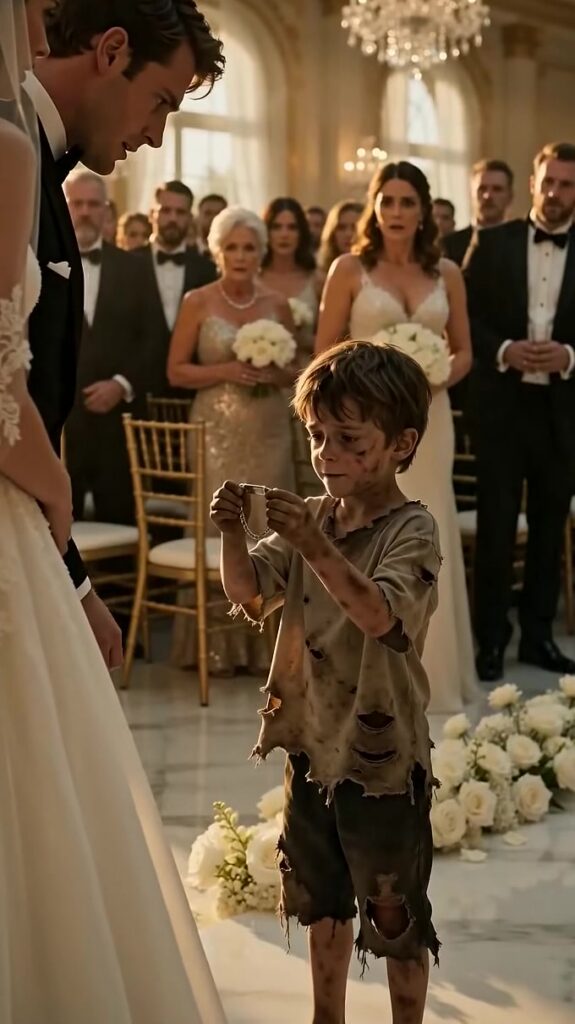
A boy stood in the doorway, small enough that the brass handles towered above his shoulders. His hair was a dark tangle. His clothes were too thin for any season, ripped at the knee, stained at the cuff. He was barefoot on stone that had been cooled for guests in satin shoes. For a moment he seemed stunned by the brightness, by the perfume of flowers and expensive bodies. Then he ran.
He cut down the aisle between rows of astonished faces. A woman clutched her pearls; a man half rose as if to block him, then sat again, unsure whether it would be worse to touch him or to let him pass. Security moved late, confused by the audacity of a child entering a world built to keep children like him outside.
Julian’s expression hardened so fast it looked like a mask snapping into place. Serena’s fingers tightened around her bouquet. The officiant took a step back, as if ritual itself had recoiled.
The boy reached the front and skidded to a stop at the first step of the altar. He was shaking, but not from cold. His eyes were wide and frantic, fixed on Julian with the desperate certainty of someone who has only one destination left in the world.
“What is this?” Julian’s voice carried, sharp as cut glass. The guests leaned in, hungry for a spectacle that would ruin the story they were supposed to be witnessing.
The boy swallowed, his throat bobbing. In his fist he held something that flashed when it caught the light—a small circle of silver that looked too delicate for his bruised knuckles. He lifted it as if it were evidence in a trial.
“I need you to see,” he said. The words were thin, scraped out of him. “Please.”
Serena’s face turned from annoyance to confusion, then to a kind of cautious alarm. Julian took the object from the boy’s trembling hand without thinking, as if his body recognized it before his mind did. The silver band lay across his palm, a baby bracelet, worn soft at the edges, the clasp scratched from years of opening and closing. When Julian turned it, the engraving caught the sun.
For my son — Daniel.
The name knocked the breath out of him. Color drained from Julian’s cheeks. His jaw loosened. A sound escaped him—half denial, half prayer.
“No,” he whispered, though no one had accused him yet.
Serena stared at the bracelet, then at the boy, as if trying to make the image align with the script she’d memorized. “Julian,” she said, soft but edged. “What is that?”
The boy took a step closer, eyes shining but fierce, refusing to blink. “My mother kept it,” he said. “She told me not to lose it. She said it would prove I wasn’t making it up.”
Julian’s fingers tightened around the bracelet until the metal bit into his skin. “Where did you get this?” His voice broke on the last word, and the break was what made the entire hall lean forward. It wasn’t anger now. It was something rawer, uglier—fear, or regret, or both.
“She gave it to me,” the boy said. “Before she… before she died.”
That sentence hit like a dropped chandelier. Serena’s bouquet sagged. Someone in the front row inhaled too loudly, and the sound was obscene in the silence.
Julian crouched, as if lowering himself might keep the room from spinning away. He searched the boy’s face with the intensity of a man trying to read his own past. “What was her name?”
The boy’s shoulders lifted with a breath that shook him. “Mara,” he said. “Mara Gray.”
The name turned Julian’s eyes glossy. In them, memories rose like oil from deep water: a cheap apartment above a bakery, the smell of yeast and damp walls; a young woman with paint under her nails and laughter that sounded like relief; a night in a hospital corridor when he’d been twenty and terrified and convinced he could outrun responsibility if he ran fast enough.
Serena’s mouth opened slightly. She looked at Julian as if she’d never met him. “You told me you didn’t have—”
He didn’t look at her. He couldn’t. His gaze remained locked on the boy, on the bones of a story he’d tried to bury under success. “How old are you?” he asked.
“Twelve,” the boy said. “Almost thirteen.” He hesitated, then added, the words dragging themselves out as if they hurt. “She said you left the day I was born. She said you were scared. She said you promised you’d come back when you had money, and then you never did.”
A murmur rolled through the guests like wind through tall grass. Phones appeared despite the warnings, lifted carefully, as if recording could protect them from being complicit.
Serena took a step back. Her veil shifted like a cloud passing over the sun. “Julian,” she said again, but now the softness was gone. “Is this true?”
Julian stared at the bracelet as if it might melt and absolve him. His thumb rubbed the engraved letters until they blurred beneath sweat. “I didn’t know where she went,” he managed, and even as he said it, the lie sounded thin. He had known. He had chosen to stop knowing.
The boy’s chin lifted. “She didn’t go anywhere,” he said. “We stayed. In the same city. We stayed in shelters. Sometimes in her friend’s car. She worked when she could. She tried to make it so I didn’t hate you.” His voice wavered, but his eyes didn’t. “Then she got sick. And when she was dying, she told me to find you. She said you were getting married. She said you’d be in a place like this.”
Serena’s hands trembled at her sides. “So I’m supposed to stand here,” she said, a strained laugh trying and failing to become real, “and pretend this is just… a misunderstanding?”
Julian rose slowly, still holding the bracelet. He looked out at the room—his colleagues, his benefactors, his mother in the front row with rigid posture and a face already calculating damage control. Then he looked at Serena, and for the first time his perfect mask cracked entirely. “I can’t,” he said. “I can’t pretend.”
The officiant cleared his throat, then seemed to remember he was a human being, not a prop, and stepped aside.
Serena’s eyes shone, not with tears yet but with the effort of holding them back. “You were going to build a life with me,” she said. “You were going to say vows.”
Julian glanced down at the boy—at Daniel, though the boy hadn’t offered his name aloud. “I should have built a life with him first,” Julian said quietly. “Or at least… not abandoned one.”
The boy flinched as if the words were too heavy to accept. “I didn’t come for money,” he blurted, sudden panic rising. “I don’t want your wedding gifts. I don’t want your house. I just—” He swallowed hard. “I just didn’t want her to die thinking you didn’t care.”
Julian’s face twisted. He reached out, then stopped, unsure if he had the right to touch. “I did care,” he said, and the confession sounded like a punishment. “I cared, and I ran anyway.”
Serena stood very still, like someone listening to a building collapse from the inside. Finally she lifted her chin, dignity reassembling itself with effort. “If you walk away now,” she said, voice thin, “there is no coming back.”
Julian looked at her, pain flickering across his features, but also something like clarity. “I know,” he said. He turned back to the boy. “Where are you staying?”
The boy’s shoulders sagged. “Nowhere,” he admitted. “A church basement, sometimes. They said I couldn’t stay after today because I kept asking people about you.” He squeezed his hands together as if bracing for rejection. “I’m sorry. I didn’t mean to ruin—”
“You didn’t ruin it,” Julian said, and the words were meant for everyone—the gawking guests, the frantic planners, the stunned bride. “I did. A long time ago.”
He held the bracelet out to Daniel like an offering. “Can you show me,” he asked, “where she’s buried?”
Daniel’s eyes flooded at last. He nodded once, quick and sharp, as if he couldn’t trust himself to nod gently.
Behind them, the hall stayed frozen in its curated beauty—flowers, crystal, sunlight—while the story it was built to celebrate fell apart. Julian took off his jacket with hands that didn’t quite work, draped it carefully around the boy’s shoulders, and guided him down the aisle the way a father might, if he had ever learned how to be one.
No one moved to stop them. Even the security guards seemed to understand that whatever this was, it wasn’t trespassing. It was reckoning. It was a debt finally collecting interest.
At the doors, Julian paused and looked back once. Serena stood at the altar, alone in her perfect dress, staring after him with a face that would haunt him for years. The guests were already rearranging their expressions into gossip and sympathy and outrage, preparing the narrative they’d tell later.
Julian faced forward again. The late sun outside was harsher than the honeyed light inside, unfiltered and honest. Daniel stepped into it, barefoot, trembling, wrapped in borrowed cloth. Julian followed, the silver bracelet warm in his palm as if it had been waiting all this time to be returned to the hand that had once fastened it.
And the wedding—so carefully designed to look flawless—ended not with a kiss, but with a boy’s thin voice and a father’s first true step toward a life he could no longer deny.