The restaurant taught people how to behave without ever saying a word. The walls held a soft amber glow that made diamonds look warmer and sins look forgivable. Glassware chimed like polite laughter. Cutlery never clattered. Even the air seemed trained to move quietly, perfumed with wine, butter, and money.
Camille Ardent sat where she always sat when she wanted to remind the city she still existed—near the window, in the center of attention without ever raising her voice. Her black blazer fit like armor. Her lipstick was the red of good decisions and bad consequences. She swirled her wine as if she were turning time itself in a glass.
The waiter had just placed the check in its leather folder. Camille didn’t open it. She slid her card inside with practiced grace, the gesture so automatic it was almost bored. The real theater of a night like this was never paying; it was being seen paying.
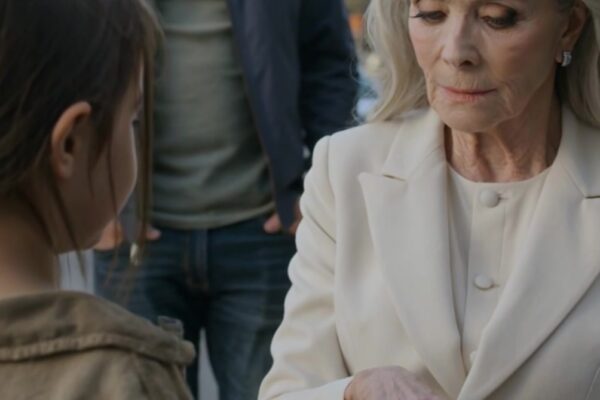
That was when the child appeared between tables, stepping with care around handbags and chairs like she had learned to navigate obstacles that weren’t supposed to be there. A tray of roses balanced on her forearm. Her sweater looked too thin for the month, too brave for the draft that slipped in whenever the front door opened. Her hair was pulled back in a ponytail that had surrendered to the day in strands and flyaways.
“A rose for the table?” the girl asked. Her voice was steady, but her eyes were older than her cheeks. “Just a small one. They’re fresh.”
Camille’s gaze flicked from the child’s face to the flowers and back again. There was a tiny pause—her mind deciding whether kindness would be an inconvenience or an accessory. She nodded once. “Fine. One.”
The girl reached for a rose with careful fingers. Camille, without thinking, lowered her hand to the table to take it. The movement was meant to be ordinary. It wasn’t. A heavy ring on her right hand caught the light and threw it back like a warning: gold, thick as a promise, set with a red stone carved into the shape of a rosebud. Tiny gold petals curled around the band, delicate and sharp at once.
The girl stopped mid-motion. The tray dipped a fraction, as if gravity had suddenly remembered its power. Her eyes locked on the ring as though it had called her name.
Camille’s mouth tightened. People froze for many reasons around her—intimidation, greed, fear. This was different. This was recognition.
“What is it?” Camille asked, her tone controlled, the kind used in boardrooms when someone has said something unacceptable.
The child swallowed. Her thumb pressed along the edge of the tray, a small nervous habit, and Camille felt something inside her recoil. She had seen that gesture before, in a mirror that belonged to the past.
“I’m sorry,” the girl said, but she did not look away. “That ring. It looks like my mom’s.”
Camille’s breath stalled. Not because the girl sounded foolish. Because the ring was not something a stranger would mistake. It wasn’t bought from a display case. It wasn’t fashionable. It was made for one family and one family alone, commissioned decades ago by a grandfather who believed love should be weighed in gold.
There had been two rings. Only two.
Camille’s fingers curled slightly, protective. She felt the metal bite her skin. “Your mother?” she echoed. “What is your mother’s name?”
The child hesitated. Not in the way of a liar searching for a better lie, but in the way of someone stepping onto ice, uncertain whether it will hold. The restaurant’s quiet thickened around them; even nearby conversations seemed to lower themselves as if sensing the shift.
Finally the girl said, “Isabel.”
The name landed like a dropped glass—silent at first, then shattering in the mind. Camille stared. She could feel her pulse in her throat. Isabel. Her sister. The sister who had vanished seventeen years earlier, swallowed by the family’s story like a stone disappearing into a river.
In Camille’s childhood, Isabel had been a bright thing—barefoot in gardens, laughing too loudly, always pulling petals off flowers to see what they hid. Later, Isabel had been rebranded as a disgrace. She had “run away.” She had “stolen.” She had “ruined everything.” Their father had said those words like prayer.
And the ring—Isabel’s ring—had been listed in a police report and never found. Camille wore hers still, proof that she had stayed loyal to the house, to the name, to the version of history carved into stone.
The girl shifted closer, and Camille saw it. Not only the eyes—dark and wide in the same shape as Isabel’s—but the mouth, the curve at the corners that always looked like it was about to question the world. A faint scar near the chin that could have been from a childhood fall Camille suddenly remembered, Isabel chasing a cat and slipping on wet marble.
Camille’s voice dropped. “Where is your mother?”
The child’s hands trembled, but her gaze didn’t. “She told me to sell flowers here on Fridays,” she said. “She said people with clean hands like to eat in places like this.” Her lips pressed together. “She said if I ever saw that ring, I should ask you something.”
Camille’s stomach turned cold. “Ask me what?”
The girl’s voice became quieter, sharper. “Why you left her bleeding on the church steps.”
For a moment Camille heard nothing but the rush of blood in her ears. The church steps. A memory slammed open, unwanted and vivid: a wedding day that wasn’t hers, the smell of lilies and incense, Isabel in a white dress not yet ruined, their father’s rage brewing like stormclouds under stained glass. Camille remembered shouting. She remembered grabbing Isabel’s wrist. She remembered the ring flashing as Isabel tore free. She remembered a sudden movement, someone’s elbow, a slip, a hard edge—stone against flesh.
And she remembered walking away.
Not because she didn’t see the blood. Because she did.
Camille looked down at her wine. The deep red in the glass suddenly looked wrong, too familiar. She set it aside with careful hands, as if it could accuse her.
“Who told you that?” Camille whispered.
“My mom,” the child said. “She doesn’t tell stories for fun. She tells them like warnings.” The girl’s chin lifted. “She said you were supposed to notice the tip.”
Camille blinked. “The tip?”
The girl nodded toward the check folder. “People like you leave tips without looking at who picks them up. She said you would do that. You would see money, and you would think that’s the only thing you ever give anyone.”
Camille felt her cheeks heat, not with embarrassment but with something closer to panic. Her card sat inside the leather folder. Her signature would be recorded, neat and unquestionable. She had come here for an evening she could control. Now a child stood in front of her holding a knife made of a single sentence.
“Where is Isabel?” Camille asked again, forcing the name out as if it might burn her tongue.
The girl’s grip tightened on the tray. “Waiting. Two blocks away. In a car that doesn’t start unless you jiggle the key.” She hesitated, then added, “She didn’t want to come inside. She said you’d look at her like she was a ghost.”
Camille stood so abruptly her chair scraped the floor, loud in a room that hated noise. Heads turned. The waiter stiffened, unsure whether to intervene. Camille didn’t care. Her hand went to the ring, thumb brushing the carved petals as if they could become a door.
“What’s your name?” she asked, though she already sensed the answer the way you sense thunder before it arrives.
“Rosalie,” the girl said. “She named me after the stone.”
Camille’s throat tightened. A rose carved in red, a child named for it, a story carried like contraband through years of silence. She looked at Rosalie—at the stubborn set of her shoulders, at the careful way she held herself as if bracing for rejection.
Camille reached into her clutch and pulled out a wad of bills, far too much for one rose. Rosalie didn’t move to take it. Her gaze stayed on Camille’s face, not her hands. The money hovered between them like an insult.
Slowly, Camille lowered it into the child’s palm anyway, but she did not let go immediately. “This isn’t for the rose,” she said, each word weighed. “This is for the years I pretended didn’t happen.”
Rosalie’s fingers closed around the bills, but her expression didn’t soften. “She said you’d try to buy your way out,” she murmured.
Camille released her. “Then tell her she was right,” Camille said, and heard the crack in her own voice. “But also tell her I’m coming.”
Rosalie stepped back, tray steadying again as if the world had decided to keep spinning. She turned to leave, weaving through tables with the practiced caution of someone who has learned how to survive in narrow spaces.
Camille grabbed the check folder, left her card behind, and walked out without waiting for permission. The restaurant’s amber light fell away, replaced by the street’s colder truth. Outside, the night wind cut through her blazer. She welcomed it. She needed something sharp.
Two blocks away, somewhere in the dark, Isabel was waiting in a car that required a stubborn key and, apparently, a sister who had finally learned there were things more costly than a tip.
Camille quickened her pace. The ring on her finger felt heavier with every step, as if the gold remembered what had been lost and refused to be silent any longer.
She had worn it for years as a symbol of belonging. Now it was a summons.
And for the first time in seventeen years, Camille Ardent walked toward the story her family had buried—toward blood on church steps, toward a sister’s eyes, and toward the child who had not come to collect kindness, but to deliver a reckoning disguised as a rose.