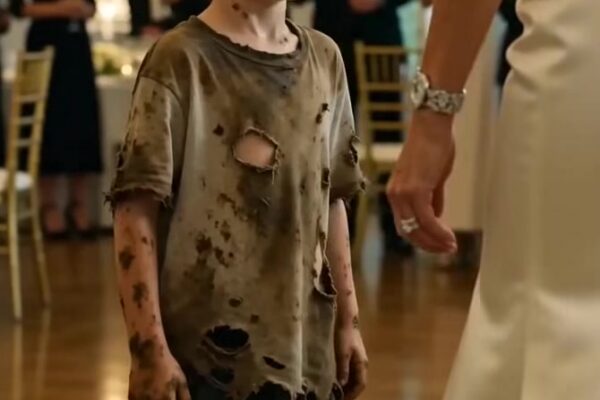
The little girl appeared as if the park had exhaled her—small, hood up against a sun that didn’t need guarding from, sneakers damp at the toes from crossing the morning sprinklers. She walked with purpose, not the restless roaming of a child hunting for a swing, but the straight line of someone who had rehearsed this moment until it fit inside her ribs.
Graham had learned to read approaches. A stranger’s pace, a glance toward the wheelchair, the practiced softness in their voice—those were the cues of pity. Sometimes pity wore the mask of charity, and sometimes it wore curiosity, both equally sharp. He stood behind his son like a wall in a blue suit that had become his uniform: court dates, hospitals, fundraising dinners, consultations that promised language like “breakthrough” and delivered only invoices.
Caleb sat in the chair beneath the late honeyed light, gray sweater pulled tight around his narrow shoulders though the air was mild. His hands rested on his thighs with the stillness of someone who had spent too many hours learning not to fidget, not to hope too hard. The accident had taken his legs. The years afterward had tried to take the rest.
The girl stopped an arm’s length away and said, very plainly, “Hi.” Her voice wasn’t timid. It wasn’t bright. It carried the quiet weight of a message being delivered.
Graham moved between them without thinking. “We’re not giving money,” he said, and hated the edge in his own tone even as it left him. Money was the reflex people expected from him now—money as apology, money as salve, money as substitute for miracles. He’d spent enough of it to build a house out of receipts and still his son’s feet remained strangers to the ground.
The girl didn’t look at him. Her gaze fixed on Caleb as if Graham were just another tree in the background. “I’m not here for that,” she said. “I came for something else.”
Caleb’s eyes lifted, cautious and bright in the way that made Graham’s chest ache. “Something else?” Caleb asked, already bracing for the answer.
The girl stepped closer and held out her hands. “I want to help you stand,” she said. “Not forever, maybe. But long enough.”
A laugh tried to force its way up Graham’s throat and turned into a bitter breath. He’d heard every version of this: prayers, magnets, oils, the right specialist in another city, the secret exercise that doctors refused to tell him about. He wanted to tell her to go find her parents, to stop playing at cruelty with a boy who’d paid too much for believing in things that didn’t exist.
But Caleb, traitorously hopeful, placed his hands into hers before Graham could stop him. The girl’s fingers were warm and small, yet when she closed them around Caleb’s, it didn’t feel like a child’s grip. It felt like an anchor.
“Just breathe,” she murmured, and her words cut through the background noise of the park—the distant laughter, the dogs, the squeak of swings—as if she’d turned a dial.
Caleb’s shoulders tightened. His knuckles whitened. Graham leaned forward, ready to pull him back, ready to shield him from whatever humiliation was coming.
Then Caleb’s feet shifted.
At first it was only the smallest movement, the soles pressing against the grass as if testing whether the world would hold him. Graham watched, unable to trust his own sight. Caleb’s legs, which had lain unresponsive in bed after bed, were suddenly engaged in an argument with gravity.
The girl rose slowly, drawing Caleb upward not with force but with an insistence that made the motion feel inevitable. Caleb’s body trembled, his face contorting between pain and wonder. His knees straightened like waking hinges. His spine lifted, vertebra by vertebra, until he was no longer sitting.
He was standing.
For an instant Graham couldn’t breathe. The air seemed to turn thick and bright. Caleb stood on the grass, unsteady, shaking, but upright in the slanting gold of the afternoon. Tears burst from his eyes as if they’d been waiting years for a reason to fall.
“Dad,” Caleb whispered, voice cracking on the single syllable. “I—Dad, I’m… I’m up.”
Graham dropped to his knees, the expensive fabric of his suit darkening where it met the damp ground. It wasn’t prayer. It wasn’t gratitude. It was the body’s only possible response to the impossible. He reached forward and gripped Caleb’s ankles as if he needed to confirm they were real, to feel the tension in the calves, the trembling proof of effort.
When Graham looked up at the girl, her eyes were shining too, but not with simple joy. Her expression held recognition, like she’d found a missing piece and it fit painfully well.
Graham’s mind, so used to calculations and schedules and medical terms, began to flip through a different catalog: memories he’d tried to bury. A hospital corridor that smelled like bleach and regret. A woman with a thin face and a headscarf, her skin the color of winter paper. Her hand shooting out as security dragged her away, fingers clamping around Graham’s sleeve with desperate strength.
Your boy was never meant to heal.
He’d convinced himself grief had invented that sentence. That it was the kind of cruel phrase the mind created when it needed a villain larger than chance. Yet now, staring into the girl’s steady gaze, he felt that corridor open like a door in his skull.
“Who are you?” he asked, and the question scraped raw on the way out.
The girl’s fingers loosened from Caleb’s hands. Caleb, still upright, swayed; Graham lunged forward and wrapped his arms around his son’s waist, holding him like a lifeline. Caleb clung to him, sobbing into his shoulder, his legs quivering as though the strength might vanish if he blinked.
The girl lowered her chin. For a moment she looked younger than she had a second ago—like a child burdened with an adult’s errand. “My name is Wren,” she said. “But that isn’t the part that matters.”
Graham swallowed. “Does your mother know you’re doing this?”
Wren’s eyes lifted, and something old and hard flickered behind them. “My mother is the one who sent me.”
The park seemed to dim around the edges. Graham held Caleb tighter. “Sent you from where?” he asked, though he already felt the answer crawling up the back of his neck.
Wren’s voice dropped, and the words came out with the calm of a rehearsed confession. “From the place you tried to forget. From the corridor where she grabbed you. From the day you decided it was easier to believe she was crazy than to believe what she was warning you about.”
Graham’s mouth went dry. “That woman…”
“Was my mother,” Wren said. “She didn’t die then. They made sure you thought she did.”
Caleb’s legs trembled more violently. Graham felt the moment’s miracle fray at the edges, turning into something sharp. “Who are ‘they’?” Graham demanded, but the question sounded weak against the sudden weight in Wren’s eyes.
Wren stepped closer, close enough that Graham could see a faint scar at her hairline, pale as a thread. She pointed at Caleb—not accusing, not blaming, just indicating. “The people who benefited when he couldn’t walk,” she said. “The people who turned your son into a lawsuit, a settlement, a story that kept their hands clean.”
Graham’s mind flashed to the crash report. The witness who changed his statement. The judge who rushed the proceedings. The neurologist who insisted there was “no measurable pathway” and yet never met Graham’s eyes.
He tasted bile. “You’re saying someone did this on purpose?”
Wren’s expression softened, but only around the edges. “Not the accident,” she said. “The accident was chaos. The rest was design.” She looked at Caleb’s shaking knees, then back to Graham. “My mother said if he ever stood up again—even for a minute—you’d finally understand what was taken from him after the crash. Not just his legs. The chance to get better. The chance to be believed.”
Caleb’s sobs quieted into frightened breaths. “Dad,” he whispered, and there was a new fear in his voice, a fear that reached beyond his own body. “What is she talking about?”
Graham stared at Wren and felt the past reassemble itself with horrifying clarity. He had been chasing cures for years while the real injury—the one that kept Caleb from healing—might have been carefully maintained.
“Why can you do this?” Graham asked. “Why you?”
Wren hesitated, and in that fraction of silence Graham saw the child again: a girl carrying something too heavy, choosing to carry it anyway. “Because my mother learned how to undo what they did,” she said. “She learned it the hard way. She learned it in rooms where there were no windows.”
Graham’s hands tightened around Caleb. “Where is she now?”
Wren’s gaze slid past him to the path that cut through the trees, where the shadows were lengthening. “Close,” she said. “Close enough to see whether you would protect your son this time.” She met Graham’s eyes. “She told me to give him back one minute on his feet. Not as a gift. As evidence.”
Caleb’s legs buckled. Graham caught him, lowering him carefully back into the chair. The moment Caleb sat, the tremor in his body continued, as if his muscles were grieving the sudden absence of standing.
Graham looked up, voice breaking. “Evidence of what?”
Wren breathed in, as though she could smell the answer on the air. “Evidence that his body remembers how,” she said. “Evidence that the story you were sold was incomplete.” Her eyes hardened again, the child’s softness replaced by the messenger’s resolve. “And evidence that someone is going to panic when they learn he stood.”
Graham’s phone buzzed in his pocket then—an incoming call from a number he didn’t recognize, as if the park itself had been listening and sent the signal outward. He didn’t answer. He couldn’t.
Wren took a step backward, already retreating into the ordinary noise of the afternoon. Before she turned away, she added, “My mother said to tell you one more thing.”
Graham’s throat tightened. “What?”
Wren’s voice came out low and precise, each word placed like a stone. “If you want him to walk again for good,” she said, “you’ll have to stop paying for hope and start digging for the person who made sure he couldn’t heal.” She paused, and her gaze flicked to the blue suit, the symbol of a man who handled everything with polish. “Because the one who hurt him is closer to you than you ever allowed yourself to suspect.”
Then she turned and disappeared between the trees, her brown hood bobbing once in the fading light, leaving Graham kneeling in the grass beside his son’s wheelchair with a miracle in his hands and a terror settling into his bones like cold ash.