The lunch rush at the diner had settled into its usual rhythm—noise arranged into something like comfort. Cups chimed against saucers. A waitress’s laugh floated up from the counter like steam. Somewhere beyond the swinging door, a cook raked a fork across a plate and cursed at a stuck burner. The windows were bright with winter light, but the air inside smelled of coffee and fried onions, as if the world outside could be kept away by grease and habit.
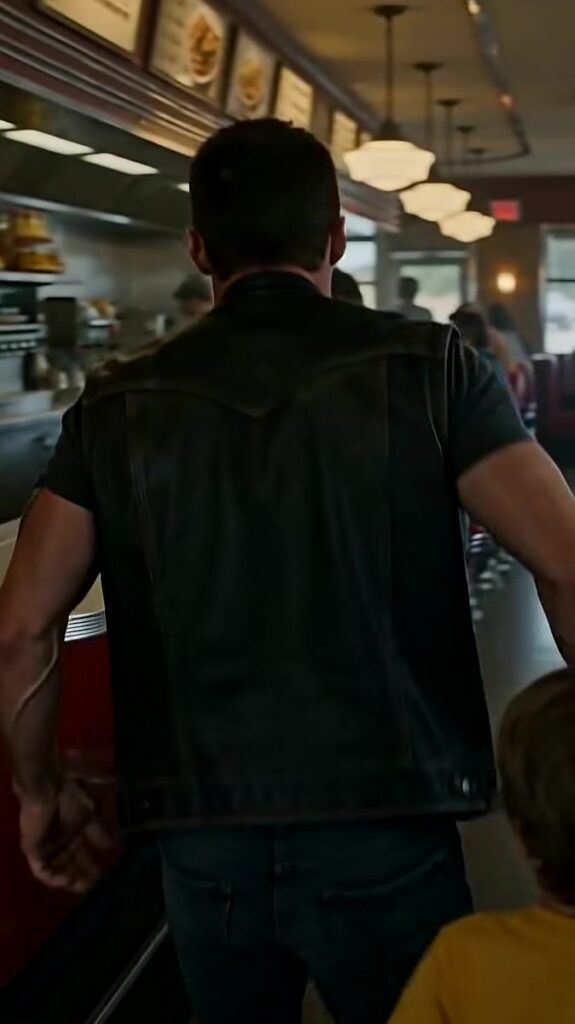
Mason Reed sat in booth seven with his back to the wall. He’d chosen it the way men like him chose corners—out of old lessons you didn’t talk about. The black leather vest he wore was scuffed at the edges, the kind of garment that remembered every mile and every bad decision. He ate a late meal he barely tasted, watching nothing and everyone at once, trying to look like the sort of man you didn’t ask questions of.
He wasn’t succeeding. He could feel his own restlessness in the tightness of his hands around the fork, in the way his gaze kept falling to the door each time the bell over it rang. A part of him—some stubborn scrap he’d never managed to kill—still expected ghosts to walk back in.
That was when a small hand curled over the vinyl edge of his booth.
Mason looked up.
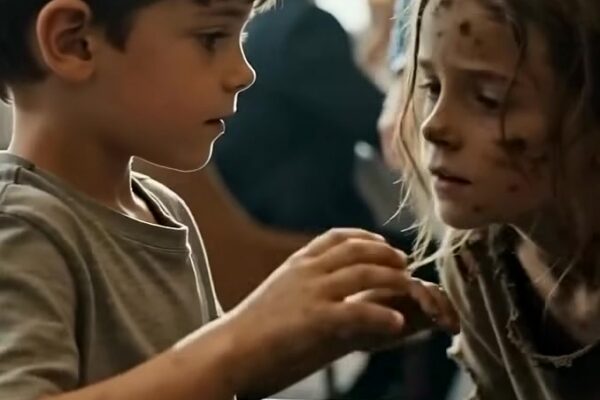
A boy stood there, maybe six, with light brown hair that had been cut by someone in a hurry. His shirt was the wrong size, a yellow T-shirt drooping on narrow shoulders. His face was pale with the kind of fear that didn’t come from scraped knees. He was breathing as if he’d been running for a long time, not just through the diner aisle but from something that kept getting closer.
“Sir,” the kid said.
The word hit Mason like a hook and tugged some softened piece of him to the surface. His expression changed before he could stop it, the hardness giving way around the eyes.
“Hey,” Mason said quietly, voice rough from disuse. “You okay?”
The boy leaned in, close enough that Mason could hear the tremor in every breath, close enough that Mason could smell cheap shampoo and cold air.
“He’s not my dad,” the boy whispered.
Mason didn’t jerk back. He didn’t call for a waitress. He went still in a way that made his stillness louder than any shout. Concern slid into something colder, something that had teeth.
His eyes lifted past the boy’s shoulder, over the aisle toward the counter.
A younger man sat there in a dark leather jacket, one elbow planted like a claim, a plate in front of him that had stopped mattering. He had the look of someone who belonged to no one and slept with one eye open. He’d been eating a moment ago. Now he was watching, not surprised—ready.
Mason slid out of the booth with slow care and put one arm around the boy’s shoulders. He drew the child behind him, the way you’d shelter a flame from wind.
“Stay behind me,” he murmured.
The boy’s fingers latched onto the back of Mason’s vest, clinging like the leather could keep him from being pulled away.
Mason stepped into the aisle.
Table by table, the diner quieted. A waitress stopped mid-step with a basket of fries in her hand. An old trucker lowered his mug without taking the sip. Even the cook leaned out through the swing of the kitchen door, a spatula frozen in his grip.
Mason stopped a few feet from the man at the counter. The distance was deliberate: close enough to speak, far enough to move.
“We need to talk,” Mason said.
The man turned on the stool, showing more of his face. Wary. Tense. Not panicked.
His gaze flicked once to the boy pressed behind Mason’s hip, then returned to Mason. “About the kid?” he said.
Something about the way he said it—like the moment had already been rehearsed in his head—made Mason’s jaw tighten until his teeth ached.
The boy pressed closer. Mason could feel his small ribs shivering against his side.
The younger man’s hand went into his jacket.
The whole room drew tight, like a breath held too long. A waitress made a sound—half gasp, half prayer. Mason’s shoulders squared. His hands flexed, ready for the flash of metal and the crack of consequence.
But the man didn’t pull a weapon.
He drew out a worn silver locket on a chain, the kind you might find at the bottom of an old jewelry box. It dangled from his fingers and swung once under the diner lights, catching a thin line of brightness.
Mason forgot how to breathe.
He knew that locket.
Eight years ago, he’d bought it from a pawnshop with money he couldn’t spare, because he’d seen it in the glass case and thought of a laugh. He’d pressed it into Lena Hart’s palm in the parking lot behind this very diner, both of them leaning against his motorcycle as if the night could belong to them if they held it hard enough. Lena had laughed and told him it was too pretty for a man like him to choose. Mason had told her it was lucky he’d chosen it for a woman like her.
Lena had vanished three weeks later.
No goodbye. No note. No phone call. Nothing but rumors that grew sharper every year and somehow never cut the truth loose.
Mason took a step forward, and his voice came out low and dangerous. “Where did you get that?”
The younger man’s expression shifted—still guarded, but weighted now, like the locket had pulled him down into something older than anger. “He told me you’d come for him,” he said.
Mason frowned. “Who?”
The man opened the locket.
Inside was a faded photograph. Mason recognized himself in it—too young, too hopeful, smiling like he’d never heard of loss. Lena’s head rested on his shoulder, her eyes half-closed in the kind of peace you only notice once it’s gone.
Behind the photo was something else: a hospital bracelet, the plastic dulled with time, small enough for a newborn.
Mason’s face drained of color. His stomach fell as if the floor had dropped away.
The boy peered around Mason’s side, staring at the bracelet with wide, haunted eyes, as though he knew what it meant without knowing how.
The younger man stood, slow and deliberate, as if sudden movements could shatter whatever thread was holding them together. “My sister kept this,” he said, voice lowering. “Until the day she died.”
Mason’s throat tightened. “Sister?”
The man nodded once. “I’m Evan.”
Mason searched his face then, really looked, and the resemblance hit him like a bruise you don’t notice until you touch it. The shape of the mouth. The stubborn set of the jaw. Those eyes—tired and fierce at the same time, as if sleep had always been optional.
Evan’s gaze went to the boy. Then back to Mason. “She made me promise,” Evan said. “If anything ever happened to her, I’d find you.”
Mason’s chest felt too small for his heart. “Where is she?” he asked, and the words came out scraped raw. “Where’s Lena?”
Evan’s nostrils flared. Pain flickered behind his caution. “Gone,” he said. “Not vanished this time. Gone for real.”
Mason swayed, barely, as if the world had nudged him and found him hollow. His hand reached back without looking, finding the boy’s shoulder, needing the contact to prove he was still in one piece.
“Because the kid hiding behind you…” Evan continued. He glanced at the boy again, and for a second Mason saw something in Evan’s face that looked like grief struggling to become rage. “…is your son.”
The sentence landed and the diner seemed to lose its sound. No clink, no scrape, no hum. People stared, suspended in the fragile silence of someone else’s life cracking open in public.
Mason stopped moving entirely. He didn’t step forward. He didn’t step back. He just stood there with a child’s hands gripping his vest like an anchor.
He couldn’t make the word form. Son. It was too heavy, too impossible, too bright to hold.
Behind him, in a voice so small it seemed it might disappear if anyone breathed, the boy whispered, “My mom said your name was Mason.”
Mason closed his eyes for a heartbeat, and in that blink he saw Lena’s smile in the parking lot, the locket warm from his palm, her fingers closing around it like a promise. He opened his eyes again and turned, slowly, to face the boy.
“What’s your name?” Mason asked, and his voice trembled in a way he hated and couldn’t control.
The boy swallowed. His gaze darted between Mason and Evan, as if expecting the wrong answer to bring punishment. “Cal,” he said. “Caleb.”
Mason nodded once, like agreeing to something he didn’t yet understand. He knelt in the aisle so his eyes were level with the boy’s. The diner seemed to lean in, the whole building holding its breath.
“Caleb,” Mason repeated, tasting it like a prayer. “Okay. Okay, kid.” He lifted a hand as if to touch the boy’s cheek, then hesitated, afraid he’d frighten him, afraid he’d confirm the miracle and the ruin at the same time.
Evan’s voice cut through, low and urgent. “The man you saw at the counter when you came in—he’s still out there,” he said. “He’s not your problem. He’s Caleb’s.”
Mason’s eyes flicked toward the windows, toward the glare of daylight and the dark shapes beyond. He understood then why the boy had run and why Evan had come armed with a locket instead of a gun. This wasn’t a reunion. It was a handoff under threat.
Mason stood, rising like a storm finding its center. He slid his arm around Caleb again, drawing him close, not as a shield this time but as a claim. “No,” Mason said, quiet and absolute. “If he’s my son, then it’s my problem.”
Outside, the bell over the door trembled with a new draft, as if someone had just stepped into the space between ordinary life and whatever came next.
Mason held the boy tighter and met Evan’s eyes. In Evan’s grip, the old locket glinted—an echo of a promise made behind the diner years ago, now returned with interest and blood.
“Tell me everything,” Mason said.
And as the diner’s rhythm tried to start up again around them—cups, laughter, forks against plates—Mason knew it wouldn’t. Not for him. Not anymore.