The old woman didn’t come into the diner for soup.
That’s what Nora decided later, after the rush eased and the fryer stopped hissing like it had opinions. At the time, she just saw another customer drifting in under the bell above the door, another body in a cardigan shaped by years and weather, another face the town had half-forgotten.
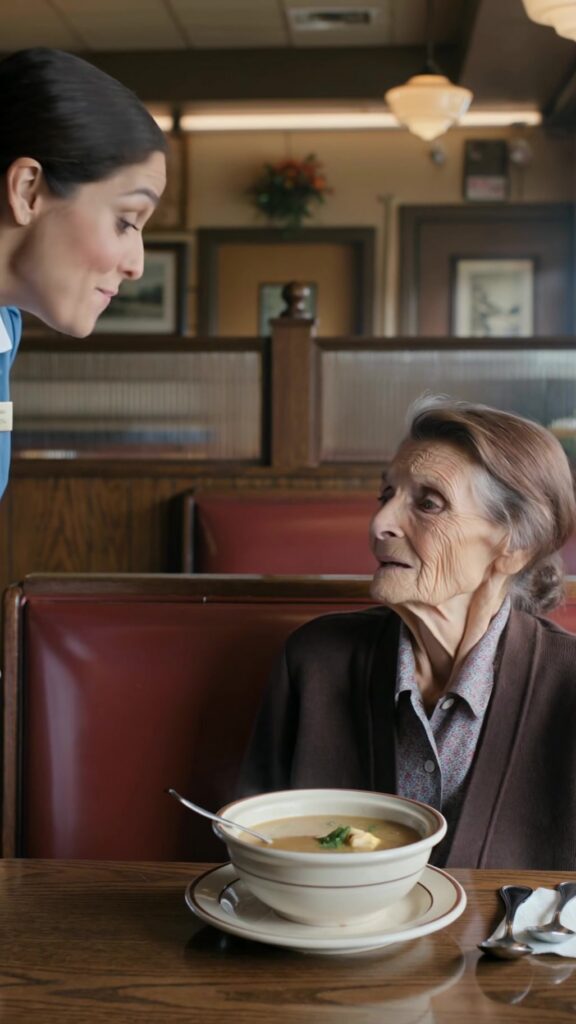
The diner was all red vinyl booths and yellow light that made everyone look a little kinder than they felt. The windows fogged up from the dish pit and the coffee. It was the kind of place where you could order pancakes at noon and nobody would ask what went wrong with your life.
Nora was halfway through refilling the sugar caddies when she noticed the old woman had taken the back corner booth—the one angled away from the room, like a hiding place. People picked it when they wanted to disappear. Truckers avoided it because it was too quiet. Teenagers avoided it because you couldn’t see who walked in. Nora liked it because it made her feel like the diner had a secret.
“Hey,” called Sal from the kitchen window, smudged apron and all. “Table twelve’s looking at you like you stole his truck.”
Nora tossed him a look that meant shut up and grabbed her pad. She moved through the room with her usual autopilot smile. Two eggs, wheat toast. Coffee. More ranch. A stack of bills under a plate. Life in small rectangles.
When she reached the old woman, the woman didn’t look up right away. She studied the laminated menu like it might bite her. Her hands were folded neatly, but they shook a little, like her body was tired of holding itself together.
“Hi, hon,” Nora said, keeping her voice light. “What can I get you?”
The old woman swallowed. “Soup,” she said. “Whatever’s hot.”
“Chicken noodle’s fresh,” Nora offered. “Or tomato basil.”
“Chicken,” the old woman decided, like it mattered more than it should.
Nora wrote it down, but something about the way the woman kept her gaze low made Nora pause. Nora had seen hungry people, sure, but this felt different. Like shame had wrapped itself around the woman’s shoulders and was pulling her deeper into the booth.
In the kitchen, Sal scooped soup into a bowl and slid it across the pass. Nora carried it back with crackers and a spoon and set it down gently, the way you might place a gift.
“Here you go,” she said. “Careful, it’s hot.”
The old woman stared at the steam as if it was telling her a story. She didn’t pick up the spoon. Her eyes went damp at the corners, and Nora had a sudden, ridiculous thought: she looks like she’s bracing for a slap.
“Everything okay?” Nora asked.
The old woman lifted her gaze for the first time. The eyes were pale and sharp, still bright under all that time. Fear lived there, but not the kind that came from being hungry. It was the fear of being found out.
“I don’t have any money,” she whispered.
Nora’s brain did the fast scan it always did: manager in the office? Not watching. Sal likely to complain? He’d complain about sunshine. The regulars? Half would pretend they didn’t hear. The other half would either make a show of being generous or make a show of being disgusted, depending on their mood.
Nora didn’t feel like doing a show. She just heard the sentence and felt something old inside herself answer it.
“Don’t worry,” she said, already turning the bowl slightly so the spoon was easier to grab. “It’s on me.”
The old woman’s face changed—not into relief, exactly. It crumpled like paper that had been folded too many times. Her mouth trembled as if she’d been holding back a sob for years and finally got tired.
“Thank you,” she said, but it came out like a confession.
Nora softened. “It’s just soup,” she added, the words automatic, the way people said it’s nothing when it was clearly something.
The old woman nodded slowly. Then, with careful hands, she reached into the inside pocket of her cardigan and pulled out a folded piece of paper. It looked ancient—creased, frayed at the edges, handled so many times it had gone soft. She held it out like it weighed more than it should.
“Please take this,” the old woman said.
Nora hesitated. “What is it?”
The old woman studied Nora’s face with an intensity that made Nora’s skin prickle. It wasn’t a stranger’s stare. It was the way someone looks when they’re trying to recognize a person they’ve been missing in their sleep.
“It’s the only reason I knew I had to find you,” the old woman said.
Nora’s fingers closed around the paper, and the diner noise seemed to dull, like someone had stuffed cotton in her ears. She unfolded it carefully. On the inside was a small photograph, faded and grainy. Two girls stood in front of the same diner, back when the sign outside still had a neon chicken that blinked. One girl had dark hair, the other light, both with wide smiles and skinned knees. Behind them was a woman in a waitress uniform, younger and laughing.
Nora’s throat tightened. She recognized the woman. Not from memory—she didn’t have those—but from the few pictures she’d stared at until the faces blurred. From the missing-person flyer that had once hung on their fridge until her dad ripped it down in a fury and said, “Stop asking.”
Her mother.
On the back of the photo, in slanted handwriting, were three words: For when you’re ready.
Nora looked up so fast her necklace swung. “Where did you get this?”
The old woman’s shoulders sagged like she’d been holding that moment up for decades. “Your mother left it with me,” she said quietly. “The night she disappeared.”
Nora’s heartbeat thumped against her ribs, hard enough to hurt. “You… you knew my mom?”
“I did,” the old woman replied. “She called me Edith. Like it was my real name. Like I deserved a real name.”
Nora blinked. “Is it not?”
Edith—or whoever she was—gave a small, tired smile. “Names change when you’re trying to survive.” She glanced down at the soup, still untouched. “I came today because I wanted to know if the world still had any gentleness in it before I’m gone. I didn’t expect…” She trailed off and tapped the paper with one trembling finger. “I didn’t expect to find you behind the counter.”
Nora sat down across from her without thinking. She could feel Sal’s eyes on her from the kitchen window, curious, but she didn’t care. “Why didn’t you come sooner?” she demanded, and hated how young her voice sounded. “We looked for her. My dad—”
“Your dad didn’t,” Edith cut in, not cruel, just factual. “Not the way you mean.”
Nora’s cheeks burned. “What happened to her?”
Edith’s hands wrapped around the bowl, soaking up the warmth without lifting the spoon. “She was scared,” she said. “And brave. People think those can’t exist together.”
Nora gripped the edge of the table. “Of who?”
Edith breathed in through her nose, slow and shaky. “Of a man who smiled in public and punished in private. Of debts that weren’t hers. Of how easy it is for a small town to decide a woman simply ran away because it’s the simplest story.” She looked straight at Nora. “She didn’t run because she didn’t love you. She ran because she loved you and she believed leaving was the only way to keep you safe.”
Nora’s eyes stung. She wanted to argue, to throw plates, to rewind her entire childhood and scream at the silence. “And you?” she asked. “Where do you fit into this?”
Edith’s gaze drifted to the diner’s front window, where snow was starting to collect in delicate piles. “I was the person she trusted for one night,” she said. “I was the stranger who didn’t ask for payment up front. She came to my porch with you wrapped in a blanket and her lip split, and she asked me if I believed in second chances. I told her I didn’t know. She said she was going to try anyway.”
Nora’s chest felt squeezed. “She left me?”
“She left you with your father,” Edith said, voice low. “Because she thought the law would believe him more than her. She thought if she took you, she’d lose you forever. So she made the cruel choice that looked like abandonment.” Edith’s eyes glistened. “And she asked me to hold onto that photo. She said one day, if you were grown and the world had not made you hard, you’d be able to hear the truth.”
Nora swallowed. “Why now?”
Edith’s breath rattled slightly, and for the first time Nora noticed how thin her skin looked, how her knuckles seemed too big for her hands. “Because I’m out of time,” Edith admitted. “And because I needed to know whether I was handing this to someone who could still do something with it besides burn it.” She nodded toward the bowl. “You didn’t ask for proof. You didn’t call your manager. You didn’t make me beg. You just… gave.”
Nora stared at the photo again. Her mother’s smile looked like sunlight. Nora had spent years thinking that smile was a lie, a trick, a mask before she vanished. Now it looked like a promise someone had tried to keep.
“Is she alive?” Nora asked, barely audible.
Edith’s mouth tightened. “I don’t know,” she said honestly. “She said she had a plan. She said she had a place. Then she was gone. For years I told myself she found peace. Then I told myself peace is rare.”
Nora pressed a hand to her forehead. The diner came rushing back—coffee pouring, a fork dropped somewhere, Sal calling for pickup. Normal life, still happening. Meanwhile, her whole history had cracked open at a corner booth.
“I can’t… I don’t even know what to do with this,” Nora said.
Edith reached across the table. Her fingers were cool and light on Nora’s wrist. “Start with kindness,” she said. “Not the performative kind. The kind you just did. The kind that says: you can be scared in front of me and I won’t punish you for it.”
Nora blinked hard. “Did she say anything else?”
Edith nodded, slow. “She said, ‘Tell Nora I’m sorry.’” Edith’s eyes filled, but she didn’t let a tear fall. “And she said, ‘Tell her she has my stubbornness. She’ll survive whatever he teaches her to fear.’”
Nora’s throat tightened so much she could barely breathe. She looked at Edith’s untouched soup. “You should eat,” she managed.
Edith gave a quiet laugh. “I will,” she said. “I just needed to see your face first. Needed to know the world still makes people like you.”
Nora tucked the photo back into the fold, holding it like it might evaporate. “If you know anything—anything at all—names, places, dates…”
Edith’s gaze sharpened. “Meet me tomorrow,” she said. “Same booth. I have more than a photo. I have a letter.”
Nora’s stomach flipped. “Why didn’t you give it now?”
Edith glanced down at the soup and finally lifted the spoon. “Because I needed to make sure you’d come back,” she said simply. “People say they want truth until it costs them comfort.”
Nora watched her take a careful sip. The old woman’s shoulders loosened, just a little, like warmth could still convince the body to trust the world.
Outside, the snow kept falling in quiet sheets, rewriting the street in white. Inside, Nora sat with her hands wrapped around a folded piece of paper and felt, for the first time in a long time, that her life might not be a story that ended in disappearance.
It might be a story that ended in someone returning.