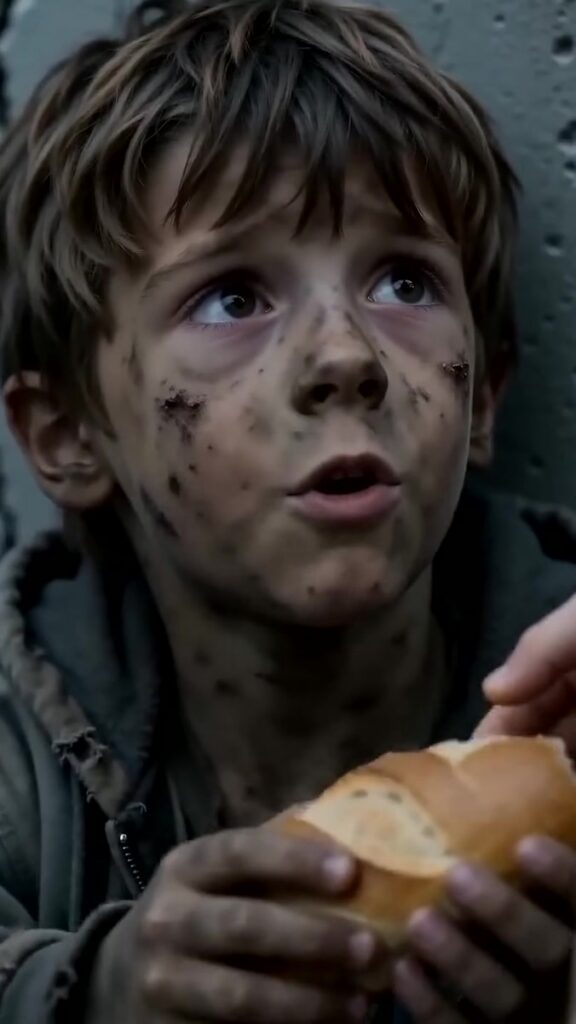
The street was unusually quiet, but not peaceful. Sound didn’t travel there the way it should have—footsteps were muffled, conversations clipped, and the city’s usual impatience felt replaced by a careful, practiced avoidance. People moved as if the air itself were watching. They hurried past storefronts with shuttered windows and posters peeling off brick, their eyes fixed on anything that wasn’t the boy against the wall.
He sat on a slab of broken concrete where a building’s corner had been chipped away by time and bad weather. The wall behind him was a map of fractures and stains. His jacket had lost its zipper months ago; it hung open like a confession. One shoe was held together with a knot of twine, and the other let in the cold with every shift of his toes. He wrapped his arms around his legs and tightened until his elbows ached, trying to press warmth into bones that didn’t remember what warmth felt like.
Hunger was not a growl anymore. Hunger was a heavy, constant pressure that made his vision wobble and his thoughts thicken. It made time stretch. It made promises sound like lies. He stared at the gray patch of sidewalk in front of him and tried not to look at the hands of people passing—hands that held steaming cups, grocery bags, keys, phones. Hands that swung freely, unburdened by the knowledge that a child could be sitting at the edge of their day, freezing.
Someone stepped around him so closely the boy caught a whiff of expensive soap. Another person stepped over a shadow he cast, as if his outline were the only part that might stain them. Nobody paused. Nobody asked his name. He had stopped counting faces because counting made him hope, and hope made the empty space inside him hurt worse.
Then a different set of footsteps slowed instead of accelerating. Not the stutter of indecision—an actual stop, the rarest kind. The boy lifted his eyes, not out of expectation but because the street’s rhythm had changed.
Another child stood a few feet away, almost the same height. The second boy’s cheeks were pink with cold rather than pale with it, and his coat—camel-colored, neatly buttoned—made him look like he belonged to a photograph someone would frame. In one hand he held a small paper bag. In the other, a loaf of bread, still warm enough that faint steam threaded into the air like a fragile flag.
The well-dressed boy stared, and the stare was not the usual quick glance that slid away in shame. It was steady, as if he were looking at something that demanded a decision.
“Are you… are you hurt?” he asked, voice quiet, uncertain where to place itself in the silence.
The boy on the ground did not answer. His mouth was too dry, and his heart had learned to distrust softness. Kindness could be a trick. It could come with hands that grabbed. It could come with questions that led to locked doors.
The standing boy looked down at the bread, then back at the boy on the ground, as if comparing two versions of the world. Without any ceremony he pulled the loaf apart. The crust cracked with a sound that, in that muted street, felt thunderous. He offered half, holding it out with fingers that trembled slightly—not from fear, but from the weight of doing something no one else had done.
“Take it,” he said. “Please.”
The hungry boy’s eyes locked on the bread. His hands moved slowly, as if he were reaching through water. When his fingers brushed the warm crust, he flinched. Heat felt unreal. He pulled the piece toward him and inhaled. The scent—yeast, salt, something almost sweet—hit him so hard his throat tightened.
“Thank you,” he whispered, the words scraping out like they hadn’t been used in days. He took a bite. His jaw worked clumsily at first, then faster. Tears slid down his cheeks without permission, hot against cold skin. For a moment, the street’s quiet changed flavor. It wasn’t peace, but it wasn’t only neglect either.
The second boy didn’t step back once the offering was accepted. He crouched, then knelt so their faces were closer, so the distance between them wasn’t a chasm. He reached out, hesitated at the last inch—asking without words—then wrapped his arms around the other boy’s shoulders. The embrace was careful, like he was afraid of breaking him, like he had never hugged a stranger but couldn’t imagine not doing it now.
Against that coat, the hungry boy felt something he hadn’t felt since he couldn’t remember: the idea that another human body could be a wall against winter.
He started to breathe differently. Not shallow and guarded, but deeper, almost shocked by his own lungs.
And then—
A door behind them slammed open so violently it banged against brick. The sound shattered what little shelter their moment had built. The hungry boy’s shoulders jolted; the other boy stiffened, arms tightening instinctively.
A man stepped out, filling the doorway with the kind of presence that made people step aside even before he demanded it. He wore a dark work coat and a knit cap pulled low. His face was pinched raw by wind or anger or both. He looked at the boys like they were a problem someone had left on his doorstep.
“Eli,” the man snapped. The name cracked like a whip. “What are you doing?”
The boy in the camel coat—Eli—flinched. His arms loosened but didn’t fully release. He turned his head, eyes wide. “Dad, he’s cold,” Eli said. “He’s hungry.”
The man’s gaze flicked to the bread in the hungry boy’s hands. Something tightened around his mouth. “And that’s your business?” he said, each word clipped, careful, the way adults spoke when they wanted the world to agree with them. “Come inside. Now.”
Eli didn’t move. It was a small defiance, the kind that could be mistaken for hesitation, but the hungry boy could feel it in the way Eli’s knee pressed into the sidewalk: planted.
“He’s just a kid,” Eli said, voice shaking. “Like me.”
“Don’t start.” The man’s eyes darted up and down the street, as if checking for witnesses—or for judgment. People kept walking, faster now, shoulders drawn in. No one intervened. No one wanted this moment to attach itself to them.
The man took a step forward. “You don’t know where he came from,” he said, and the sentence carried the sour taste of assumptions, of stories told to justify distance. “You don’t bring trouble home.”
The hungry boy’s stomach clenched, not from hunger this time but from a familiar dread. Trouble. That was the name people gave him when they didn’t bother with his real one. He drew back, ready to retreat into the cold because retreat was safer than being forced.
But Eli shifted, placing himself slightly between the man and the boy on the ground. It wasn’t a heroic stance—it was an eight-year-old’s fragile body trying to become a barrier. “He has a name,” Eli said, the words spilling out as if he’d only just realized they mattered. “What’s your name?”
The hungry boy swallowed, bread stuck for a second in his throat. “Noah,” he managed. It felt strange to say it aloud, like pulling something delicate out of a pocket and risking that it might tear.
Eli looked at the man. “Noah,” he repeated, turning the name into an anchor. “He’s Noah.”
The man’s jaw worked. His eyes flashed with something complicated—fear, annoyance, maybe even an old memory he didn’t want to touch. “Eli,” he said again, lower, dangerous. “Inside.”
Eli’s hands balled into the fabric of his coat. “If we can share bread,” he said, voice trembling but stubborn, “we can share heat.”
For a second, the street seemed to hold its breath. The wind pushed a scrap of paper along the curb. Somewhere far away, a siren wailed and faded, like a reminder that help often arrived too late.
Noah stared at the doorway behind the man. Warm air spilled out, scented faintly with soup and laundry detergent. The kind of ordinary that felt impossible. He didn’t dare hope for it, not fully. Hope was sharp. Hope cut deep when it failed.
The man’s eyes traveled from Noah’s torn sleeves to his trembling hands, then to Eli’s face—so open, so stubbornly bright against the gray street. He exhaled, and the breath looked like smoke leaving a fire that didn’t want to die.
“Five minutes,” the man said, as if bargaining with the universe. He stepped aside, not kindly, but not blocking the door anymore. “In the entryway. Not further.”
Eli’s shoulders dropped in relief so sudden it looked like pain. He grabbed Noah’s wrist gently, not pulling, just offering direction. “Come on,” he whispered, and his voice carried a fierce tenderness, as if he were afraid the world might change its mind.
Noah hesitated at the threshold. The warm air touched his face, and it felt like stepping into a different life. Behind him, the street remained quiet, still not peaceful—full of people who had moved past without seeing. Ahead of him was a narrow strip of light and a boy who had looked straight at him anyway.
He took one step, then another, and the door began to swing inward, not slamming this time, but closing with a careful, measured sound—like the first stitch in a tear that had been left open too long.
Outside, the street kept its secret. Inside, the cold started to loosen its grip, and Noah realized with a shock that the hardest part wasn’t surviving the winter. The hardest part was believing he was allowed to.