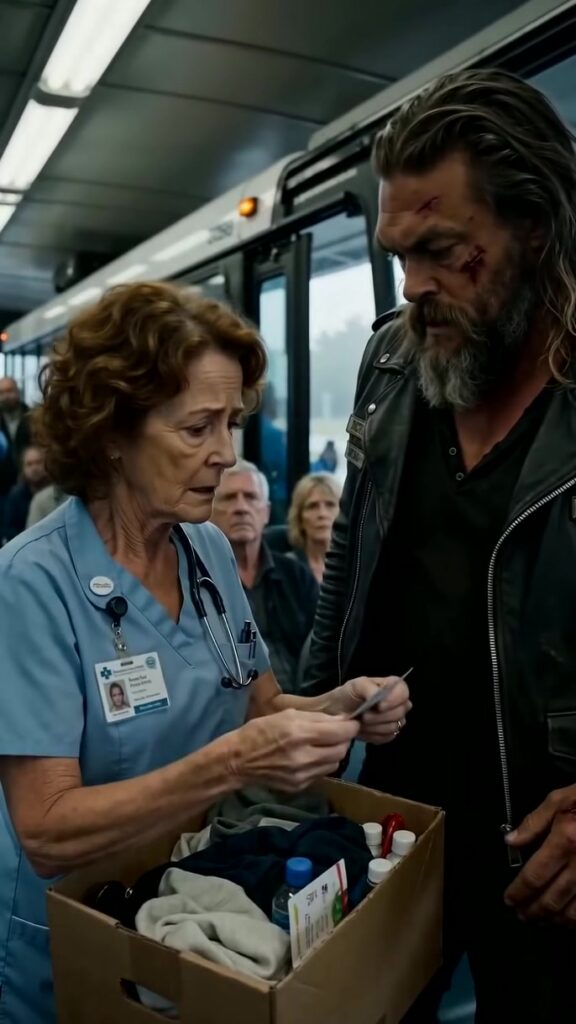
The terminal detonated into chaos when the driver seized the injured biker’s arm and wrenched him toward the aisle. “Off my bus!” he roared, voice ricocheting off tile and glass. The older man—gray beard, leather jacket slick with rain—stumbled and crashed into a molded plastic seat. Pain flared across his scarred face like a lightning strike, and the nearest passengers recoiled as if pain were contagious.
Outside, rain sluiced down the station’s giant windows in thick, trembling sheets. The neon from the street bled into the water and made the world look bruised. Somewhere, a suitcase rolled unattended, its wheels ticking in a steady, nervous rhythm. People craned for a better view, phones hovering half-raised, breath held between outrage and fear. No one spoke. No one stepped between a man with authority and a man who could barely stand.
Then a woman in a dark coat pushed forward through the clutch of bodies. She was fifty-five, her hair pinned up in the tired way of someone who hasn’t looked in a mirror for days. Scrubs peeked out from the coat’s collar, and a nurse badge swung from a strap as she walked, tapping softly against a cardboard box clutched to her chest. The box was labeled in thick marker: DIANE KELLER, PERSONAL. Under the tape, something glittered—an old stethoscope, one earpiece broken, tucked among other fragments of a life.
The biker braced himself against the seat and tried to rise, jaw clenched as if anger could staple his bones back together. “I paid,” he rasped, the words grinding like gravel. The driver jabbed a finger toward the rain beyond the doors. “Then crawl out there and wait. You’re not bleeding on my seats.”
Diane’s throat tightened. The driver’s badge on his chest read MARTIN, as if a name could excuse cruelty. Diane heard her own heartbeat in her ears, too loud, too fast. She spoke anyway, the way she spoke in emergency rooms when seconds mattered. “I’m a nurse,” she said, and the truth of it stung—because she wasn’t, not anymore, not on paper. “He needs room. And he needs dignity.”
Martin snorted. “Then give him yours.” He gestured to the front of the bus, the roped section with wider seats and fewer stains, where comfort was sold in neat rectangles of printed ink. Diane’s fingers found the first-class ticket folded in her pocket. It was the last thing she’d bought with her severance pay, the last attempt to cross the state line quietly and start somewhere her name didn’t taste like accusation.
For a long beat, she didn’t move. She could feel the eyes on her—some curious, some hungry, some relieved that someone else might take the risk. Finally she stepped closer and pressed the ticket into the biker’s palm. Her hand was warm; his was chilled through the leather glove, trembling from shock or pain. “Take my seat,” she said, voice steady even as her stomach sank. The terminal seemed to lose its sound. Even the suitcase wheels stopped clicking.
The biker stared at her as if he’d forgotten what kindness looked like. Slowly, he reached inside his jacket. The crowd stiffened. Someone sucked in a breath. Diane’s own reflexes screamed at her to back away—she’d worked too many nights where reaching into a pocket meant the flash of a blade. But the man’s movement was careful, deliberate, painful. He drew out not a weapon but a gold hospital badge, worn smooth at the edges, the kind that meant security clearance, access to back hallways and locked doors.
Diane’s vision tunneled. The name of the hospital stamped on the badge was the same one that still haunted her sleep. Her own badge, swinging from her strap, carried the same logo—though hers had been deactivated, a dead piece of plastic she couldn’t bring herself to throw away. The biker looked directly into her face, and his eyes were a storm on their own. “They dismissed the wrong person,” he said, quietly enough that Martin had to lean in to hear, quietly enough that it sounded like confession.
Diane’s lips parted. “How would you—”
He didn’t let her finish. From behind the badge, he slid out a folded sheet of paper, creased and softened by being carried too long. He held it out as if it weighed more than his bruised ribs. Diane took it with both hands. Her fingers shook so hard the page rustled like leaves. The heading was an internal incident review. The text below was dense, clinical, merciless. It contained time stamps, access logs, and statements from staff. Several names had been blocked out, thick rectangles of black, but one remained uncovered, printed cleanly as if daring the world to read it.
Diane swallowed a sound. “No,” she whispered. “He told me the recording was wiped.” She could see that night all over again: alarms, the smell of antiseptic and fear, the director’s office with its polished desk and its promise that cooperation would make everything easier. Her signature on forms she hadn’t been allowed to read. Her badge taken. Security escorting her out while colleagues stared at the floor.
“It wasn’t wiped,” the biker said. Every syllable cost him. “Someone copied it.” He shifted his weight and winced, the mask of toughness slipping long enough to show the injury beneath. “I was there when they pointed at you. I saw who pulled the plug on the monitor. I heard who gave the order.”
Martin, still hovering with authority like a cheap cologne, began to back away. “Whatever soap opera this is, it’s not my responsibility,” he muttered, suddenly careful with his volume. But the crowd’s silence had changed. It had teeth now. People were filming openly, their screens glowing like a constellation of witnesses. A woman with a toddler held her phone high. A businessman in a suit zoomed in on the report. A teenager mouthed, “No way,” as if watching a crime documentary in real time.
Diane looked up from the paper. Her eyes burned. “Why help me?” she asked the biker, the question sliding out before she could stop it. Help meant danger. Help meant the return of attention she’d been trying to outrun. Help meant reopening a wound that had never truly closed.
The biker’s mouth twitched, not quite a smile, but a crack in the wall. “Because you didn’t let me die,” he said. “Years ago. When the ambulance dropped me off like garbage. You fought for me when I was nobody.” He tapped his badge. “They took my job after that night, too. Different story, same rot.”
The bus doors hissed as if the vehicle itself exhaled. Rain gusted in, cold and sharp. And then Diane felt it—an invisible pressure shift in the room, the instinctive tightening that comes when predators enter the territory. Heads turned toward the terminal entrance. Even Martin stopped moving.
Security officers were striding in fast, radios crackling at their shoulders, hands near their belts. Between them walked a man in a tailored coat, silver hair immaculate despite the weather, posture practiced in rooms where decisions ruined lives. Diane knew him without needing to read a name: the hospital director. The same man whose signature sat at the bottom of her termination notice, elegant as a blade.
The biker angled himself subtly in front of Diane, a shield held together by grit. “Don’t let him take it,” he murmured. Diane clutched the report to her chest, the paper suddenly hotter than skin. The director’s gaze locked onto her badge, then the biker’s, and for the first time in years Diane saw something flicker behind his controlled expression—fear, thin and bright.
“Ms. Keller,” the director called, voice smooth enough to pass as concern. “We need to speak privately.”
Diane’s hands steadied. She stepped forward into the open space the crowd had unconsciously formed, into the glare of phone cameras and fluorescent lights. Her box of belongings sat at her feet like an anchor. She lifted the report so everyone could see she was holding something he wanted. “Not privately,” she said. “Not ever again.”
Rain hammered the glass. The terminal held its breath. And Diane, who had been shoved out of her own life like an inconvenience, finally stopped running. She looked at the director and felt the fear in her bones turn into something else—something sharper, something strong enough to stand on. “You erased the footage,” she said, loud enough for every phone to catch it. “But someone saved the truth.”
The director’s smile faltered. Around him, security shifted, uncertain now, caught between a paycheck and a hundred witnesses. The biker exhaled through gritted teeth, pain and relief tangled together. Diane glanced at him once—an exchange of silent recognition—and then faced forward again as if stepping into an operating room where the patient was justice itself and the procedure had already begun.